

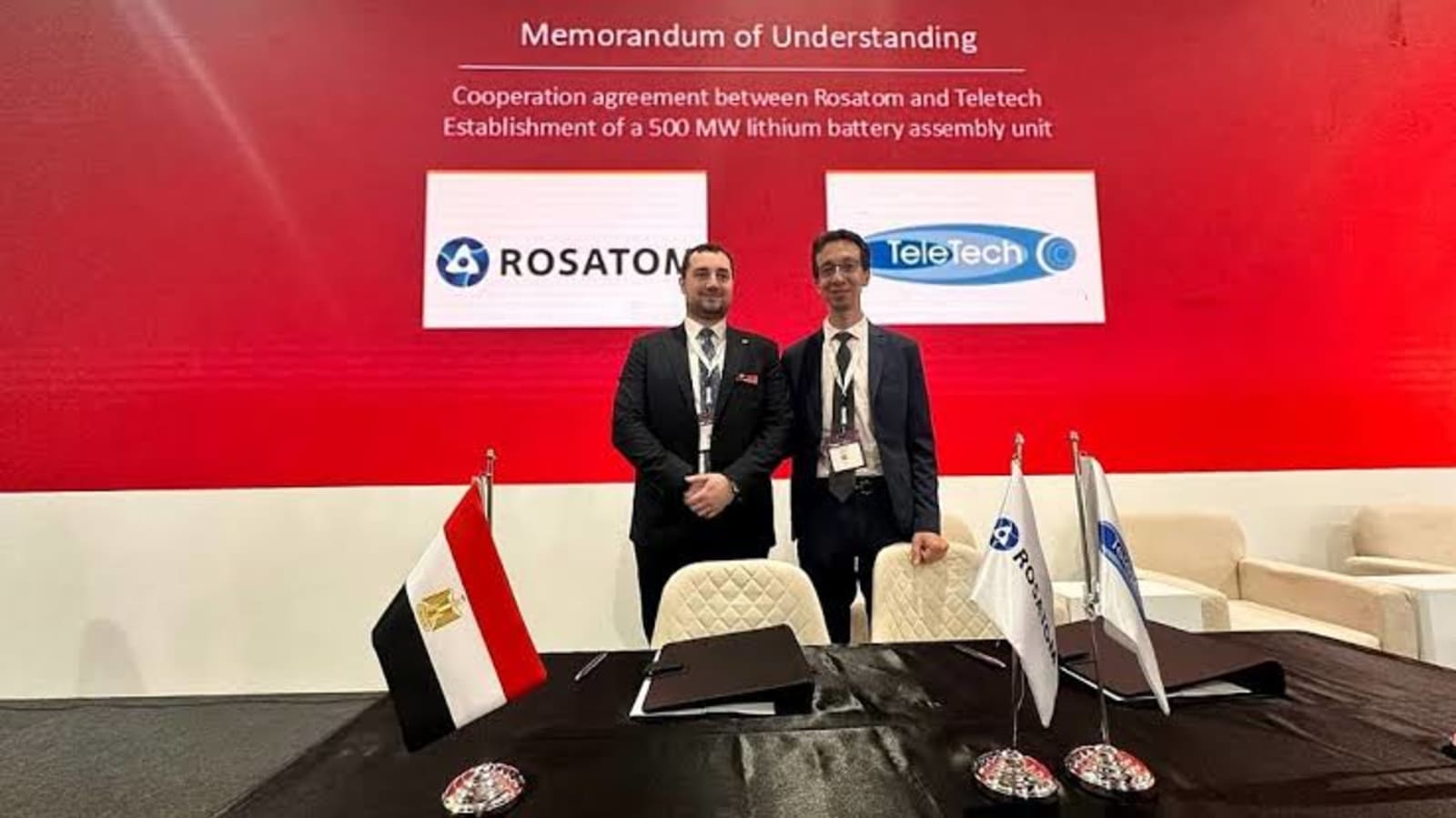
Rosatom , the Russian state corporation known for its nuclear business, is looking to open a new front in energy storage with a BESS assembly plant in Egypt . The project will be developed in partnership with Telecom and Technology Co. (Teletech) and aims to achieve an annual production capacity of 500 MWh.
According to the information released, the facility could be located in the Fayoum Governorate and begin operating within approximately eight months , in addition to contemplating the joint development of local assembly capabilities, staff training, and a progressive expansion of production.
The first phase would have a capacity of 500 MWh per year and anticipates that between 40% and 50% of the components will be of local origin . In later phases, that percentage could increase to 80% or more .
Production will initially be geared towards the Egyptian market, although the project envisions a subsequent commercial expansion into North Africa and other markets on the continent .
The goal is not solely to assemble batteries.
Rosatom seeks to establish industrial capabilities capable of serving applications in electrical systems, telecommunications, data centers, oil and gas and other industrial sectors , adapting solutions to local infrastructure needs.
“ Developing local capacity for energy storage systems can contribute to grid stability as renewable energy expands, reduce dependence on imported technologies and external supply chains, and develop national technical expertise ,” said Murad Aslanov, director of Rosatom’s office in Egypt.
From nuclear energy to its own storage chain
The incursion is supported by a division that already works on different technological links in the battery industry.
Rosatom develops lithium-ion storage systems and is involved in activities related to electrodes, cells, battery management systems, modules, traction batteries and stationary storage .
The assembly capacity in Egypt would allow the company to increase its international presence in energy storage and bring production closer to markets where it anticipates greater demand for batteries.
The agreement also incorporates training of Egyptian personnel and a strategy of progressively increasing local content, which could reduce dependence on fully imported equipment.
The financing of the plant will be the responsibility of the local partner, according to the information available about the project.
The initiative also comes at a time of strong industrial activity in the Egyptian storage market.
In August 2026, Sungrow laid the foundation stone for a USD 50 million BESS assembly plant in the Suez Canal Economic Zone, with a planned annual capacity of 10 GWh and an estimated start of operations by April 2027.
With both developments, Egypt is beginning to attract projects that not only seek to supply its own renewable growth, but also to use the country as a platform for other African markets.
Rosatom is also looking at storage for transport
The expansion into batteries is not limited to stationary applications.
Rosatom's Director General, Alexei Likhachev, noted that the company is already prepared to supply its storage systems for electric mobility and rail transport .
“We are already prepared to supply our energy storage systems. They are necessary, of course, for electric propulsion in general and for rail transport in particular,” he stated.
The executive also recalled the historic Soviet concept of an “atomic locomotive”, although that idea remains for now in the realm of a long-term vision and is not part of the BESS project planned for Egypt.
The concrete step is today in Fayoum: 500 MWh of annual assembly capacity as a first scale, increasing local content and a possible platform to extend Russian storage technology to Africa .
 By Florencia Guglielmetti
 By Energía Estratégica

 By Matías Medinilla
 By Ailén Pedrotti