
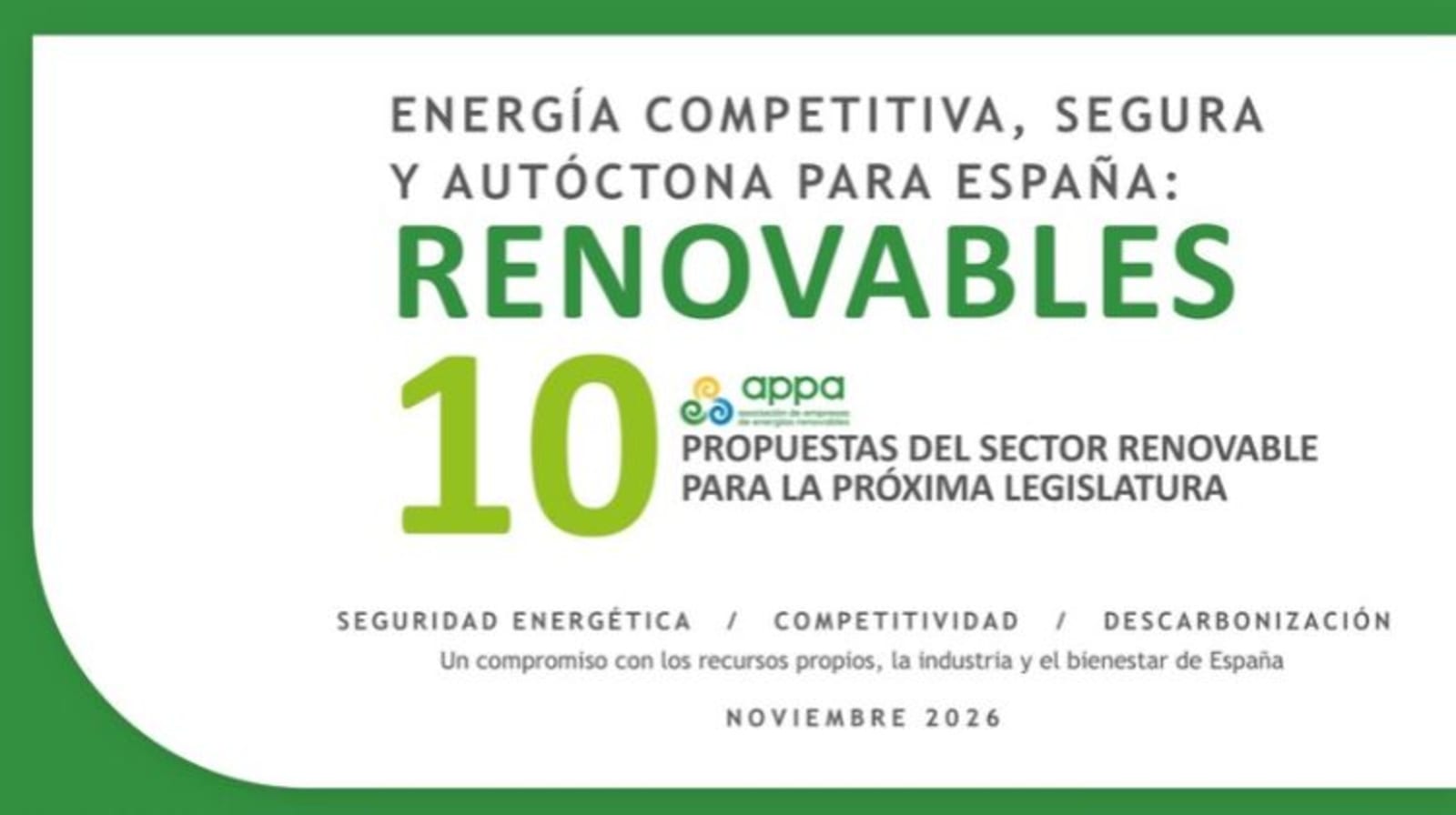
The Spanish Renewable Energy Association (APPA Renovables) has presented its ten-point plan for the next legislative session, a document outlining ten lines of action to advance towards a competitive, secure, and domestically produced energy sector. The Association calls on all political groups to ensure that energy, and especially renewable energy development, forms part of a shared development strategy for Spain, with stable agreements that will reduce dependence on foreign energy, strengthen the industry, and protect consumers from future energy crises.
Energy is a cross-cutting need: it affects business activity, household budgets, the provision of public services, and the development opportunities of each region. “Security of supply, business competitiveness, job creation, territorial cohesion, and decarbonization are common goals for all political forces, so we are confident that we can move forward together to make the most of our resources,” explained José María González Moya, CEO of APPA Renovables.
The ten-point plan is presented as the sector's contribution to this collaborative effort. Its purpose is to ensure that energy decisions have the continuity required for industrial investment and that there is effective collaboration between the national government, regional governments, and municipalities. The next legislative term must allow for the consolidation of a national policy that transforms Spain's energy potential into lasting benefits for society as a whole.
Own resources for a safer economy
Spain imports 68.4% of the energy it consumes and recorded an energy trade deficit of €29.292 billion in 2025, according to data compiled in the document. This dependence exposes our economy to the fluctuations in fuel prices, which we no longer control, as well as the consequences of international conflicts. Reducing oil and gas imports through measurable targets and a stable regulatory framework is therefore the first proposal of the ten-point plan.
Harnessing the sun, wind, water, biomass, and other renewable resources allows us to reduce this vulnerability and maintain a greater share of economic activity in our country. In 2025, renewables avoided fossil fuel imports worth €14.814 billion and sustained 140,621 direct and indirect jobs. The challenge is to consolidate this contribution and extend it to all energy uses.
To make this possible, the Association calls for a stable and equitable tax system, including the elimination of the tax on the value of electricity production, a review of existing regional taxes, and the removal of new charges that would negatively impact investment. This approach should also support the development of thermal renewables, biofuels, biogas, and biomethane.
The third proposal addresses the electrification of demand and the expansion of self-consumption. The document outlines a national roadmap for electrifying industry, transportation, and buildings, reducing the tax burden on electricity, and promoting self-consumption and batteries through deductions of at least 25% of the investment. It also proposes ongoing dialogue with industrial sectors seeking to establish operations in Spain, to facilitate the utilization of available renewable energy generation by new demand. Access to competitive energy should become an advantage for attracting industry and creating jobs.
Continue reading
A system designed to take advantage of all renewable energy sources
Energy resilience requires preserving existing capacities and developing the infrastructure necessary to integrate more renewable generation. In this area, the ten-point plan proposes a national hydroelectric policy that guarantees the continuity of power plants when their concessions expire, preventing shutdowns due to bureaucratic reasons. Modernizing existing facilities and implementing a national long-duration pumped storage plan should strengthen their contribution to system security. Alongside hydroelectric power, APPA Renovables calls for recognizing the value of biomass and promoting new capacity. In addition to providing firm renewable generation, the sustainable mobilization of agricultural and forestry waste contributes to rural employment, land management, and fire prevention. The Association proposes compensating for these benefits, facilitating the continuity and modernization of existing plants, and promoting new plants through specific mechanisms.
The sixth measure outlines a roadmap for completing the enhanced operation of the system once the necessary technical safety conditions are guaranteed. This requires accelerating investments in networks, deploying energy storage and demand flexibility, and incorporating a greater share of renewables and batteries into the services that ensure stability of supply. The goal is to reduce additional costs, make better use of renewable energy, and avoid unnecessary dependence on gas-fired generation.
Streamline projects and share their benefits with the territory
“The development of these investments, which are very costly and long-term, requires streamlined and harmonized procedures, with common criteria, maximum timeframes, and standardized documentation agreed upon with the autonomous communities,” González Moya emphasized. Along these lines, the ten-point plan also proposes a National Repowering Roadmap to modernize wind farms, produce more electricity with fewer turbines, and strengthen associated industrial capacity.
Collaboration with local councils and communities must be an integral part of this process. Participation from the earliest stages and the sharing of benefits are fundamental to ensuring that projects also address the priorities of the territories where they are located. This approach is particularly relevant for promoting domestic biogas and biomethane, the eighth proposal in the document. Spain could mobilize between 25 and 35 TWh of biomethane annually by 2035, leveraging its own resources and generating opportunities in rural areas. To advance toward this potential, the Association proposes harmonizing permits, facilitating long-term contracts, reviewing the distribution of connection costs, and supporting projects with local information and participation from the outset.
In the transportation sector, APPA Renovables proposes increasing biofuel blends, moving from B7 diesel to B10 and from E5 gasoline to E10, with guarantees of quality, technical compatibility, and sustainability. This measure would reduce fossil fuel consumption by leveraging existing infrastructure, complementing the progress of electrification.
Innovation and industry for a common national strategy
The ten-point plan is completed with a commitment to R&D&I and marine energy. The Association calls for stable programs for research, demonstration, and industrial scaling, support for testing platforms, and greater knowledge transfer between universities, research centers, and companies. It also requests the first offshore wind auction to advance the development of an area where Spain possesses technological and industrial capabilities. With these ten proposals, APPA Renovables invites the various political groups to incorporate renewable energy development into their priorities for the next legislative term and to build agreements that can be sustained over time. Strengthening energy independence, facilitating affordable energy, boosting industry, and generating opportunities in rural areas are shared interests that require a joint response.
“Spain has the resources, companies, and knowledge necessary to move forward. Transforming that capacity into a more competitive and resilient economy requires a common strategy, stability for investment, and a willingness to collaborate between administrations. All of this can only be achieved through a broad consensus on how we should take advantage of our only native energy sources: renewables,” explained the CEO of APPA Renovables.
 By Emilia Lardizabal

 By Energía Estratégica

 By Matías Medinilla