
Patria Investments , through its Atrien platform, identifies opportunities to develop another 700 MW of photovoltaic capacity in Colombia , although its implementation will depend on new economic signals that allow for the structuring of long-term contracts and the expansion of renewable energy supply to time slots that are not currently served by conventional solar generation.
The company, which has already made 610 MWp viable between the Puerta de Oro and Puertos de Santander parks, believes that the next investment cycle requires overcoming the limitations of traditional power purchase agreements (PPAs).
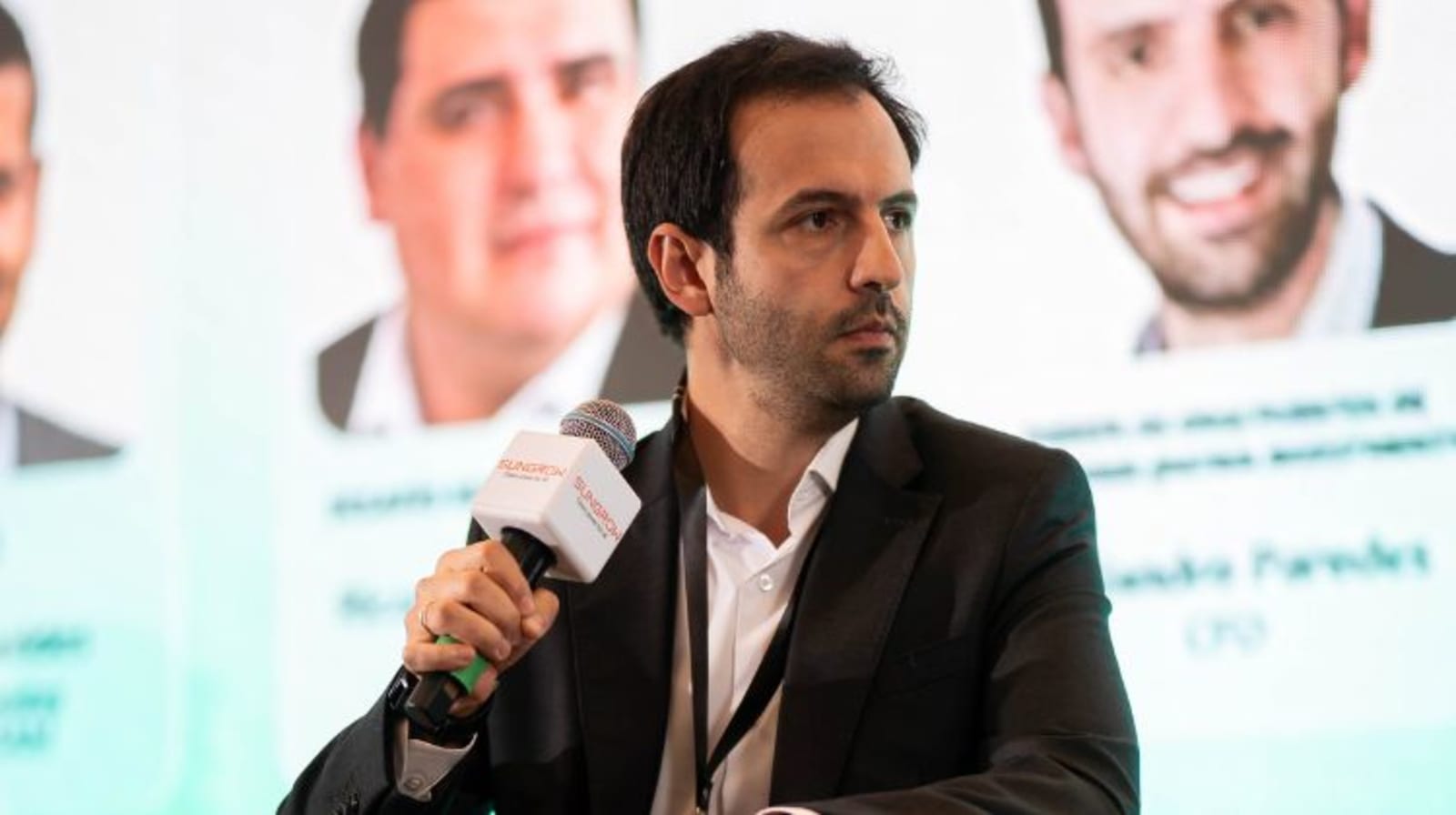
“We need to create incentives as a system to make products with solar capacity viable, but which can also serve other time blocks, and this requires a price signal,” said Alejandro Paredes , CFO of Puerta de Oro and Puertos de Santander, projects of Patria Investments, who identifies the 6 to 11 p.m. time slot as an opportunity to develop hybrid solutions that allow the expansion of renewable supply beyond the hours of conventional photovoltaic generation.
Atrien's experience reflects how this business model works. The platform successfully backed two photovoltaic projects through long-term bilateral contracts with buyers of high credit quality , under a supply model concentrated on peak solar production hours.
However, the executive warned: “This product is a finite product and one that we cannot rely on indefinitely as a country,” and emphasized the need to incorporate products with different characteristics than conventional solar blocks.
In this scenario, the executive suggested that the discussion should go beyond bilateral PPAs and long-term auctions , to focus on economic mechanisms that allow structuring projects with supply capacity at different times of the day.
The need to expand commercial alternatives is becoming relevant for Patria Investments' portfolio, which identifies a 200 MW expansion in Puertos de Santander and an additional 500 MW of photovoltaic power whose realization is conditional on its commercial viability.
“We have the possibility of expanding it by another 200 MW and we have identified projects for an additional 500 MW of photovoltaic capacity that require commercial viability,” the CFO explained.
If these initiatives materialize, the platform's portfolio would reach approximately 1310 MWp , combining existing developments and the newly identified capacity. However, the additional projects still need to secure the necessary contractual conditions to move forward with financing and construction.
From the 610 MW made viable to a new stage of investments in Colombia
Patria Investments' capital deployment in Colombia began in 2022 , through a co-development strategy with local companies that allowed progress in the structuring and subsequent execution of its first photovoltaic parks.
In 2024, the platform began construction of Puerta de Oro, a 360 MWp facility that reached its regulatory commercial operation date (COD) in July of the year referred to by the executive during his presentation.
Subsequently, the company moved forward with Puertos de Santander, a 250 MWp development located in Cimitarra, Santander , which is under construction and completes the first phase of investment in the platform.
“With that, we reach this first phase, which is about 610 MW that we expect to be fully operational next year,” Paredes stated.
Continue reading
Beyond the execution of these assets, the company's strategy contemplates an investment model based on the deployment and subsequent rotation of capital , characteristic of private equity funds that participate in the development of energy infrastructure.
In that sense, references to 1000 MW or 1 billion dollars of investment do not necessarily represent a fixed portfolio of assets, but rather a target associated with successive cycles of investment, construction, and transfer of projects.
“What is natural for us is to deploy equity, raise debt, build on time and within budget, and deliver those projects to long-term players who are committed to operating them in perpetuity,” the CFO explained.
Under this structure, the announced transaction on Puerta de Oro constitutes an example of Patria's financial strategy , which contemplates the transfer of facilities to investors interested in maintaining their operation in the long term.
However, the executive identifies an obstacle to sustaining that model continuously: the limited availability of counterparties with high credit quality and contracts that recognize construction and operating costs .
According to Paredes, the Colombian market has approximately five or six triple-A rating agencies that facilitate project financing and the entry of new investors, while hiring opportunities have arisen mainly during specific periods.
“I believe that in the last four to eight years there have been contracting windows; the bet on the long-term auction I think was a first attempt, but there is no structural market condition for long-term PPAs,” warned the representative of Patria Investments.
In this context, Colombia's long-term auction awarded 995 MW of solar power and 100 MW of storage , distributed among six projects from four companies, with 15-year contracts that will begin in 2030.
However, the product designed exclusively to supply the 6 PM to 10 PM time slot was not awarded a contract, despite registering a daily demand of 5,990 MWh compared to an offer of 558 MWh. In contrast, hybrid projects that combine daytime and evening supply secured contracts at an average price of 315.87 Colombian pesos per kWh, approximately 28% higher than the conventional solar block.
These results reflect the difference between the interest in contracting energy outside of solar hours and the availability of projects capable of responding to that demand, one of the commercial challenges that Paredes identifies to sustain the country's photovoltaic expansion.
This situation also affects the prospects for energy security towards 2030 , given that the use of available renewable resources requires commercial instruments capable of transforming the identified potential into new generation capacity.
“Colombia is a country with resources that other countries, not only in the region but in the world, hardly have, so the basic conditions are in place to meet the 2030 goal,” Paredes pointed out.
Looking ahead to 2027 , the executive calls for structural conditions that will allow the country to overcome its dependence on sporadic contracting mechanisms, a problem that, he says, has been present in the debates of the Colombian electricity sector for between 10 and 15 years.
“And so that there is a pipeline that is not just PowerPoint presentations and project promises, but that truly becomes a flow of projects that enter the construction phase, are financed, become operational, some of them are sold, and others of them simply remain in perpetuity in the hands of the developer,” the CFO concluded.
 By Emilia Lardizabal
 By Energía Estratégica


 By Matías Medinilla