
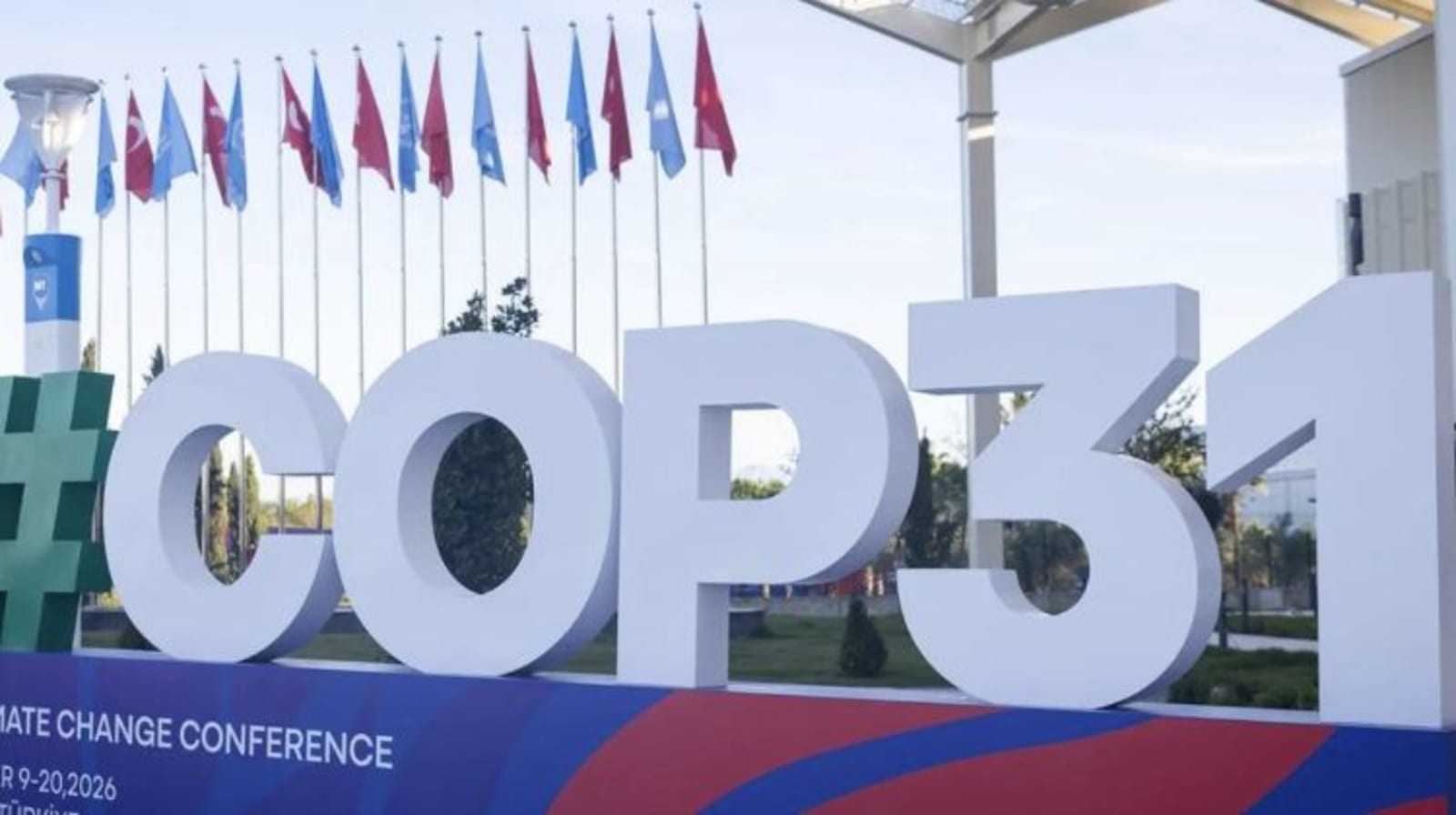
The COP31 in Antalya, Turkey, reaches its final day with commitments to invest in renewable energy, new electrification goals and proposals to accelerate the development of electrical infrastructure, although without a definitive consensus on the future of fossil fuels.
Among the main results is a package of initiatives involving more than 150 countries, the European Union, 37 cities and more than 260 companies , accompanied by investment plans of at least $156 billion annually in networks, renewable generation and storage.
Added to this are the proposal to raise the share of electricity in global energy consumption to 35% by 2035 , a roadmap for the wind industry to exceed 4 TW installed and new international agreements aimed at expanding clean generation capacity.
However, the progress of sectoral initiatives contrasts sharply with the state of multilateral negotiations. The second draft of the final agreement, presented on November 19, removes explicit references to the phase-out of fossil fuels and maintains electrification as one of the main pillars of international cooperation.
The proposal also omits a fundamental condition for decarbonization: that the increase in electricity consumption is accompanied by a greater share of renewable sources.
Electrification at 35% and billions for networks and clean energy
One of the central announcements of the summit is the 35x35 Global Electrification Commitment , promoted by Turkey and Australia, which aims to increase the share of electricity in global final energy consumption from approximately 23% today to 35% in 2035.
The initiative aims to accelerate the replacement of direct oil, gas, and coal consumption in sectors such as transportation, industry, and buildings. However, it is a voluntary global goal and not a uniform obligation for all countries.
Among the governments supporting the proposal are Spain, Chile, Brazil, and Uruguay. For its part, China reaffirmed its national goal of achieving 35% electrification by 2030 , five years ahead of the international target.
Spain also plans to bring forward its target to 2030, while the European Union projects to increase the share of electricity in its energy demand to 46% by 2040.
" Spain supports electrification that goes hand in hand with renewables; we believe it is important to electrify, but only if we manage to decarbonize ," says Sara Aagesen , Spain's Third Vice President and Minister for Ecological Transition.
Chile, for its part, formalized its adherence to the international commitment, although it demanded that the implementation take into account the particularities of each country and be supported by investments in renewable generation, transmission, distribution and storage.
" It is a relevant and consistent signal with the progress that Chile has made in this area in recent years ," says Francisca Toledo , the South American country's Minister of the Environment, regarding the country's incorporation into the global goal.
The political momentum is complemented by the COP31 Electrification Implementation Package , presented on November 19 by UN Climate Change and organizations linked to the Global Climate Action Agenda.
The document brings together actions from governments and companies that represent more than two-thirds of the world's gross domestic product and companies whose combined revenues exceed four trillion dollars annually.
Among their announcements, the commitment of the members of the Net Zero Emissions Utility Companies Alliance (UNEZA) stands out, who plan to allocate at least $156 billion annually to electricity grids, renewable energy and storage.
The figure represents a 5% increase compared to 2025 and a 35% increase compared to 2024. In addition, its members reported that during the last year they built more than 21,000 kilometers of new networks, 50% above the previous year.
"The transition to clean energy is now irreversible," says Simon Stiell , executive secretary of UN Climate Change, during the high-level event of the Global Climate Action Agenda.
The official emphasizes the need to translate commitments into concrete infrastructure and results, while noting that developing countries require access to affordable financing and technologies to participate in this transformation.
In terms of distribution, Turkey and the International Renewable Energy Agency (IRENA) launched D-GRIDs, an initiative aimed at improving planning, digitalization, resilience and investment in electricity grids in emerging economies.
According to estimates presented by IRENA, cumulative global investment in networks should reach $10 trillion by 2035 , which implies more than doubling the current rate of disbursements.
"We cannot accelerate electrification without accelerating the development of electricity networks," warns Francesco La Camera , director general of the agency, in statements released during the conference.
New financial instruments were also announced. The AMPLIFI mechanism, initially backed by a £400 million UK contribution, aims to mobilize up to £5 billion for clean energy and electricity infrastructure projects in emerging markets.
Meanwhile, Octopus Energy launched an Asian electrification fund with a $600 million target, intended to finance solar, wind, storage and electric vehicle charging.
The instrument's first operation is linked to a Philippine developer that projects a portfolio of 450 MW solar and 350 MWh of batteries .
AIB bank also doubled its green and transition financing target for 2030 to 60 billion euros, while BBVA reported having channeled nearly 60 billion euros into sustainable business activity associated with electrification between January 2025 and September 2026.
The rollout also extends to small island developing states, which have ahead of schedule exceeded their target of 10 GW of installed renewable capacity and set a new collective target of 30 GW by 2035 .
The wind power industry is aiming for 4 TW while the dispute over fossil fuels persists
Another important announcement from COP31 came from the Global Wind Energy Council (GWEC) and the Turkish Wind Energy Association (TÜREB), who presented a joint statement to accelerate the incorporation of new projects.
The industry proposes to exceed 4 TW of global wind power capacity by 2035 , compared to the nearly 1.3 TW recorded at the end of 2025 , through predictable regulatory policies, faster permits, and greater investments in transmission and storage.
During 2025, the sector added 165 GW, a year-on-year growth of 40%. However, current projections point to approximately 3 TW in 2035, so exceeding 4 TW will require a further acceleration of deployment.
Continue reading
"We have built an industry that today generates almost 1.3 TW of capacity globally, and just last year we added a record 165 GW," highlights Michael Hannibal , president of GWEC.
The organization identifies the main obstacles as administrative deadlines, the availability of connection infrastructure, access to competitive financing, and the stability of investment signals.
"If, for example, it takes two years to build an offshore wind farm, it shouldn't take eight to twelve years to obtain the necessary permits," questions Ben Backwell , CEO of GWEC.
In this context, one of the most important moves for renewable development corresponds to the memorandum of understanding between Turkey and China, valued at approximately $15 billion .
The initiative envisions adding 7 GW of solar and wind capacity , along with storage and 4 GW of transmission infrastructure. However, details of the individual projects and the implementation schedule have not yet been released.
The agreement is part of Türkiye's plans to expand its energy mix, with an aspiration to reach 175 GW of solar and wind capacity by 2040.
In Europe, regulatory and financial progress was also made for renewable energy projects. The European Commission authorized a Dutch public support scheme of up to €9.45 billion to facilitate 2 GW of new offshore wind power .
The mechanism is aimed at the IJmuiden Ver Gamma-A and Gamma-B parks in the North Sea, whose combined generation could reach 7,441 GWh per year.
The tenders are expected before July 2027 and will prioritize bids that do not require subsidies. State support will only be activated if no viable proposals are submitted under that scheme.
For its part, the United Kingdom advocated during the conference for a greater commitment to clean technologies as a tool for energy security and announced a contribution of 200 million pounds over four years through the Private Infrastructure Development Group.
This contribution is expected to help mobilize approximately $1 billion annually of private capital for resilient infrastructure in emerging economies in Africa and Asia.
"We must make the era of clean energy electrification a reality," argues Ed Miliband, British minister, defending the role of renewables against the volatility of fossil fuel markets.
Electrification has also advanced in transport and industry. The climate action package identifies 13 zero-emission freight corridors, spread across six continents and with a combined length of over 29,000 kilometers.
Six cities announced plans to incorporate around 2,200 electric buses by 2027. In the industrial sector, 36 deep decarbonization projects at commercial scale reached a final investment decision during the 12 months prior to November 2026.
In addition, the United Nations Industrial Development Organization presented a Global Agenda for Green Industrialization, aimed at coordinating investments, public policies and technology transfer.
What about the draft?
Despite these advances, the debate over abandoning fossil fuels remains one of the biggest obstacles to reaching a political agreement to close the border.
The second draft of the final decision of COP31 reduces the number of paragraphs in the document from 144 to 80 and eliminates explicit references to the phase-out of oil, gas and coal.
The proposal maintains the electrification target of 35% by 2035 , but without expressly stating that the additional electricity supply must come from clean sources.
This difference is the focus of criticism from countries and organizations that consider it insufficient to increase the weight of electricity without simultaneously guaranteeing a reduction in generation emissions.
Meanwhile, China, the United States, and Russia announced an agreement to increase the production and supply of petroleum products , with the aim of ensuring the stability of international energy supplies in the face of tensions related to the war in Iran and the situation in the Strait of Hormuz.
The understanding between the governments of Xi Jinping, Donald Trump and Vladimir Putin comes as COP31 negotiators seek to reach a consensus on the future of hydrocarbons.
However, the joint presidency of the conference, led by Turkey and Australia, supports China's participation in the climate negotiations. Chris Bowen , the Australian chair of the negotiations, emphasizes that Beijing maintains a constructive attitude and actively participates in the search for consensus.
Similarly, Murat Kurum , president of COP31 and Turkish Minister of the Environment, highlights the diplomatic representation sent by China to Antalya, which includes Vice President Han Zheng and several ministers.
On climate finance, the European Union also ruled out opening new negotiations for additional resources and advocated focusing efforts on implementing existing commitments.
"What we should refrain from is having yet another conversation about 'new money' that will not resonate and will not be the outcome of this COP," says Wopke Hoekstra , European Commissioner for Climate Action.
The position follows the international commitment to mobilize at least $300 billion annually for developing countries by 2035 , along with a broader aspiration to reach $1.3 trillion annually in public and private climate finance.
Thus, while governments, banks and developers move forward with new goals and investment instruments, the main unknown of COP31 continues to be the scope of the political agreement that the countries will sign.
For the renewable energy sector, Antalya's announcements set a concrete agenda: expand clean generation, multiply investment in networks, accelerate authorizations, finance storage, and electrify new segments of demand .
The final decision will have to define the extent to which these sectoral initiatives are supported by an explicit multilateral approach to reducing dependence on fossil fuels.

 By Matías Medinilla
 By Energía Estratégica

 By Emilia Lardizabal