
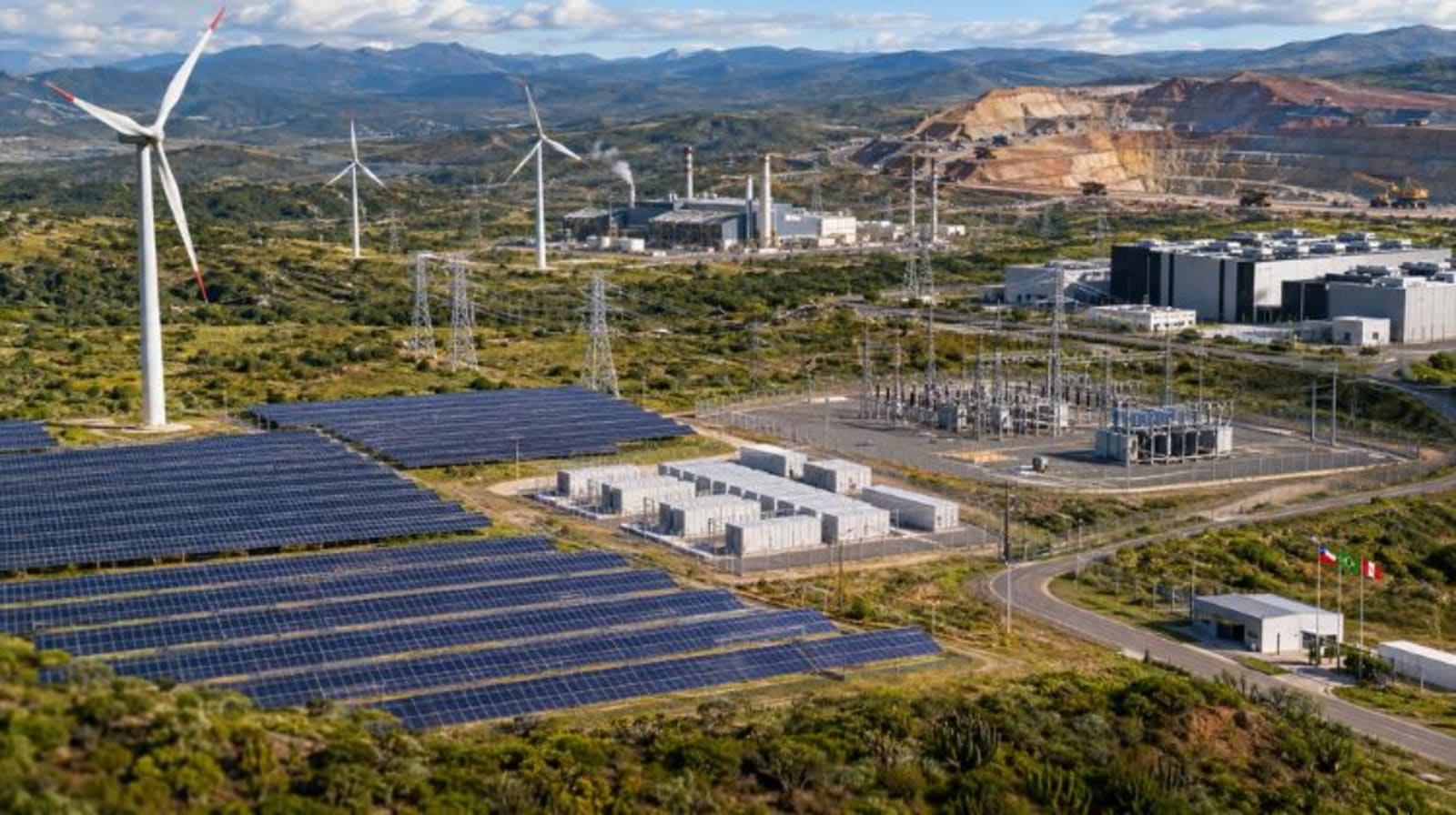
Large electricity consumers in Latin America are diversifying their renewable energy contracting strategies during 2026, with agreements of up to 240 MW associated with self-production, night contracts of 1 TWh per year and supply commitments that reach 20 years .
Mining, the chemical industry, retail chains, and data centers are among the key sectors involved in the identified operations.
According to a survey conducted by Energía Estratégica on the main renewable energy purchase agreements (PPAs) in the region, mining, the chemical industry, large commercial chains and data centers are among the leading sectors in the identified transactions.
The regional shift comes amid a slowdown in international corporate contracting. According to BloombergNEF’s 1H 2026 Corporate Energy Market Outlook, companies announced clean energy deals totaling 55.9 GW during 2025, a 10% drop from the record high of the previous year.

However, America was the only major region where the volume of off-site corporate contracts did not decline.
The consultancy also identifies a growing concentration of demand: Meta, Amazon, Google and Microsoft accounted for 49% of global activity, while Meta and Amazon jointly contracted 20.4 GW, including 4.7 GW of nuclear power.
In this regard , Nayel Brihi, corporate energy analyst at BloombergNEF, points out that buyers are operating at two different speeds, with large technology companies moving towards larger-scale deals and smaller companies facing complex conditions in the electricity markets.
The consultancy also recorded 5.8 GW of hybrid and co-located technology agreements during 2025 , while products capable of offering supply profiles similar to those of baseload accounted for 5.2 GW.
This behavior finds concrete examples in Latin America, where new PPAs are beginning to incorporate differentiated contractual mechanisms according to the consumption of each industry, exposure to electricity prices and hourly supply requirements.
In terms of investment, the International Energy Agency (IEA) estimates that Latin America and the Caribbean will have invested approximately $70 billion in clean energy by 2025, an increase of nearly 25% compared to a decade ago. This figure includes various technologies and infrastructure, not just power purchase agreements.
Brazil promotes self-production and Mexico diversifies industrial contracting
Brazil brings together some of the most relevant corporate agreements identified during 2026, particularly due to the incorporation of energy self-production schemes, corporate participation in renewable assets and long-term supply commitments.
One of the largest cases corresponds to the Carrefour Brazil Group, which signed a solar self-production contract with Casa dos Ventos valued at 1 billion reais, equivalent to the supply of 25% of its electricity consumption.
The agreement includes 240 MW destined for Carrefour, Atacadão and Sam's Club, coming from the Paraíso Photovoltaic Complex, which will reach a total installed capacity of 640 MW in Mato Grosso do Sul.
The operation will last for ten years, with supply starting in 2027, and is part of the commercial group's strategy to achieve 100% renewable electricity supply by 2030.
In parallel, Unipar Indupa do Brasil signed a PPA in February with Ventos de São Norberto Energias Renováveis, belonging to the Casa dos Ventos group, to acquire an average of 33 MW over 15 years, with deliveries planned from 2028.
The volume is equivalent to approximately 289 GWh per year, assuming a constant average supply for 8,760 hours. The contract is associated with the development of two 80 MW solar power plants within the Paraíso Solar complex.
The unique aspect of the agreement is its corporate structure: Unipar will have the right to acquire, once certain conditions are met, 9.8% of the capital of the generating company, through a transaction worth approximately 27 million reais.
The strategy also extends to mining. In August, EDF Power Solutions announced a PPA with Salobo Metais and Mineração Onça Puma , companies linked to Vale Base Metals, for the energy of the first phase of the Diana Wind Farm, located in Bahia.
The project comprises 142.5 MW of installed capacity and 23 wind turbines, with commercial operation scheduled to begin in 2027. Operation is structured under a self-generation model, allowing for the sale of any surplus generation. The facility also includes 192 MW of photovoltaic capacity and is part of a 439 MW complex. According to PV Tech, the contract was announced in March, following the start of commercial operation of the wind farm.
In Mexico, meanwhile, the identified agreements show two paths: the renewable supply of large industrial and logistics facilities, and the expansion of PPAs associated with distributed generation behind the meter.
In January, APM Terminals Lázaro Cárdenas signed a contract with Iberdrola México to cover 95% of its port terminal's electricity demand with renewable energy, while the remaining 5% will come from its own solar installations. It's worth noting that Cox acquired Iberdrola's assets in the country.
The supply was scheduled to begin in the third quarter of 2026 and would allow the facility to operate on entirely renewable electricity, backed by guarantees of origin.
Distributed generation is emerging as another contracting mechanism in the Mexican market. Revolve Renewable Power announced in April definitive agreements to develop nine solar projects totaling 2.4 MW, destined for a manufacturing company whose identity was not disclosed.
The contracts include a 20-year PPA, as well as engineering, construction, operation and maintenance services, with an estimated investment of $1.9 million.
The company also reported on another portfolio of 16 photovoltaic installations totaling 2.8 MW, linked to a department store chain. Taken together, these transactions illustrate decentralized contracting for commercial and industrial establishments, albeit with considerably smaller capacities than those of large-scale renewable energy parks.
Continue reading
Chile anticipates up to 4 TWh in PPA renewals and new electricity demand
Energy storage is beginning to change contracting conditions in different Latin American countries, especially when the goal is to supply electricity during hours without photovoltaic generation.
Chile presents some of the most advanced examples of this model. In June 2026, Grenergy announced a nighttime supply contract for 1 TWh annually for 15 years , signed with an international electricity company whose identity was not disclosed.
The agreement includes deliveries during non-solar hours from the Elena storage complex, located in Antofagasta, which has a nominal battery capacity of 3.5 GWh, with a planned expansion to 7 GWh.
The transaction represents the largest PPA by volume subscribed by Grenergy to that point and was scheduled to begin between July and October 2026.
“The largest energy sales agreement ever signed by Grenergy reinforces the visibility, stability and strength of our business,” highlighted David Ruiz de Andrés, CEO of Grenergy.
The same company formalized another hybrid PPA in June for the fifth phase of its Atacama Oasis platform, called Algarrobal, with 350 GWh annually for 12 years and deliveries planned from January 2028. The project will combine 242 MW of photovoltaics and 1,412 MWh of storage, with the purpose of selling electricity beyond the hours of solar irradiation.
This model has a prominent precedent in Chilean mining: Grenergy's agreement with Codelco, signed in April 2025, which includes 500 GWh annually for 15 years, with continuous supply 24 hours a day, seven days a week, starting in January 2026.
Meanwhile, demand from large consumers anticipates new contracting opportunities. According to a survey by Energía Estratégica during the Future Energy Summit (FES) Chile , the mining and desalination sectors project movements of up to 4 TWh between PPA renewals and new electricity requirements .
Codelco plans to tender at least 1 TWh in early 2027 , primarily to replace contracts nearing expiration, through agreements of between ten and fifteen years. This was confirmed by Francisco Danitz , Codelco's Corporate Manager of Energy and Water.
Desala, for its part, projects an additional 2 to 3 TWh of electricity demand by 2030 , driven by the expansion of desalination infrastructure, which opens up opportunities for flexible contracts that combine renewables and storage.
The retail sector is also participating in this transformation. Grupo Falabella consumes around 500 GWh annually in Chile and has closed a new contracting process for the cycle that will begin in January 2027.
“The message is to seek strategic partners who understand our business and support us in the long term to continue growing and advancing in corporate goals, beyond a simple sale of electricity,” says Felipe Flores , Energy Manager of Grupo Falabella.
Thus, Chile combines large night contracts and 24/7 supply with new contracting opportunities for mining, desalination and trade , in a market where scheduling flexibility, storage and cost predictability are becoming more important.
In Argentina , renewable energy PPAs are also gaining ground among large industrial consumers. YPF Luz signed an agreement with Molinos Basile for 2,200 MWh annually , which will cover 50% of the electricity demand of its plant in Chacabuco, using energy from the 305 MW El Quemado solar park in Mendoza.
In parallel, 360Energy and Stellantis commissioned an 8 MW photovoltaic plant in Córdoba , with a projected annual generation of 16.7 GWh , complemented by renewable energy supplies from the La Rioja solar complex through contracts under the Renewable Energy Term Market (MATER). This initiative is part of a joint $100 million investment plan and reflects the automotive sector's combination of self-generation and clean energy procurement.
On the other hand, in Colombia, recent contracts show a greater presence of marketing companies and electric utilities as counterparties, rather than directly identified industrial buyers.
In October, Cox signed a PPA with Empresas Públicas de Medellín (EPM) to supply approximately 115 GWh of solar energy per year for 15 years, with progressive deliveries planned from 2027.
The agreement supports a portfolio of 58 MWp photovoltaic plants, distributed across different municipalities, and includes an investment of nearly 40 million euros.
In January, Atlas Renewable Energy also announced a PPA with a Colombian trading company to develop the 128 MWp El Campano solar plant, with operations scheduled to begin by the end of 2027.
The project will deliver approximately 245 GWh annually, equivalent to the electricity consumption of more than 110,000 Colombian households, and is part of Atlas' plan to reach 1 GW of renewable capacity in Colombia.
In Central America, the combination of solar power and battery storage is appearing in increasingly large-scale agreements. In July, the Spanish company MASPV formalized two 15-year Power Purchase Agreements (PPAs) with Empresa Eléctrica de Guatemala and Distribuidora de Electricidad de Oriente.
The contracts support the development of the Estanzuela project, which will integrate 130 MWp photovoltaics and 100 MWh of battery storage, with an investment of over 100 million dollars.
Storage isn't the only trend emerging in Central America. In Panama, data centers are starting to appear among corporate buyers with specific long-term contracts.
In May 2026, KIO Data Centers signed a ten-year PPA with Celsia to supply its operations in the country, including its KIO PAN1 campus in Panama City.
Thus, the agreements analyzed demonstrate that Latin American renewable energy contracts do not follow a single model. Brazil is moving forward with self-production and corporate structures; Mexico combines large supplies and distributed generation; Colombia uses contracts with energy retailers to support new projects; and Chile is expanding its nighttime and 24/7 supply.

 By Ailén Pedrotti
 By Florencia Guglielmetti

 By Energía Estratégica
 By Emilia Lardizabal