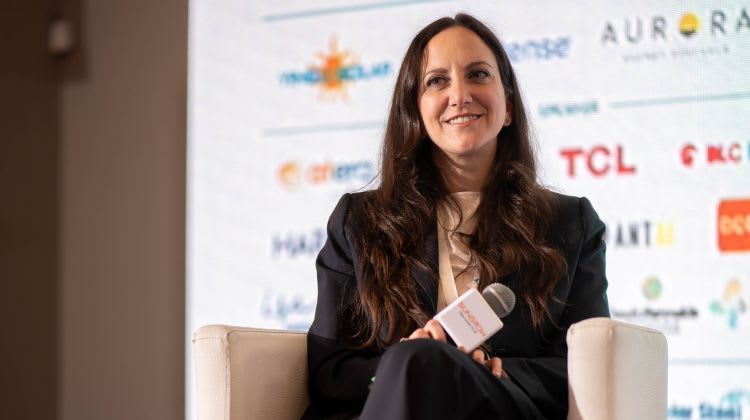

The growth in electricity demand and the difficulties in obtaining new PPA contracts were among the main concerns of the candidates for the Board of Directors of the Chilean Association of Renewable Energies and Storage (ACERA), which will renew seven positions on October 30.
The debate is taking place against a backdrop of abundant generation capacity and moderate expansion of regulated consumption . According to the 2026 Final Bidding Report, published by the National Energy Commission (CNE) on October 1, regulated consumption is projected to reach 31,397 GWh this year and grow at an average annual rate of 1.2% over the next five years.
The agency also determined that no additional short-term tenders are required between 2026 and 2028 due to contracted surpluses, although it is maintaining the 2026/01 process to cover subsequent needs. From 2031 onward, projections again identify contracting requirements, with significant deficits in contracted energy beginning in 2032.
This scenario raises questions about the business opportunities of a renewable portfolio that needs to secure long-term income to realize its investments.
For Carlos Cabrera , co-founder of Sphera Energy, the challenge is no longer just about having technically viable projects, but about finding buyers and financing.
“Today in the market it is not enough to just have a good and quality development, but it practically has to be accompanied by a PPA,” he said during the meeting.
The executive attributed this difficulty to the number of initiatives competing for connectivity and contracting opportunities. In that regard, he welcomed the modifications to the open access rules, which aim to require a greater degree of progress in the environmental permitting process for certain procedures.
However, he cautioned that improving the quality of developments does not guarantee that there will be a market for everyone.
“I unfortunately expect there will be a large number of projects that fail,” he predicted.
Data centers: an opportunity that could be missed
Given this scenario, Alan Álvarez , AES's Regulatory Manager, proposed making the attraction of data centers a priority for the Chilean renewable energy industry.
“I believe that data centers have even greater potential than green hydrogen. I think that needs to be understood,” he stated.
The executive pointed specifically to facilities intended for artificial intelligence, some of which may require power of 500 MW or more, creating opportunities for companies in generation, storage, transmission and backup.
This perspective is related to the projections of the National Electric Coordinator , which in April anticipated a demand for the National Electric System of more than 100 TWh per year towards 2030, driven by mining, desalination, industry and data centers, among other segments.
However, this is a different scenario from the regulated consumption analyzed by the CNE: the former considers the electrical system as a whole, while the latter focuses on customers supplied under that regime.
Álvarez considered that the main difficulty in capturing the opportunities of the digital sector lies in the speed of response of the country, particularly in connection and permitting procedures.
"The country that does not take advantage and does not get its act together with these timings will lose the opportunity to participate in this new demand," he warned.
He explained that Chile would have a window of approximately three to five years to position itself for these investments, and therefore proposed strengthening collaboration between ACERA, the authorities, and organizations linked to data centers.
Continue reading
The approach seeks to accelerate the arrival of large consumers in a market where other forms of electrification, such as the replacement of fossil fuels in industrial processes, may require considerably longer timeframes.
Electrification also needs new rules
The possibility of increasing consumption was addressed in other interventions, although with different proposals regarding how to achieve it.
Óscar Álamos , head of Regulatory Affairs at ISA Energía, proposed reviewing the bidding contracts for regulated clients, an instrument that has historically helped to mobilize investments in generation.
“We need to start looking at demand,” he said during his presentation, in which he also stressed the need to pass on the economic benefits of the energy transition to consumers.
At this point, the regulatory agenda already includes mechanisms for future contracting. The 2026/01 Supply Tender , currently underway, considers two blocks of 1,575 and 1,260 GWh annually, with 15-year contracts and deliveries starting in 2029 and 2030, respectively.
The process incorporates time and geographical segmentation, as well as mechanisms designed to manage supply risks and facilitate the participation of new or existing assets, including storage systems.
The bids are scheduled for December 2026 and the contracts awarded for January 2027. Thus, although the CNE does not foresee additional calls for bids to cover immediate needs, long-term contracting opportunities still exist.
From another angle, Rodrigo Güell , manager of New Business and Regulation at Celeo, pointed out that it is also necessary to modify the signals that consumers receive.
“How is it possible that we don’t care whether we consume energy at midday or at night?” he questioned during his speech.
Therefore, he proposed advancing in smart metering and mechanisms that allow for better management of consumption, along with improving the use of the transmission infrastructure.
This discussion takes on special relevance at a time when Chile is preparing an electricity grid reform , the implementation of which could open up space for new digitalization and demand management tools.
Teresita Vial , a partner at DV+ Abogados, also pointed to the obstacles potential consumers face in electrifying their businesses. Among these, she mentioned the systemic costs associated with the operation and the need to strengthen distribution networks.
Their approach broadens the problem of demand: it is not enough to promote fuel replacement if the connection and supply conditions are not convenient for customers.
An agenda that transcends the election
The need to expand the electricity market also came up in the interventions of Julio Lira , partner of B-Ambiental, who proposed strengthening the coordination of the association with organizations linked to data centers, green hydrogen and electrified transport.
“We must anticipate regulatory challenges,” he argued, considering that the experiences accumulated during the renewable expansion can help avoid similar problems in the development of new consumption.
For his part, Alfredo Solar , regional manager of Atlas Renewable Energy, distinguished two dimensions that should be considered in sector priorities: growth through new contracts and investments and the efficient operation of existing assets.
Their approach aims to preserve regulatory conditions that allow projects to be developed, financed, and returns obtained on committed capital.
With ten candidates vying for seven positions, the renewal of ACERA's Board of Directors will test the association's ability to translate these proposals into concrete priorities. The discussion revealed a point of agreement among representatives from different sectors: the future of renewable energy investments will depend not only on how much energy Chile can generate, but also on its capacity to find new consumers .
 By Energía Estratégica

 By Ailén Pedrotti
 By Emilia Lardizabal