
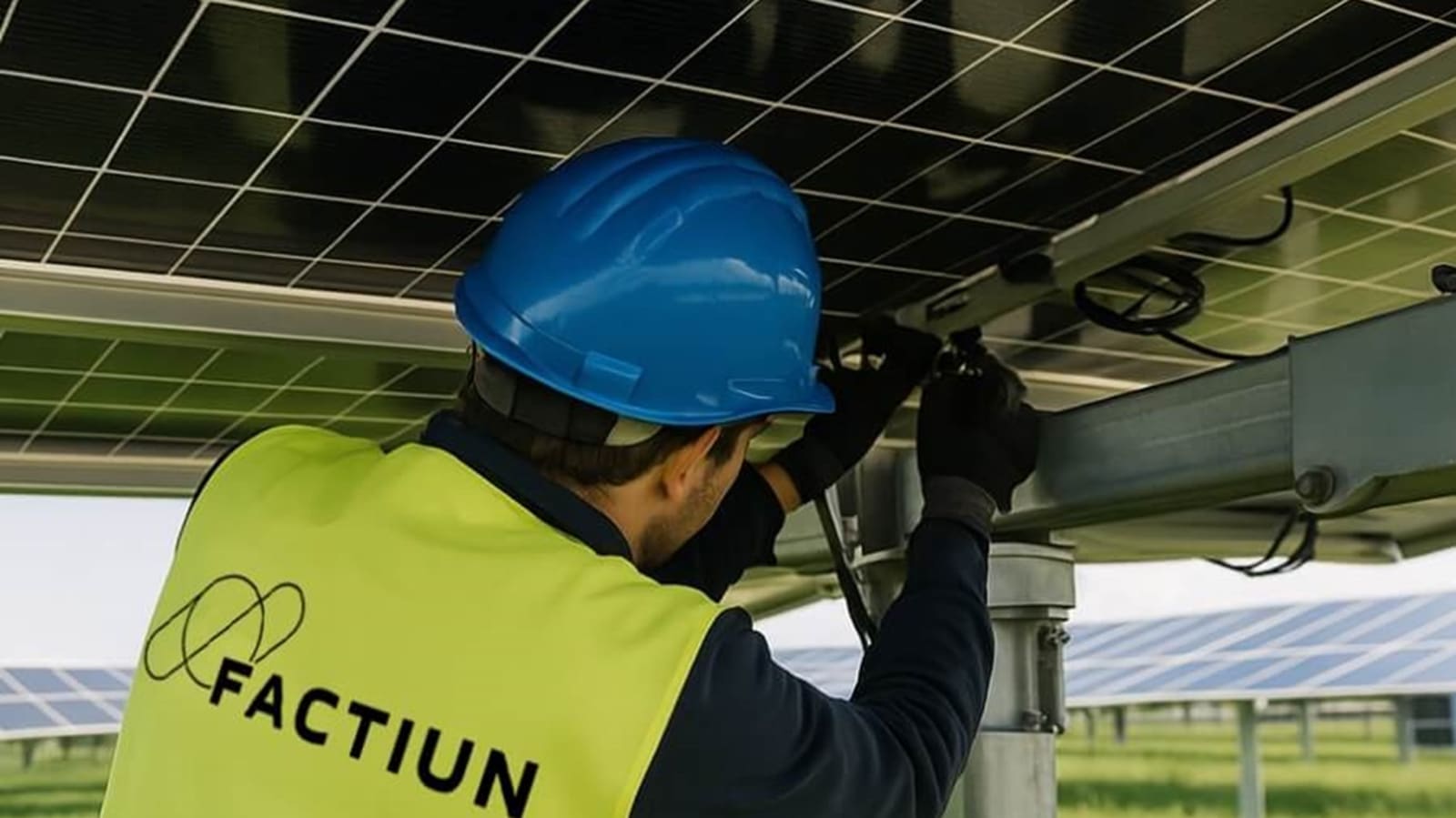
Factiun expects to more than double its supply of photovoltaic structures in Latin America and the Caribbean over the next year , with a projection exceeding 500 MW. The company anticipates that its project portfolio already allows it to support a significant portion of that goal, even before the start of the next fiscal year.
“By next year, 2027, I believe we will be above half a gigawatt of capacity supplied in Latin America. We have significant projects in our backlog that are bringing us closer to that goal even before the year begins,” stated Pablo Landa, CEO of Factiun , in an interview with Energía. Strategic .
“That number represents a growth of over x2. And in the coming years, starting in 2027, it will be a very important region for us,” he highlighted in the conversation framed within the XI Energy Week that took place in the Dominican Republic.
Mexico is currently one of Factiun's main commercial focuses, considering that the country has reactivated various calls to accelerate permits from the private sector and finalize joint projects with the Federal Electricity Commission (CFE), for more than 10 GW of renewables and +1.2 GW of storage.
Furthermore, it was recently announced that Mexico's Energy Ministry (SENER) is moving forward with defining the second call for renewable energy projects under mixed development schemes with the CFE, with a Selection of 66 initiatives totaling 8241 MW of solar and wind capacity, distributed among 34 economic groups.
“The Mexican market is currently attracting a bit more attention. We're actively pursuing it, and we hope to have some interesting news about the region in the coming months,” Landa noted.
The renewed interest in that country adds to the company's activity in Peru, where it is carrying out a 180 MW project and has large-scale references. Chile also remains a priority, despite the slowdown experienced by its photovoltaic market.
The regional portfolio also includes projects in Brazil and El Salvador, opportunities in Ecuador and the Dominican Republic, as well as evaluation initiatives in Colombia and Guatemala.
The Latin American focus also reflects the company's international aspirations, which aim to position itself among the top three virtual manufacturers of photovoltaic structures .
It's worth noting that Factiun has been operating as an independent brand for just over three years, although its founders and managers have more than two decades of combined experience. Their combined track record includes over 12 GW of solar trackers and 7 GW of fixed structures .
Beyond volumes, the strategy aims to gain market share in power plants with demanding execution conditions, where the selection of the structural system can determine the economic viability of the development.
The Dominican Republic stands out as one of the most relevant markets under this criterion. “We are exploring ways to help developers unlock projects that may have stalled due to certain requirements or difficulties. Therefore, we must work very thoughtfully to effectively resolve the specific problems of each project,” explained the company's CEO.
Continue reading
“We are working on some projects that may well be the largest in the region. For example, there is a project that will begin construction soon, which will be a benchmark in the country and will emerge with much more positive KPIs than when it arrived,” he stated.
The case highlights one of Factiun's business lines: reducing implementation costs to restore the viability of projects conditioned by topography .
In these locations, earthmoving can become a significant budget item. This is compounded by construction deadlines and environmental restrictions that, in certain cases, directly limit on-site work.
Less earthmoving and lower CAPEX: the solutions behind the expansion
To meet these demands, Factiun offers TRX® Gen 2 , an evolution of its solar tracker for large-format modules and complex terrain. The new generation incorporates more efficient drives, a unique transmission shaft, and structural redesigns aimed at improving wind resistance, simplifying assembly, and optimizing transport.
In addition to this solution, there is Factiun FIX® , designed for installations with high wind loads or topographical limitations. This fixed structure system incorporates advanced wind tunnel testing and is designed for sites exposed to extreme conditions, including cyclonic winds.
However, the technological advantage also lies in choosing the most suitable configuration for each power plant, especially when slopes or environmental restrictions affect implementation.
“Adaptability is an issue we have worked on from the beginning, and we have understood that developers and EPC contractors need help to resolve it,” says Landa.
This process involves CALISTO, Factiun's proprietary software, which optimizes topographic surveying and reduces earthworks to zero or near zero . The tool calculates the overhead lengths of the supports and allows for the analysis of shadows between continuous trackers, minimum distances of the modules from the ground, and layout configurations.
“All the technical improvements we are introducing, where they truly shine and emerge, is in the methodology we apply to decide when to select and when to apply one or the other,” the executive explains.
The main economic benefit is concentrated in CAPEX , through reduced civil works requirements and faster execution. According to the executive, the operation of the facilities is not affected by these adjustments.
The impact goes beyond savings when there are environmental restrictions that prevent the modification of certain surfaces: "It is no longer a matter of saving, it is a matter of making the project viable as such."
With this approach, Factiun aims to consolidate its regional growth through projects where structural adaptation and cost optimization play a decisive role: “What satisfies us most is adding value to the projects. So, of course, we seek growth, but we seek growth by adding that value to the projects,” concludes the CEO.
 By Energía Estratégica
 By Florencia Guglielmetti

 By Matías Medinilla

 By Ailén Pedrotti