

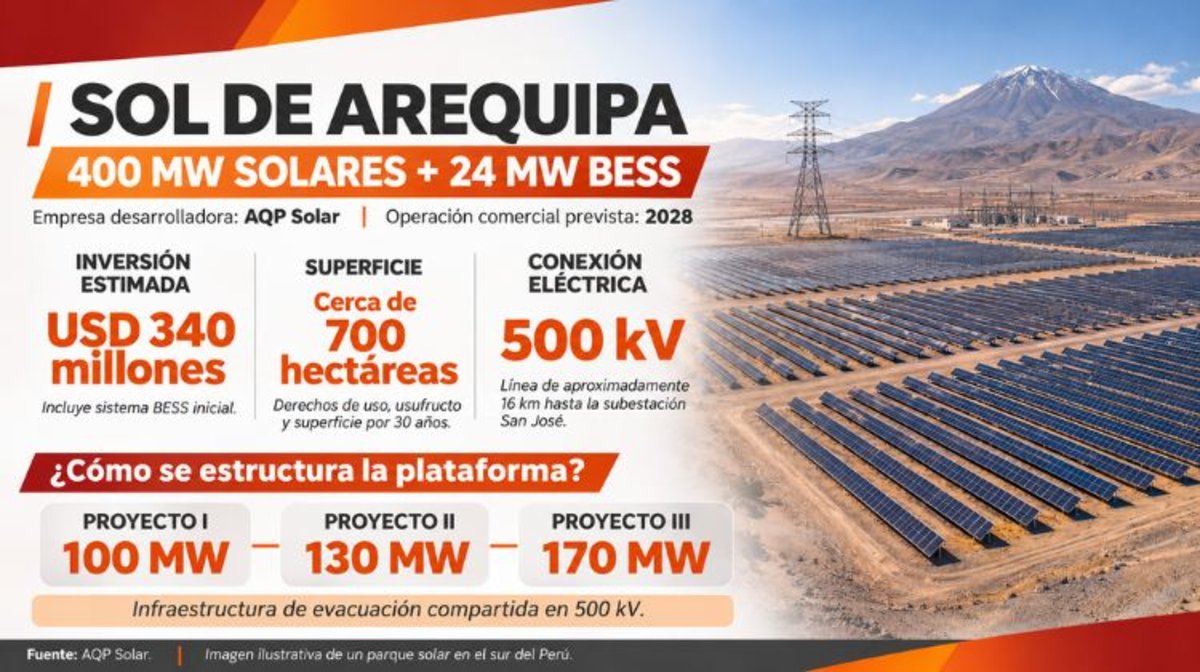
Converting nearly 700 hectares of southern Peru into a 400 MW photovoltaic platform, which aspires to be among the largest in the country, is the challenge facing AQP Solar , which is advancing in the development of Sol de Arequipa with the aim of starting its construction in 2027.
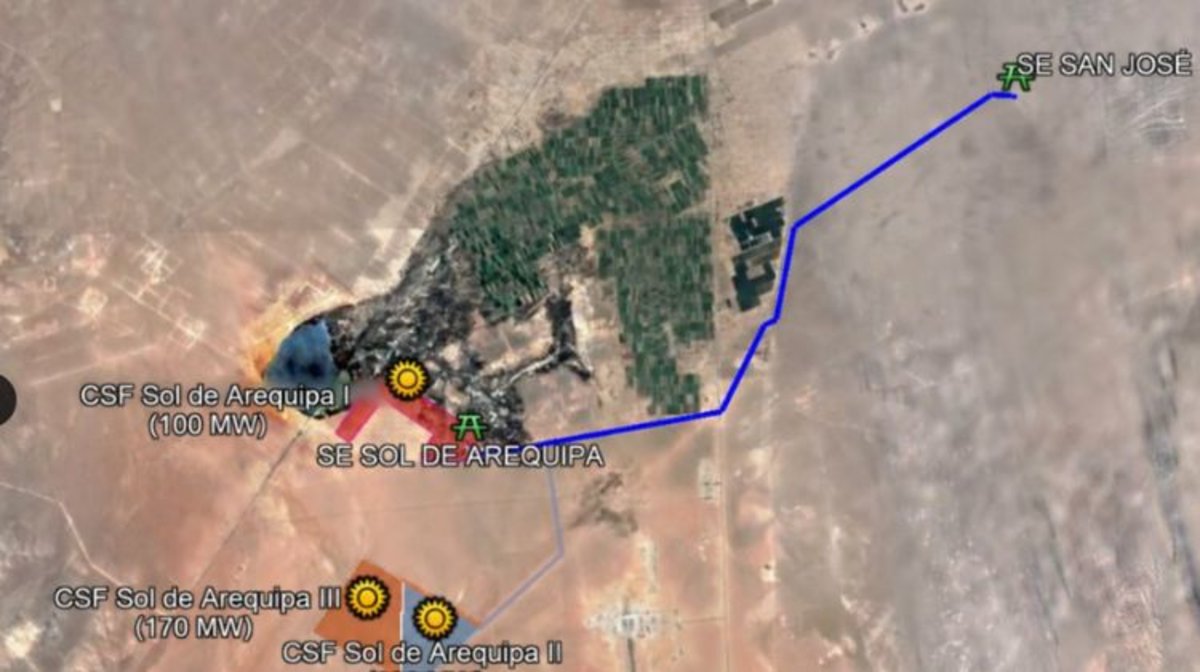
“Sol de Arequipa is structured around three specific projects of 100 MW, 130 MW, and 170 MW, conceived from the outset to be built, connected, and operated in a coordinated manner. They share the same main evacuation solution: the future Sol de Arequipa substation and an approximately 16 km, 500 kV line to the San José substation,” stated Augusto Vargas, Deputy General Manager and Director of Projects and Infrastructure at AQP Solar , in an interview with Energía Estratégica.
The platform will include a 24 MW battery energy storage system (BESS). The project will require an estimated investment of $340 million. However, the next crucial step will be to identify the investor who will support the development and finalize the financing structure in order to move toward the final investment decision and begin construction.
Due to its scale, Sol de Arequipa ranks among the largest photovoltaic developments in Peru , in a segment where few projects reach capacities close to 400 MW. Other major initiatives include Central Solar Illa, a 396 MW plant currently under construction; Sunny, a 309 MW plant; and Valladolid, a 400 MW plant , the latter with an approved Pre-Operational Study (EPO).
The project has network access approved by the Economic Operation Committee of the National Interconnected System (COES), rights over approximately 680 hectares for 30 years and a shared evacuation solution at 500 kV , through a line of approximately 16 kilometers to the San José substation.
With these advancements, AQP Solar aims to achieve ready-to-build (RTB) status in April 2027 and begin construction during the second quarter of that year, subject to financial closing. Commercial operation is planned for 2028.
AQP Solar seeks investors to raise USD 340 million
Although Sol de Arequipa is making progress in land acquisition, permits and electrical infrastructure, the company still needs to define the investment partner that will accompany the execution of the 400 MW, as well as the final capital and financing structure.
The search is one of the next milestones in realizing an estimated investment of $340 million.
“That is the next big step today: to define the investor, close the financial structure and, on that basis, make the final investment decision and mobilize construction and procurement,” Vargas explained.
AQP Solar's strategy anticipates that the investor will join when the platform reaches the technical and administrative maturity expected in April 2027.
The company will continue to support the acquisition of generation and transmission concessions, scheduled for July or August of that year, as well as the subsequent processing of the easements necessary for the electrical infrastructure.
“Financially, it’s not necessarily a matter of a single payment after obtaining all the concessions. It’s perfectly possible to structure payments by milestones and maintain certain sections conditional on obtaining the concessions and easements,” the company representative pointed out.
What is the current status of the 400 MW of Sol de Arequipa?
AQP Solar is making progress in obtaining the necessary permits and studies to bring the three projects to RTB status by April 2027, with different levels of development in each component.
The company does not plan to build the initial 100 MW first and then expand the capacity , but rather to execute all three components under the same program of works, equipment supply and electrical connection.
Project I, of 100 MW, has approximately 180 hectares with rights of use, usufruct and surface for 30 years, Certificate of Non-existence of Archaeological Remains (CIRA), Pre-operational Study (EPO) approved by COES and detailed engineering for generation and transmission.
In addition, there is the Environmental Impact Statement (EIS) corresponding to the generation component, approved by the Ministry of Energy and Mines (MINEM).
“The main fronts we are completing now are the environmental certification of the main transmission line, the extension of the Project I POC to 2028 and the preparation of the files for the generation and transmission concessions and the corresponding easements,” the executive explained.
While Projects II and III, which add up to the other 300 MW, comprise 500 hectares with rights of use, usufruct and surface for 30 years, CIRA and EPO approved by COES, and the detailed engineering of generation and transmission, as well as the corresponding environmental files, are currently being prepared.
“Project I already has the necessary permits to begin construction of its generation component. What we are doing is aligning its execution with the other 300 MW and with the platform's common infrastructure, because our strategy is not to build it in isolation,” Vargas stated.
A strategic component of the development is the 500 kV connection to the San José substation , through a transmission line of approximately 16 kilometers, designed to jointly evacuate the generation of the three projects.
“A large part of the area’s power generation is connected or seeks to connect at 220 kV. Our assessment is that connecting to the 500 kV output of San José gives us less relative exposure to congestion and eventually to curtailment,” Vargas explains.
However, the executive clarifies that this solution does not completely eliminate the risk of evacuation restrictions , but rather responds to an assessment of the connection capacity and the expected behavior of the network.
“This means that when we designed the project, we didn’t just look at irradiation and terrain; we also looked at where we were going to inject 400 MW and what could happen to that energy once it was produced,” he emphasized.
If the schedule is maintained, the construction of the 400 MW would begin during the second quarter of 2027 , conditional on the closing of the investment and the final investment decision (FID).
For the execution, AQP Solar estimates an approximate period of 16 months , which includes construction, supply and assembly of equipment, civil and electrical works, testing and start of commercial operation.
Currently, the platform is aiming for a commercial launch (POC) in 2028. Projects II and III already have dates compatible with that timeframe, while the company is preparing an extension of the schedule for Project I with COES.
However, the original timeline was shifted by approximately one year due to environmental permitting . Initially, the company was considering starting operations in 2027, but the requirements of the permitting process led to a reorganization of the development schedule.
“What we found was an environmental review with a level of depth and rigor greater than initially anticipated, and we felt it was more efficient to incorporate those standards rather than submitting several files in parallel and having to adjust them during the evaluation,” the executive explained.
Continue reading
Who will buy the energy from the 400 MW? Marketing, PPAs, and future tenders in Peru
Marketing is another key pillar of Sol de Arequipa. AQP Solar prioritizes the open market through long-term supply contracts with large industrial and mining consumers , while also exploring opportunities that could arise from upcoming electricity distribution tenders.
The company is in talks with potential buyers and is evaluating different contracting options, but does not yet have a signed power purchase agreement (PPA) .
Their strategy considers aspects such as price, contract duration, supply schedule, indexation, guarantees, and the credit quality of counterparties, variables directly related to financing.
“Our pricing curves for 2028 and beyond allow us to structure PPAs with unsecured customers at levels that are attractive to them and, at the same time, adequately cover CAPEX and achieve the expected project returns. That is our base case,” the company representative noted.
In addition to the free market, future electricity supply tenders represent a commercial alternative for photovoltaic and wind power generation , particularly after the changes introduced by Law 32249.
The regulations allow distributors to structure their requirements through energy blocks or separate or combined power and energy contracts. This scheme opens the possibility for solar power plants to compete for electricity supply without necessarily having to integrate both products into a single offer.
However , the implementation of the new bidding system is still pending final approval of its regulations , while the sector debates the conditions of participation, the contractual deadlines and the mechanisms that will allow financing of new renewable projects.
“For Sol de Arequipa, this opens up a much more natural and especially interesting regulated contracting route from a bankability point of view,” the executive highlighted.
Under its current projections, the company estimates that future competitive processes could register energy prices between 55 and 60 USD/MWh , a range it considers attractive for its platform.
Regarding the short-term market, AQP Solar's strategy contemplates using it as an alternative to place energy that is eventually not contracted, but not as the basis of its investment decision.
This positioning is based on a long-term assessment of the evolution of demand, the new generation that will actually enter the system, transmission restrictions, hydrology, and the costs of the technologies that determine marginal prices.
“Our interpretation is that there is sufficient demand for new efficient generation and that the supply-demand balance does not show a renewable oversupply of such magnitude as to justify assuming a structural collapse of marginal costs or prices, neither when Sol de Arequipa comes into operation nor in the following 10 years,” he stated.
This vision considers the growth of mining and industrial consumption, the electrification of processes, and new demands from data centers, desalination, and electric mobility, among other activities.
“An investment of around USD 340 million isn't decided by looking at this month's marginal cost. It's decided by looking at how we believe supply, demand, and marginal costs and prices will evolve over many years,” Vargas pointed out.
Beyond Arequipa: New opportunities and challenges for renewables in Peru
AQP Solar is evaluating other large-scale photovoltaic opportunities in southern Peru , with particular interest in Ica, Arequipa and Moquegua.
In parallel, storage could become more relevant within AQP Solar's business strategy , both for its ability to shift energy between schedules and for the eventual provision of flexibility services to the system.
The expansion of BESS, beyond the initial 24 MW required by COES, will depend on hourly price differentials and the definition of regulatory mechanisms that allow for adequate remuneration of the services provided by the batteries.
“Technically, installing a battery is relatively simple; the important thing is that there is a market that economically recognizes the different services it can provide to the system,” he explained.
Regarding the pipeline, Vargas avoids assigning a specific additional capacity until the new developments reach a sufficient level of maturity.
“We prefer to say that we have 400 MW that are actually executable rather than present several gigawatts that still exist primarily on paper,” he said.
Looking ahead to the country's renewable energy expansion, the executive identifies four priority areas: greater predictability in environmental procedures, expansion of the electrical infrastructure, regulatory development of energy storage, and generation planning linked to demand .
Regarding transmission, it warns that the availability of lines does not in itself guarantee the possibility of connecting new projects, since the capacity of substations, busbars, transformers and evacuation points must also be considered.
This problem is especially important in southern Peru, where the concentration of new developments could increase the infrastructure needs to transport electricity to consumption centers.
According to the executive, planning must anticipate the formation of large electrical nodes that allow new generation to be connected at scale and reduce the restrictions associated with energy transport.
Regarding environmental procedures, AQP Solar calls for more uniform and predictable criteria , especially to prevent different administrative interpretations from altering project timelines, investments, and financing conditions.
“We are not asking for less environmental enforcement; we are asking for clear rules, proportionate to the instrument and applied consistently,” Vargas emphasized.
Despite these challenges, the company bases its expansion strategy in Peru on three fundamental pillars: solar resources, demand growth, and long-term price expectations .
In particular, it believes that the development of new industrial and mining loads, along with the electrification of economic activities, will create opportunities to incorporate competitive generation over the next few years.
 By Ailén Pedrotti

 By Florencia Guglielmetti
 By Energía Estratégica
 By Emilia Lardizabal