

Clenergy completed, delivered and connected its first tracker project in Latin America during 2026, a 2 MW installation in Honduras that marks the beginning of its regional activity in this segment.
The progress comes in a market that has 570.9 MW of photovoltaic capacity and 238.1 MW of wind power , according to data presented by the Honduran Renewable Energy Association (AHER) in February 2026. The entity counted 3480.4 MW of installed electrical power in the country and pointed out the need to strengthen regulatory and investment conditions to expand the renewable energy sector.
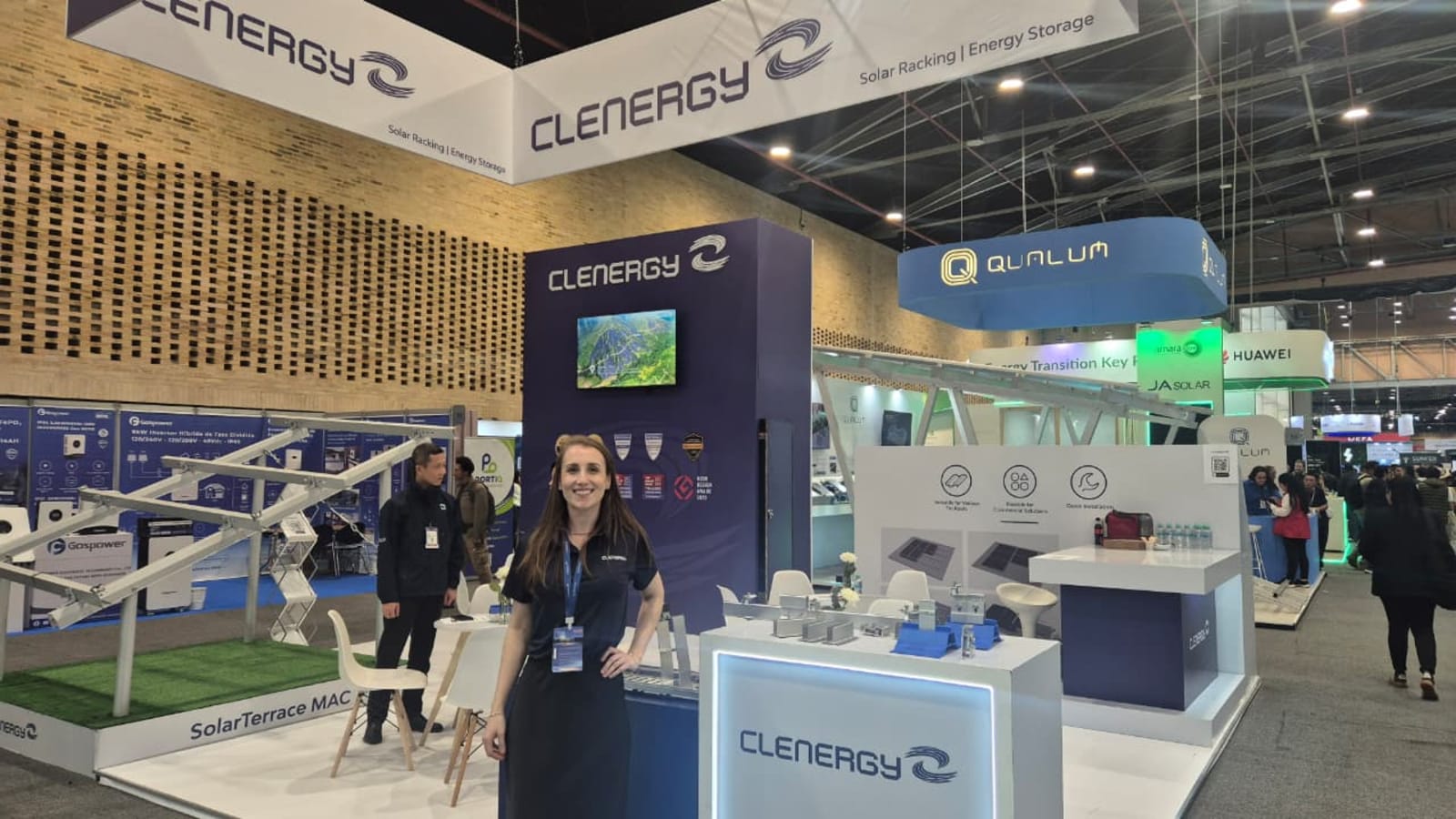
“It was a challenge because it was the first time we were selling trackers in Latin America, due to all the communication issues,” explained Emma Thorman , Business Development and Commercial Manager for Clenergy in Latin America, in a dialogue with Energía Estratégica during Expo Solar Colombia.
With over 50 GW of global experience in solar installations , the firm began to strengthen its Latin American presence at the end of 2025, with a strategy that combines new supplies, commercial alliances and local technical assistance.
The first results of this expansion also reached Guatemala, where the company supplied fixed structures for ground installations, and Nicaragua, with solutions for photovoltaic rooftops.
In Guatemala, solar power plants increased from 17 facilities and 127 MW of effective capacity at the end of 2024 to 21 plants and 196.4 MW in April 2025 , according to the Ministry of Energy and Mines. The growth of this technology opens up opportunities for equipment suppliers, both for centralized plants and smaller-scale projects.
Nicaragua, for its part, had 838.56 MW of renewable generation capacity projected for 2026 , including hydroelectric, geothermal, wind, biomass, and solar plants, according to the Ministry of Energy and Mines. In March, renewable sources accounted for 83% of electricity generation, although this figure represents all technologies combined and not just photovoltaics.
To support its expansion, Clenergy added sales staff in Brazil, Argentina and Mexico , as well as pre-sales and after-sales engineers based in Latin America, with the aim of strengthening support for developers, distributors and installers.
“Manufacturing has always been in China, and due to the time difference, coordination can sometimes be difficult. That's why we invested in staff in Latin America, to offer better service in Spanish and Portuguese,” Thorman explained.
The support also extends to project execution. In certain facilities, the manufacturer sends engineers to the site to oversee the receipt of materials and train the teams responsible for assembly.
Colombia: The rise of mini solar farms opens new business opportunities
What opportunities are opening up for structure manufacturers as the photovoltaic expansion begins to multiply smaller-scale projects? Colombia is among the markets where Clenergy seeks to gain ground, relying on its alliance with INGE SOLAR , a distributor of rooftop solutions, while exploring new agreements to market fixed ground-mounted systems.
This interest is supported by the sector's growth. According to the Mining and Energy Planning Unit (UPME), as of November 2, 2026, the country had 5,320.48 MW of solar and wind capacity in operation and testing , including distributed generation and self-generation. Meanwhile, the operator XM reported that 39 solar projects were connected to the National Interconnected System during the third quarter, representing a total of 698.2 MW of new power plants.
The expansion also extends to homes, businesses, and industries. As of May 2026, the Ministry of Mines and Energy had recorded 24,447 registered solar systems , of which more than 15,000 had been installed between 2024 and 2025.
This scenario leads Clenergy to look beyond large photovoltaic plants, with special attention to mini solar farms and commercial and industrial installations.
What do developers look for when choosing a photovoltaic structure?
Continue reading
“Besides price, they ask about the type of fixing and the available alternatives. We can offer circular posts or L-shaped profiles, foundations using drilling or concrete, and configurations of one or two posts,” the executive explained during Expo Solar Colombia.
To respond to that demand, the company introduced the AERI-N family, intended for conventional rooftop installations; ACENT , which allows mounting panels on flat roofs without perforations using a ballasted system; and Solar Tree Pod , designed for structures supported on concrete bases.
In on-site installations, their proposal includes Solar Terrace MAC , a fixed solution with corrosion resistance up to category C5, whose design can be adapted to wind, soil conditions and module configuration.
The diversity of applications now presents a commercial challenge: expanding the availability of these technologies in the country. Although Clenergy already has a distributor for roofing, it is still seeking partners to enable it to extend its reach to the ground-mounted structures segment.
Brazil, Mexico and Argentina: three markets to strengthen commercial presence
The installation of local equipment also responds to the size and evolution of the main photovoltaic markets in Latin America.
Brazil reached 77.3 GW of installed solar capacity by September 2026 , according to the Brazilian Photovoltaic Solar Energy Association (ABSOLAR), which counted more than 4.6 million distributed generation systems. The size of the market presents supply opportunities, but also requires competition in a sector with a consolidated network of manufacturers, distributors, and installers.
In Mexico, distributed generation added 447.47 MW during the first half of 2026 , reaching a cumulative total of 5,675.47 MW, according to statistics from the National Energy Commission published by the Mexican Photovoltaic Industry Association. Photovoltaic technology accounted for 99.54% of that capacity.
For its part, Argentina reached 3015 MW of installed solar capacity in September 2026 , according to data from CAMMESA, in a context where renewable generation covered 22.7% of the monthly electricity demand.
Although Clenergy did not specify contracts or supply volumes in these three countries, the addition of sales staff is a first step towards strengthening relationships with developers, installers and distributors.
The challenge will be to translate that presence into awarded projects and new agreements during 2027.
Supply times and new alliances: Clenergy's challenges for 2027
How can Latin American projects be delivered on time with manufacturing centralized in China? According to Thorman, standard production takes five to six weeks , plus another five to six weeks for shipping. For urgent orders, the manufacturing process can be reduced to three weeks, although logistical delays are beyond the manufacturer's control.
The service also includes on-site support. At certain facilities, Clenergy sends engineers to oversee the receipt of materials and train the assembly teams, a practice designed to facilitate the implementation of its technologies.
Looking ahead to 2027, the priority will be to expand the distributor network, incorporate technical and commercial staff and add benchmark projects , although the company has not yet communicated specific targets for installed power or revenue.
“Without alliances, no manufacturer can achieve high visibility or develop its full potential in each country,” Thorman said.
The goal will be to turn the initial regional experiences into long-term business relationships and gain market share in sectors with varying levels of photovoltaic development.
 By Emilia Lardizabal
 By Energía Estratégica
 By Matías Medinilla
 By Ailén Pedrotti