

Colombia's renewable energy expansion This has begun to open a new opportunity for energy storage. With nearly 3 GW of solar power in commercial operation , according to figures presented by developers during the Future Energy Summit (FES) Colombia 2026 , and a first long-term contract auction that incorporated almost 100 MW of batteries , the country is moving towards a scenario where the integration of new generation demands additional solutions for flexibility and grid capacity.
The shift is particularly relevant given the lag in renewable energy projects. During the meeting, participants recalled that Colombia had projected reaching 6.6 GW of solar power by 2026 , a goal that contrasts sharply with the actual operational capacity and the grid connection difficulties faced by developers.
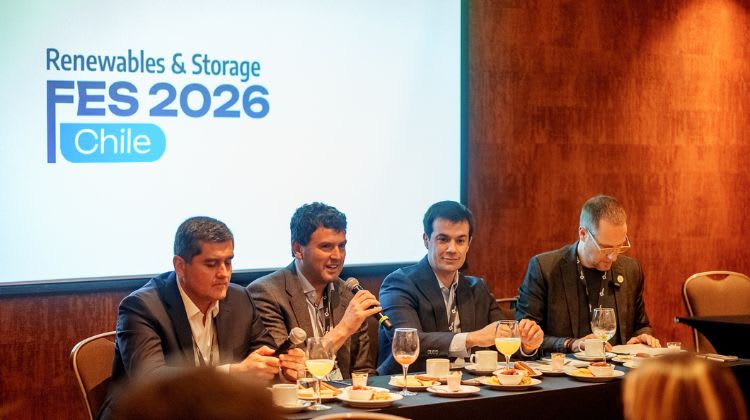
“I would think that by 2030 I hope it will be a market of several gigawatt-hours of storage already implemented , ” said Ricardo Garro, commercial director for Latin America at CATL, during the first panel of FES Colombia 2026.
In that scenario, CATL anticipated that local expansion would be affected by the implementation of commercial and regulatory mechanisms that would allow investors' interest to be transformed into concrete projects.
The projection was accompanied by a specific proposal: to call for tenders for independent batteries at critical points in the grid, capable of alleviating transmission restrictions, facilitating renewable integration and offering electricity services beyond the displacement of energy between time slots.
Despite this, the speaker anticipated the issue and didn't miss the opportunity to warn: “The battery is a solution. It shouldn't be thought of as something that needs to be incentivized so that it has to be incorporated by force.”
Standalone battery tenders: CATL's proposal for saturated nodes
The advancement of renewable energy generation also highlighted the limitations of Colombia's electrical infrastructure. According to a report by the Superintendency of Residential Public Services, 48.5% of the 390 restrictions identified in the system did not have an associated expansion project as of May 2026 , while 94.9% lacked projects underway according to the planned schedule.
The situation also affects the addition of new capacity. An analysis by the Stockholm Environment Institute (SEI) warned that 41% of generation projects with assigned connection capacity depend on transmission works still under construction , in a scenario where 55% of the expansion projects analyzed are experiencing delays.
In that context, Garro proposed using storage as a complementary alternative to conventional network expansion.
“The option of having the battery as a network asset, that is, an independent battery, already exists, but mechanisms need to be implemented where that battery can be adopted,” he explained.
The executive suggested that hiring stand-alone BESS systems at strategic points would allow them to respond to specific system constraints , without limiting their development to solar or wind power plants.
“With a tender for stand-alone projects at certain network points, that would significantly boost battery penetration,” he stated.
The proposal gains relevance after the approval of CREG Resolution 101 113 of 2026 , which established mechanisms to incorporate storage systems as network assets, independent facilities and next-generation hybrid resources.
The regulations allow independent BESSs to participate in the wholesale energy market and offer secondary frequency regulation, although they exclude their participation in Firm Energy Obligations of the reliability charge.
However, the CATL executive considered that it was still necessary to develop contracting mechanisms that would allow these capabilities to be used in places where the electrical infrastructure has limitations.
“What we really see is that it would bring a solution to be able to integrate even more renewables and solve the critical points of the network,” he said.
The manufacturer also identified opportunities to shift energy from daylight hours to nighttime periods, a need that could intensify as photovoltaic share increases.
From El Dorado airport to utility-scale projects: CATL seeks to expand Colombian storage
CATL's bet towards 2030 found its first commercial precedent at the El Dorado International Airport in Bogotá, where the manufacturer participated in an approximately 8 MWh storage project with a collaborator, as Garro explained during the meeting.
The executive confirmed that the system was already installed and operational, although he clarified that it responded to a different business model than large-scale independent storage.
Continue reading
The experience allowed us to identify a second business opportunity for Colombia: the incorporation of batteries in the facilities of large consumers who seek to manage their energy needs and transfer electricity between different time slots.
“We have several other clients who have been reviewing these cases of being able to transfer energy blocks, but from more of a consumption perspective. These are large consumers who are going to implement large projects,” he explained.
The company also identified opportunities in hybrid renewable projects. “It’s good to see that developers are already thinking about implementing batteries in all new projects, because that shows that these renewable projects can also bring more solutions,” Garro said.
According to figures shared during the panel, CATL has accumulated more than 6 GWh supplied in Latin America , a regional experience that the manufacturer seeks to leverage to support Colombian growth.
“The experience exists, and it’s simply a matter of trying to implement it. The technology, as we’ve discussed, is here now and will only get better,” he stated.
Nearly 100 MW awarded: the first step in a market that demands continuity
The first large-scale commercial signal came with the clean energy auction held in July 2026. The Ministry of Mines and Energy reported that the mechanism awarded 995 MW of solar and nearly 100 MW of storage , of which 270 MW of photovoltaic associated with batteries correspond to the first day of the auction with supply contracts for 15 years and a planned start date of 2030 .
However, for CATL, a single contract award does not guarantee the consolidation of a storage market. Garro questioned the erratic trajectory that had characterized the Colombian energy sector and the difficulties in sustaining investment expectations.
“It’s been like ups and downs, it’s very unpredictable, like it seems like it’s going to explode, but it never quite gets going,” he noted.
The executive recalled that Colombia had already experienced previous attempts to boost storage that failed to materialize and considered that the lack of stable regulations had hampered commercial planning. While acknowledging recent progress, he cautioned that definitions regarding remuneration and the continuity of the bidding processes were still lacking .
“It still needs to be implemented; it needs to have clear amounts for remuneration and to launch bidding processes that can be predictable over time,” he explained.
The recent award, therefore, represented a starting point, but did not completely resolve the uncertainties of manufacturers and developers.
“The process was just awarded in July, now for the first time with storage, but it's a one-time thing and we don't know when it will be offered again,” he said.
Technology has advanced, but Colombia still needs commercial signals
The Colombian discussion coincided with a broader transformation of the international storage industry.
During the Future Energy Summit Peru 2026, Garro explained that battery costs had decreased by more than 90% over the past decade and that new LFP generations had begun to improve variables such as degradation and system lifespan.
The executive had also warned about the elimination of the Chinese tax rebate scheduled for January 2027 , a tax change that could introduce temporary pressure on costs, although without reversing the long-term competitiveness trend.
In Colombia, however, the manufacturer focused its analysis on a different challenge: how to transform the availability of technology into investments backed by predictable income .
“To reach the point where it is truly evaluated as a solution, we have to rethink how the battery is viewed within the network scheme,” Garro stated.
In that regard, he noted that auxiliary services should gain ground within commercial mechanisms and that specific tenders could allow the incorporation of batteries where there are concrete operational needs.
With the first storage award, a new regulatory framework, and operational projects demonstrating various commercial applications, Colombia has some of the initial conditions to develop a larger-scale market .
However, Garro avoided committing to a specific figure for installed capacity and linked his expectations to the evolution of trade rules and investments.
“It’s hard to say how much, but I would think that by 2030 I hope it will be a market of several gigawatt-hours already implemented,” he concluded.
 By Emilia Lardizabal

 By Energía Estratégica

 By Ailén Pedrotti