
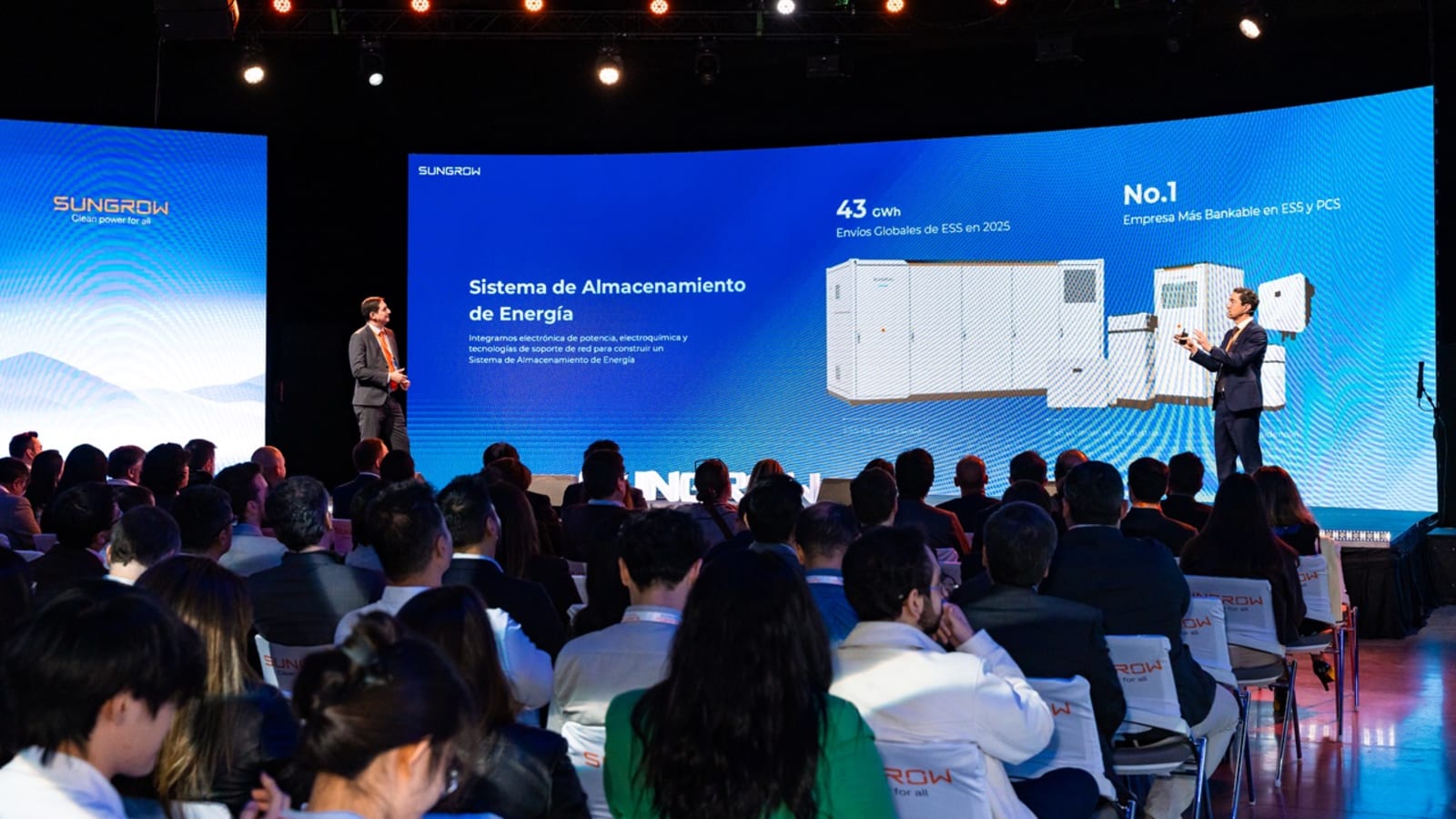
Sungrow has accumulated 6.5 GW of photovoltaic inverters distributed between Chile, Peru and Argentina, in addition to 13 GWh of contracted BESS systems in Latin America, excluding Brazil.
The figures were presented during the Summit South LATAM 2026, where the company introduced the SG510HX to the regional market, a 511.5 kW string inverter with which it seeks to reduce the levelized cost of energy (LCOE) by up to 1%.
The new solution, integrated with medium-voltage substations, increases power density by 28% and allows for savings of up to $180,000 in auxiliary equipment for 100 MW projects , in addition to shortening commissioning times by 15 days. Its development responds to a scenario of stagnation in photovoltaic cost reductions.
“As suppliers and manufacturers, we have developed our new product with the following key pillars in mind: reducing initial investment costs and increasing production. In other words, doing more with less,” stated Constanza Muñoz, Application Engineer at Sungrow .
In parallel, Luiz Fernando Biagini, Head of Sales Southern Cone, and Héctor Núñez , Head of Sales for Colombia, Mexico, Central America and the Caribbean, presented the company's commercial results.
Globally, the manufacturer has recorded more than 1 TW of photovoltaic inverters shipped in its history and 43 GWh of BESS solution shipments during 2025 .
“In the Southern Cone (excluding Brazil), there are 6.5 GW of investors, divided between Peru, Chile and Argentina. I believe that Chile, of course, carries almost all of this installed base, but every day there are countries that will add more, that will diversify their matrix,” they mentioned.
Of that number, approximately 5200 MW of PV inverters correspond to those contracted in Chile and 1.3 GW sold for solar projects in Peru .
“In addition, we have 13 GWh of BESS systems contracted in northern and southern LATAM, divided into Central America, Mexico, the Dominican Republic, Colombia, Chile, and Argentina, not counting Brazil,” they added.
What makes Sungrow's new solution different?
The SG510HX features 36 string inputs and a maximum power output of 511.5 kW , with dimensions similar to the SG350. To increase its capacity, Sungrow incorporated silicon carbide semiconductors, third-generation cooling, and new magnetic materials.
“We have switched to silicon carbide, which is much more efficient and reduces losses when switching from DC to AC,” explains the specialist.
The cooling system improves its efficiency by 15% , while the magnetic components reduce their losses by 25%. These modifications allow for a 28% increase in power density compared to the previous generation.
The architecture incorporates 1000 volts AC, longer strings, and power blocks exceeding 7.44 MW . This configuration reduces cabling requirements, mounting structures, and auxiliary components, directly impacting the initial investment.
In terms of safety, the SG510HX incorporates Smart Shutdown 3.0 , along with new lightning protection features under different operating conditions.
“We have also implemented a self-cleaning system for our inverters, so that fewer visits are needed to clean their filters. And finally, a change in our control system, developing the VSG, with which we try to emulate a synchronous generator to have greater flexibility and autonomy for the inverters,” Muñoz explained.
The functionality incorporates Grid-Forming capabilities, while AI-based optimization algorithms improve active power delivery in grid support scenarios.
Chile surpasses 11 GW BESS between operation, testing and construction
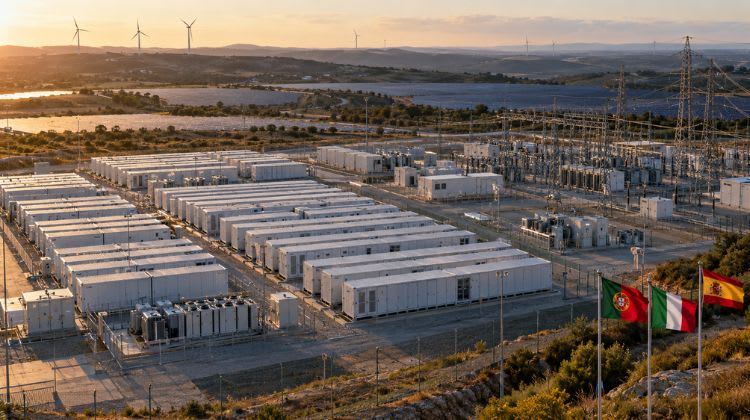
Sungrow's commercial growth coincides with the expansion of Chilean storage, a market where the Chilean Association of Renewable Energies and Storage (ACERA) registers 3125 MW BESS in operation, equivalent to 13,555 MWh of energy capacity , according to its statistics from September 2026.
These are in addition to 3,017 MW in the testing phase and 5,130 MW under construction , bringing the total power capacity across the three stages to 11,272 MW . However, only a portion is available for commercial dispatch.
During September, storage facilities injected 584 GWh into the grid, equivalent to 7.9% of the electricity injections recorded by technology , representing a year-on-year growth of 216.3%.
In this context, the bankability of BESS systems and best practices for managing large-scale installations were part of the meeting's technical agenda.
Sungrow also announced the creation of a division specializing in storage for artificial intelligence and data centers , aimed at integrating its battery solutions with the power supply needs of these infrastructures.
With this new segment, the manufacturer expands its activity beyond traditional renewable generation and grid-scale storage applications, while incorporating greater conversion, control and electrical support capabilities into its photovoltaic portfolio.
 By Energía Estratégica

 By Florencia Guglielmetti

 By Emilia Lardizabal