
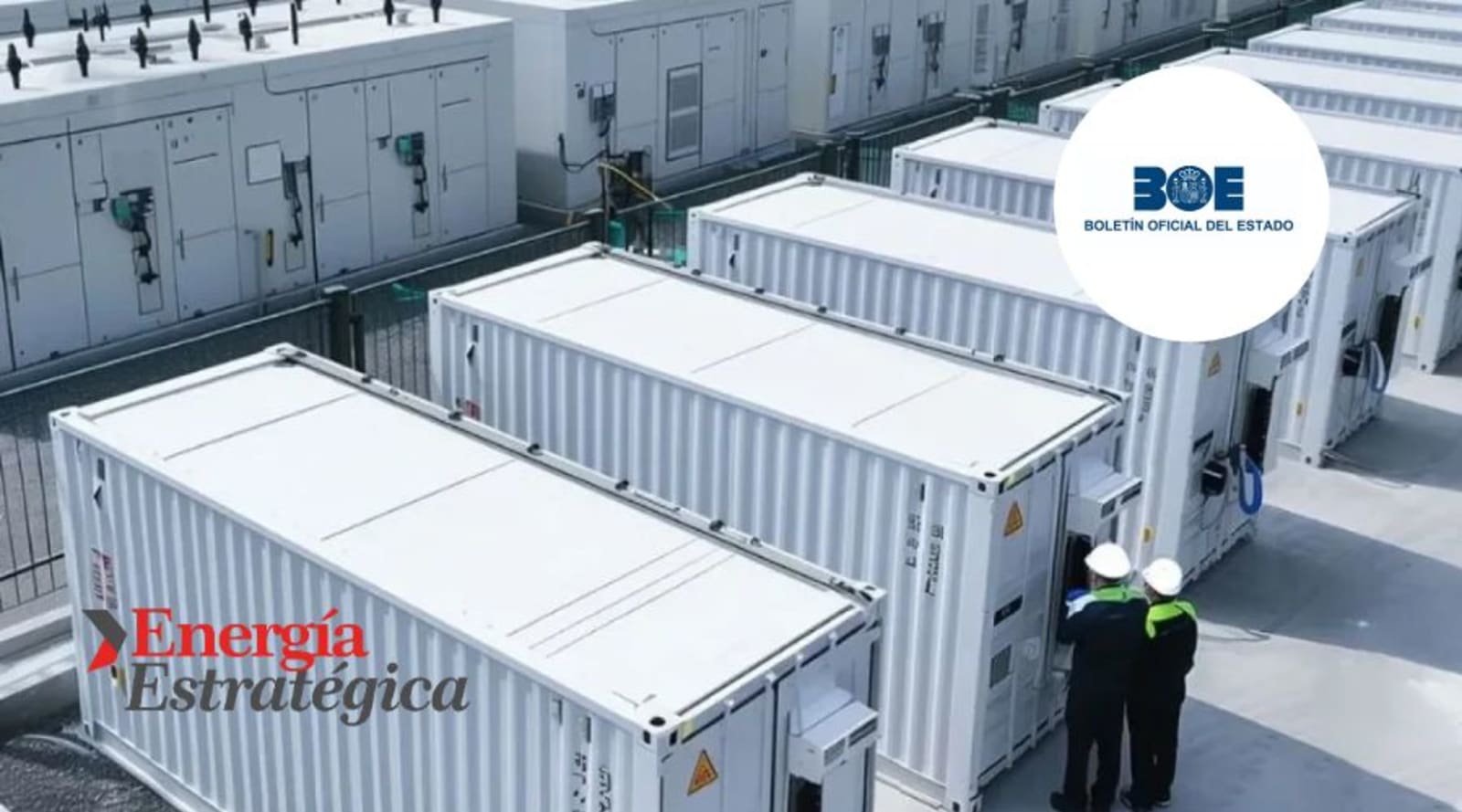
Energy storage gained ground in the Official State Gazette (BOE) during October. In a market marked by renewable energy curtailments and episodes of zero or negative prices, developers accelerated the incorporation of batteries into photovoltaic and wind power installations to increase their operational flexibility.
According to the Strategic Energy survey, at least 928.81 MW of battery storage were listed in files published during the month, although at different stages of processing.
Of that volume, 566.55 MW obtained prior administrative authorizations (AAP), construction authorizations (AAC) or both , while another 362.26 MW appeared in public information or environmental assessment procedures.
This movement contrasted sharply with the withdrawal of 699.92 MW of renewable energy projects , distributed between administrative rejections and withdrawals by their developers. To this total were added 184.23 MW of wind power projects in Galicia with unfavorable environmental impact statements, a situation requiring separate consideration.
Tagus 2 leads the expansion of storage
The largest single project was Tagus 2 HBESS , developed by Khons Sun Power in Toledo. The facility obtained AAP and AAC approvals to integrate 176.44 MW of batteries into a 224.4 MW photovoltaic plant.
The operation stood out for its scale: the power of the BESS system is equivalent to almost 79% of the associated photovoltaic capacity, a proportion that reflects the growing weight of storage within hybrid configurations.
Ignis also made progress with two projects totaling 90.07 MW of BESS . In Madrid, Azor Solar Storage received preliminary authorization to add 68.51 MW of batteries to a 64.02 MW photovoltaic plant. In Toledo, Mulhacén obtained the same permit to add 21.56 MW of BESS to a 70 MW solar installation.
The files represent different sizing strategies, from storage systems with lower power than the generating plant to configurations where the batteries exceed the nominal photovoltaic capacity.
In Castile and León, Solaria obtained prior and construction permits for two virtually identical modules: Santiz I, in Salamanca, and Castor, in Toledo. Each project incorporates 19.99 MW of BESS alongside a 49.99 MW photovoltaic plant, totaling 39.98 MW of new storage capacity.
Opdenergy standardizes its batteries in Aragon
The repetition of designs was one of the most visible patterns in October. Opdenergy obtained the AAP and AAC for three 26.74 MW BESS projects , associated with existing solar installations in Aragon.
Los Arcos and Montesol, in Teruel, and Los Belos, in Zaragoza, have a combined authorized storage capacity of 80.22 MW .
The company also appeared in the environmental procedure for the Plana de la Pena 1 and 2 developments, in Zaragoza, with another 53.48 MW BESS , distributed in two modules of 26.74 MW.
In total, the five systems represent 133.7 MW of batteries , although only 80.22 MW have the energy authorizations indicated in the survey.
The repeated configuration allows for the identification of a standardization strategy that can facilitate the replication of engineering and equipment between facilities, although the records do not allow for quantifying investment or construction savings.
Aragon also concentrated Iberdrola 's bet, which obtained the AAP and the AAC to incorporate 27.64 MW BESS into its Teruel photovoltaic plant, of 42.56 MW.
Naturgy, Statkraft and Enel expand the hybridization map
In Andalusia, Naturgy obtained the prior and construction authorizations for Tabernas I and II , two BESS systems of 19.8 MW each, associated with photovoltaic plants of 48.8 MW in Almería.
The company also put Los Pedreros , in Albacete, out to public consultation, a project that proposes to incorporate 25.08 MW of batteries and a 0.4 MW flywheel into a 49.95 MW wind farm.
The combination introduces a technological variant within hybridization strategies, by integrating electrochemical storage and an inertia system.
In Zamora, Statkraft submitted the Ribadelago Hybrid and Sanabria Hybrid projects to public information, with 69.65 MW BESS associated with 80.85 MW photovoltaics .
For its part, Enel Green Power obtained the AAP and AAC for Tesouro Storage, in A Coruña, which will incorporate 17.5 MW of batteries into a 50.4 MW wind farm.
The expansion also extended to stand-alone storage. In Castellón, Soner Picasso obtained prior administrative authorization for BESS Cuevas, a 55.18 MW facility , without an associated renewable energy installation in the mapping.
The data shows that battery storage is no longer limited to solar farms: it now extends to wind power projects, hybrid systems, and stand-alone developments. Its profitability will depend on operational capabilities, available revenue, and investment costs, as well as the ability to shift energy to off-peak hours.
The BOE screening: almost 700 MW rejected or abandoned
While storage progressed, October saw 265.2 MW rejected by the Administration and 434.72 MW withdrawn through withdrawals , without duplicating shared capacity between files.
Continue reading
Castilla y León accounted for the five identified rejections , which affected wind power projects and hybrid photovoltaic modules.
In Soria, the Administration rejected three solar developments associated with existing wind farms: Ventosa del Ducado , by Iberdrola, with 43.89 MW; Bordecorex Norte , by Biovent Energía, with 44.20 MW; and Los Campillos , also linked to Iberdrola, with 33.83 MW of photovoltaics.
The three projects totaled 121.92 MW of additional solar capacity that was rejected , without implying the withdrawal of the original wind farms with which they were intended to be hybridized.
In León, Cefiro Holdco received rejection notices for El Páramo, with 92.4 MW, and Ampliación El Páramo, with 50.88 MW. Both facilities accumulated 143.28 MW of wind power .
Galicia has faced another environmental challenge. The Alamoceiros, Chamarrapio, and Xubrintas wind farms in Pontevedra received unfavorable environmental impact statements. Their capacities of 68.49 MW, 53.79 MW, and 61.95 MW, respectively, total 184.23 MW .
These latter cases are not included in the count of rejections, since an unfavorable environmental declaration does not in itself equate to a resolution rejecting the energy authorization.
Greenalia, Solaria and Enel are retiring more than 430 MW
The withdrawals showed a different dynamic. In Galicia, Greenalia formalized the withdrawal of two wind power projects: Mistral , with a capacity of 106.4 MW, and Nordés , with a capacity of 67.2 MW.
Both parks represented 173.6 MW of wind capacity voluntarily withdrawn .
In Zamora, Solaria decided not to continue with Valentina Solar, of 60.38 MW, and with the Valentina wind farm, of 90 MW, planned to be hybridized with that photovoltaic installation.
The withdrawal of the complex thus affected 150.38 MW of solar and wind power , counting the photovoltaic plant that appears in both files only once.
They were joined by Enel Green Power , which withdrew from FV El Clavel, a 110.74 MW photovoltaic plant in Albacete.
Although the withdrawals may be due to technical, financial or strategic reviews, the resolutions analyzed do not allow us to establish a common reason for the decisions of these promoters.
The contrast is especially visible in Solaria and Enel, which during the same month registered administrative progress in storage and withdrawals from other renewable developments.
Toledo and the plateau concentrate the pressure on the territory
The energy expansion was also reflected in the procedures for declaring public utility (DUP) and drawing up records prior to occupation.
Toledo brought together some of the main photovoltaic files, headed by Ebisu II , promoted by Envatios, of 164.84 MW , whose DUP project was submitted to public information.
The province also saw three declarations of public utility granted to projects linked to EDP Renovables : Marcote, with 23.36 MW; Morata de Tajuña 3, with 42 MW; and Tobizar, with 22.8 MW. Together they totaled 88.16 MW of photovoltaic capacity .
EDP also initiated the permitting process for Los Romeros and Los Callejones, two 62.7 MW facilities located between Toledo and Madrid. This package represents an additional 125.4 MW currently under public consultation for prior authorization and environmental assessment.
In Guadalajara, the BOE published preliminary proceedings related to Bichero Solar, Bruma Solar, Montería Solar and Ojeador Solar , four projects totaling 243.08 MW of photovoltaic capacity .
The procedural pressure extended to Madrid with Quilla Solar , of 51.04 MW, and Varadero Solar , of 47.71 MW, both linked to land occupation procedures.
These procedures show the territorial dimension of the renewable portfolio, although they must be distinguished from the authorizations to build: a DUP or the drawing up of preliminary records does not equate to the entry into operation of an installation.
October consolidates two speeds in the renewable portfolio
The BOE report reveals a shift in development priorities. On the one hand, 928.81 MW of BESS ( Basic Energy Storage and Storage) projects appeared in administrative procedures, with large-scale projects and standardized modules that utilize existing renewable infrastructure.
On the other hand, 699.92 MW of renewables were dismissed or withdrawn , while another 184.23 MW of wind power received unfavorable environmental declarations.
The difference does not imply that batteries are directly replacing renewable energy plants, but rather that the ability to manage when electricity is delivered is becoming more important for new investment models .

 By Emilia Lardizabal
 By Energía Estratégica