

Italy has taken another step forward in the development of floating offshore wind energy following the publication, on October 29, of the Provvedimento Unico Ambientale (PUA) for 7SeasMed, a 250 MW wind farm planned off the coast of Sicily. This resolution represents a regulatory step for an initiative that aims to become one of the first commercial installations of this technology in the Mediterranean.
The project, led by Copenhagen Offshore Partners (COP) , has thus passed another administrative hurdle, although its implementation remains contingent on the finalization of Italy's incentive scheme for innovative renewable energy sources. Specifically, the sector is awaiting the revision of Decree FER2, which must be submitted to the European Commission before auctions can be held under the new conditions.
The recently published environmental authorization should not be confused with the favorable environmental impact assessment obtained by 7SeasMed in March 2024. That resolution made the initiative the first Italian floating wind installation to pass that assessment, while the October 2026 publication corresponds to another stage of its processing.
With a planned capacity of 250 MW, the park is equivalent to approximately 11.9% of Italy's target of 2.1 GW of offshore wind by 2030, as outlined in the planning framework mentioned by the sector.
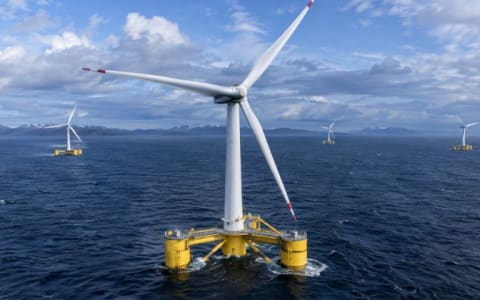
The facility will be located approximately 35 kilometers from Marsala, in the Strait of Sicily. According to the developer's technical information, it will consist of 21 floating wind turbines of 12 MW each, connected to the national electricity grid near the town.
The initiative is part of Divento, an alliance comprised of Copenhagen Infrastructure Partners, GreenIT (a joint venture between Plenitude and CDP Equity), 7 Seas Wind Power, and NiceTechnology. The consortium has a portfolio of nearly 3 GW of floating offshore wind projects located in Sicily, Sardinia, and Lazio.
According to forecasts released by Divento, 7SeasMed plans to begin construction in 2028 and generate approximately 1,000 regional jobs during the construction phase. These projections remain subject to pending permits and the conditions necessary to finalize the investment.
Continue reading
On the technological front, the association reached an agreement in March 2025 with Saipem to study the application of its STAR 1 solution, based on semi-submersible floating foundations, both in 7SeasMed and in the Ichnusa project, in Sardinia.
The FER2 decree and the auctions, the main pending definitions
Although 7SeasMed is progressing administratively, the review of the FER2 decree is one of the main outstanding issues for converting the Italian offshore wind portfolio into executable projects.
The mechanism includes competitive procedures with state support for renewable technologies that require specific financing conditions. However, the original parameters raised questions about their suitability to the costs and characteristics of floating installations.
Among the modifications analyzed by the Italian Ministry of Environment and Energy Security (MASE) are the differentiation between fixed and floating foundation projects, indexation mechanisms against inflation, and changes in the economic criteria of the auctions.
The technical proposals disseminated during the process included differentiated reference tariffs of €160 per MWh for fixed installations and €185 per MWh for floating projects. These amounts correspond to the conditions proposed during the review and should not be interpreted as awarded prices.
The Italian Offshore Renewable Energy Association (AERO) is urging authorities to expedite the process. Its president, Fulvio Mamone Capria, called on Minister Gilberto Pichetto Fratin on October 9th to finalize the regulatory amendment and submit the text to Brussels.
In an official statement, the executive raises the need to finalize the FER2 review to enable the tenders and demands, verbatim, "Servono segnali chiari" (I need clear signals), referring to the signals he considers necessary to give certainty to investors.
AERO's position responds to the need to establish an auction schedule that allows developers to define commitments to investment, industrial contracting and construction.
 By Emilia Lardizabal

 By Energía Estratégica
 By Ailén Pedrotti