

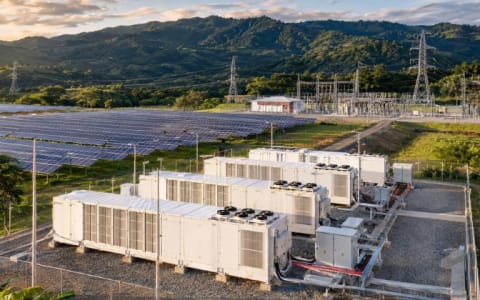
With 3125 MW of batteries in operation, another 3017 MW in testing and 5130 MW under construction , Chile faces new challenges to sustain the profitability of storage, in a market marked by the rapid incorporation of BESS projects and the limited growth of electricity demand.
“There are so many batteries that the arbitrage is being diluted and each additional storage unit dilutes that income,” warned Alfredo Solar , Regional Manager Chile and Southern Cone of Atlas Renewable Energy, during Future Energy Summit (FES) Chile 2026 .
The executive explained that the systems aim to store electricity during peak solar generation hours, when prices approach zero, to later sell it at prices exceeding USD 100/MWh. However, he noted that discharges are already occurring at virtually zero prices.
From DNV, Mario Acevedo Bilbao , Country and Market Manager, pointed out: “You look at the financial model you saw two years ago and it is very different now.”

The specialist noted that banks are already requesting sensitivity scenarios that consider a greater incorporation of BESS capacity, even above the projections initially used.
More batteries and new financing options
According to September statistics from the Chilean Association of Renewable Energies and Storage (ACERA) , projects in operation, testing and construction total 11272 MW and 49413 MWh , although not all of that capacity is commercially available.
Operating capacity has practically doubled compared to the 1575 MW recorded at the end of 2025. In addition, the portfolio includes environmentally approved initiatives and others under evaluation, which could considerably expand supply during the coming years.
Solar compared this evolution with the expansion previously experienced by photovoltaic generation in Chile, when the increase in capacity resulted in spills, lower incomes and economic difficulties for certain developers.
“It is worrying that storage in Chile continues to grow or become over-installed beyond what is reasonable,” he said.
In addition to arbitrage, it identified pressures on capacity payments, another source of remuneration that is part of business models.
At the same time, Acevedo warned that the speed of execution of the developments makes it difficult to anticipate how the electrical system will evolve in relatively short periods.
He explained that some installations can be completed in approximately six months, while certain regulatory and operational adjustments require considerably longer timeframes.
“Banks are also asking for things like, let’s add an extra 2 GW, let’s lower another one by so much, what happens if these conditions change?” he exemplified.
The DNV representative commented that these simulations are part of the risk assessments required for new investments and refinancing operations, given possible variations in marginal costs and expected revenues.
The office and the remuneration, under scrutiny
During September, energy storage systems injected 584 GWh into the National Electric System , equivalent to 7.9% of the total injections by technology, according to ACERA. This volume represented a year-on-year increase of 216.3%.
In parallel, Solar called for accelerating the implementation of mechanisms that incorporate the opportunity cost in battery scheduling , as contemplated in Chilean electricity regulations.
The executive explained that offloading decisions should consider the value of conserving energy for later, rather than concentrating operations at certain times and causing further price drops.
“Two years is too long a time,” he questioned, referring to the implementation timeframe for operational tools mentioned during the meeting.
He also warned that these assets are being used to meet system needs, such as sudden variations in solar generation, without necessarily receiving compensation equivalent to the service provided.
“If they are using it as a complementary service, let’s be clear and say: this is a complementary service,” he argued.
Continue reading
The proposal comes as Chile continues to face difficulties in utilizing all of its renewable energy generation. Between January and August 2026 , 3,014 GWh of energy cuts were recorded, compared to 3,125 GWh in the same period of the previous year, according to ACERA.
Acevedo agreed with the need to improve remuneration schemes and mentioned alternatives used in other markets, including mechanisms based on offers.
“The point is to, in addition to talking, execute,” he emphasized.
The specialist recalled that Chile has already faced differences between the expansion times of photovoltaic generation and the development of transmission infrastructure, so he considered it necessary to avoid new discrepancies with the growth of batteries.
Contracts, cybersecurity, and guarantees to sustain investments
Solar identified long-term power purchase agreements (PPAs) as a fundamental tool to support new developments.
Atlas has approximately 1000 MW of four-hour storage capacity in Chile and an equivalent solar capacity, associated with agreements with large mining and industrial consumers, including Antofagasta Minerals, Codelco and CAP.
The executive also distinguished between hybrid projects, which can be supplied through self-generation, and independent systems, whose load depends on electricity purchases in the market or specific supply contracts.
“The decision regarding the first storage units was quite obvious, and the investment decision for those that are coming now, I believe, requires being much more careful, both for equity and debt, and for the banks that will be providing the financing,” he said.
For his part, Acevedo included cybersecurity among the factors that are beginning to acquire greater relevance for financial entities .
“We have already had some cyberattacks that have occurred here in Chile,” he stated, noting that both DNV and the banks are deepening their assessments on this matter.
He also noted differences in the technical studies requested by developers, especially regarding hazard identification, operability analysis, and risk scenario assessment.
According to the DNV representative, these verifications are relevant because the facilities must maintain their performance for periods that can extend for 20 years or more.
Data centers, an opportunity to boost demand
The National Energy Commission (CNE) projects that Chile's regulated electricity consumption will reach 31,397 GWh in 2026 , with an average growth rate of 1.2% per year over the next five years.
The Final Bidding Report 2026, published on October 1, also determined that the surplus of contracted energy allows the needs foreseen between 2026 and 2028 to be covered without additional short-term calls for bids.
“Chile has a demand that has practically not grown for many years,” said Solar, who considered that a large part of the renewable investments responded to the replacement of fossil fuel generation and not to a significant increase in energy needs.
In that context, he identified large-scale data centers as potential drivers of new electricity contracts.
“If 10, 20, or 30 large-scale data centers come to Chile, they will have a transformational effect on demand,” he projected.
Acevedo revealed that DNV is already participating in financial evaluation processes related to this type of infrastructure and stressed that its installation will depend on competitive conditions compared to other markets.
The specialist also mentioned the electrification of other energy sources as an alternative to expand demand, although he anticipated that its effects might materialize more slowly.
In that sense, the CNE's projections anticipate that consumption associated with electromobility will increase from 179 GWh in 2026 to 11,000 GWh in 2046, although much of that increase would be concentrated in the long term.
“Ultimately, public policy provides the foundation for investment,” Acevedo noted, highlighting the importance of regulatory stability, environmental permits, and financing conditions.

 By Emilia Lardizabal
 By Florencia Guglielmetti