

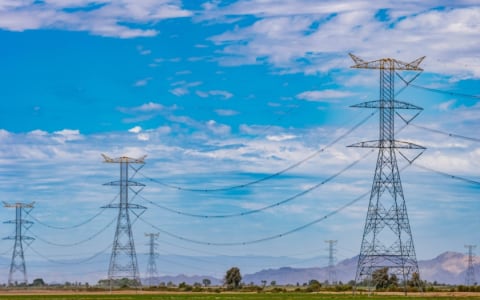
The Kimal-Lo Aguirre project , Chile's first high-voltage direct current (HVDC) electric transmission line, has reached an overall progress of over 55%, compared to 22% physical execution , as confirmed by Carola Venegas, Sustainability and Public Affairs Manager of Conexión Kimal-Lo Aguirre, during the Future Energy Summit (FES) Chile.
The infrastructure project spans 1,346 kilometers and has a transmission capacity of 3,000 MW , running from the Kimal substation in María Elena, Antofagasta Region, to Lo Aguirre in Pudahuel, Metropolitan Region. It will traverse five regions and 28 municipalities, with the aim of transporting surplus renewable energy generation from the north to the country's main consumption centers.
The design comprises more than 2,600 towers and two converter stations, which will transform alternating current electricity to direct current for long-distance transport and back to alternating current for its incorporation into the National Electric System (SEN).
“Today we have achieved several milestones and are closely monitoring the project, which is more than 55% complete. However, I don't like to talk about that 55% because I like the work itself. And in reality, the physical execution is over 22%,” he explained.
The first indicator includes technical studies, administrative background, purchase orders and other commitments supervised by the National Electric Coordinator, while the second counts foundations, structures and construction execution.
Despite this difference, the project is slightly ahead of schedule , with operations expected to begin on May 7, 2029. However, it was clarified that this alone does not guarantee that the final deadline will be met.
Currently, around 200 structures are under construction , mainly in Antofagasta and Atacama, where the availability of state-owned land allowed for faster progress in the processing of electrical concessions.
In September , the company reported a construction progress of 20.35% , with work underway on 179 structures. At that time, earthmoving had reached 99% completion at the Kimal converter station platform and 37% at Lo Aguirre.
The challenge of permits to increase staffing
The processing of authorizations is one of the main conditions for enabling new construction fronts and maintaining the execution schedule.
“To reach the year 2029, we currently have around 1,500 workers; we need to quickly reach a peak of 7,000. And for those 7,000 to be activated, we still need around 880 permits to be approved,” Venegas warned.
The project requires processing approximately 5,000 permits from various authorities, including sectoral procedures related to forestry, industry, and health. However, during the meeting, the executive did not specify what proportion of the approximately 880 permits mentioned corresponds to each category.
Sectoral forestry environmental permits represent one of the most complex fronts, especially for advancing in sections 4, 5 and 6 of the line.
Continue reading
In addition, there is the issue of land management. According to Venegas, the route involves approximately 1,000 landowners , of whom more than 500 already have registered voluntary electrical easements.
The greatest challenges are concentrated in Coquimbo, Valparaíso, and the Metropolitan Region, where the presence of private land requires additional negotiation and electricity concession processes. The company expects to complete the remaining concessions during 2027.
In environmental matters, Kimal-Lo Aguirre obtained its Environmental Qualification Resolution (RCA) in November 2025, after a 735-day evaluation. The process involved 117 state agencies and concluded with 103 environmental commitments and 32 mitigation, compensation, and recovery measures .
Its approval allowed the works to begin, although the execution remains subject to compliance with environmental obligations and obtaining the corresponding sectoral authorizations.
The actual investment exceeds USD 2 billion: how is Kimal-Lo Aguirre financed?
Beyond the construction progress, Venegas revealed that the actual investment in the project exceeds USD 2 billion .
“ This benchmark investment is $1.481 billion and is what, in essence, allows the project to establish its future cash flow, its profitability ,” he explained.
The difference is due to the fact that the awarded value constitutes the basis for calculating the regulated remuneration of the infrastructure over a period of 20 years, while the actual investment reflects the resources needed to materialize the development.
He explained that the financial structure required approximately two years of preparation, under Chilean and New York legislation, with the participation of a syndicate of international banks, including Santander and Bank of China, and specialized advisors.
“ The financing agreements are already finalized ,” confirmed the representative of Conexión Kimal-Lo Aguirre.
In September, the company had already reported USD 422 million disbursed, equivalent to 28.51% of the investment budget used in that monitoring , and 95% of the works budget awarded to suppliers.
The financial structuring included an independent technical assessment by Black & Veatch and environmental, social, safety and governance due diligence processes, aligned with the performance standards of the International Finance Corporation (IFC).
The next disbursements will be linked to the fulfillment of commitments and the construction progress, so obtaining permits and enabling new fronts will continue to be determining factors for executing the project.
With financial agreements finalized and construction slightly advanced, Kimal-Lo Aguirre now faces the challenge of converting that support into physical execution , accelerating the processing of authorizations and expanding the necessary staffing to meet its commissioning deadline of May 2029.
 By Energía Estratégica

 By Ailén Pedrotti

 By Emilia Lardizabal