


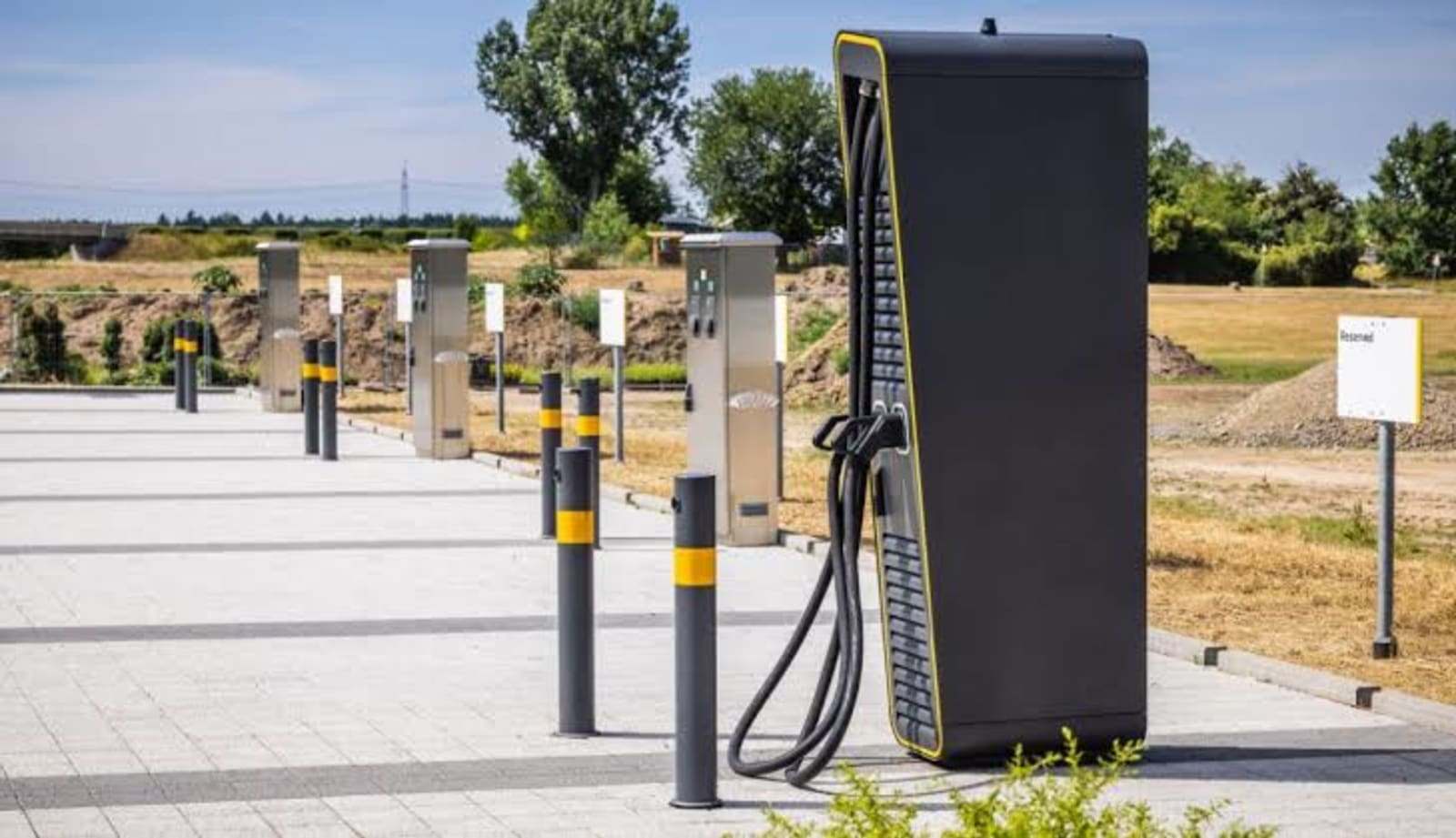
Spain introduces a regulatory change that could revive fast and ultra-fast charging projects that until now have faced a barrier not in the availability of power, but in the difficulty of physically bringing it from the grid to the chargers.
Royal Decree-Law 41/2026 , published on November 21 in the Official State Gazette, modifies the Electricity Sector Law and reduces from 3,000 kW to 250 kW the threshold from which electrical infrastructures linked to charging stations can be subject to the authorization regime provided for by the regulation and be declared of public utility.
The change affects elements such as network access and extensions, transformer and switching stations, and especially the lines connecting the supply point to the substation. In practice, it opens up a legal tool for much smaller-scale projects, allowing them to resort to eminent domain and the imposition of easements when necessary to carry out the connection.
From 3 MW to 250 kW to unlock easements
Until now, this possibility was reserved for infrastructures associated with stations of more than 3 MW, a level far higher than that of most of the hubs being deployed in Spain.
With the new wording, infrastructure corresponding to power stations with a capacity exceeding 250 kW may be declared of public utility for the purposes of expropriating the necessary properties and rights or establishing easements. The Royal Decree-Law itself justifies the change by noting that a significant portion of the new stations required by European regulations will exceed this power level.
The impact can be especially significant in projects where electrical capacity is available, but the connection must cross land belonging to third parties. A 600 kW hub, for example, now falls within a framework that allows this mechanism to be used to resolve such blockages, something that was not possible with the previous 3 MW threshold.
The modification also aligns with AFIR's requirements. European regulations mandate charging stations of at least 400 kW every 60 kilometers on the TEN-T core network , a power output that will increase to 600 kW from 2027, while even higher levels are required for heavy goods vehicles.
The BOE itself explicitly links both issues and acknowledges that much of the infrastructure that will need to be deployed in the coming years will exceed 250 kW.
A second path for projects that do not require public utility
The change does not mean that all projects exceeding 250 kW must undergo a full administrative procedure. The Royal Decree-Law also introduces a simplified process for infrastructure projects that do not require a declaration of public utility and are not subject to environmental impact assessment .
In such cases, the facilities may be exempt from prior administrative authorization for construction and operation. Before starting construction, the developer must submit a construction project plan and a declaration of responsibility certifying compliance with industrial quality and safety regulations, as well as justifying that the activity does not fall within the scope of the Environmental Assessment Law.
Royal Decree 1955/2000 specifies this exemption for power supply infrastructure for stations up to 3,000 kW . To qualify for this exemption, a report justifying the absence of an environmental impact assessment and an express waiver of the right to request a declaration of public utility must also be submitted.
In this way, the reform opens two different paths depending on the characteristics of the project. When it is necessary to cross third-party land, developers of hubs larger than 250 kW will be able to access public utility services; when there is no such problem or environmental impact to assess, they will be able to proceed through a simpler procedure.

 By Florencia Guglielmetti
 By Energía Estratégica

 By Matías Medinilla
 By Ailén Pedrotti