

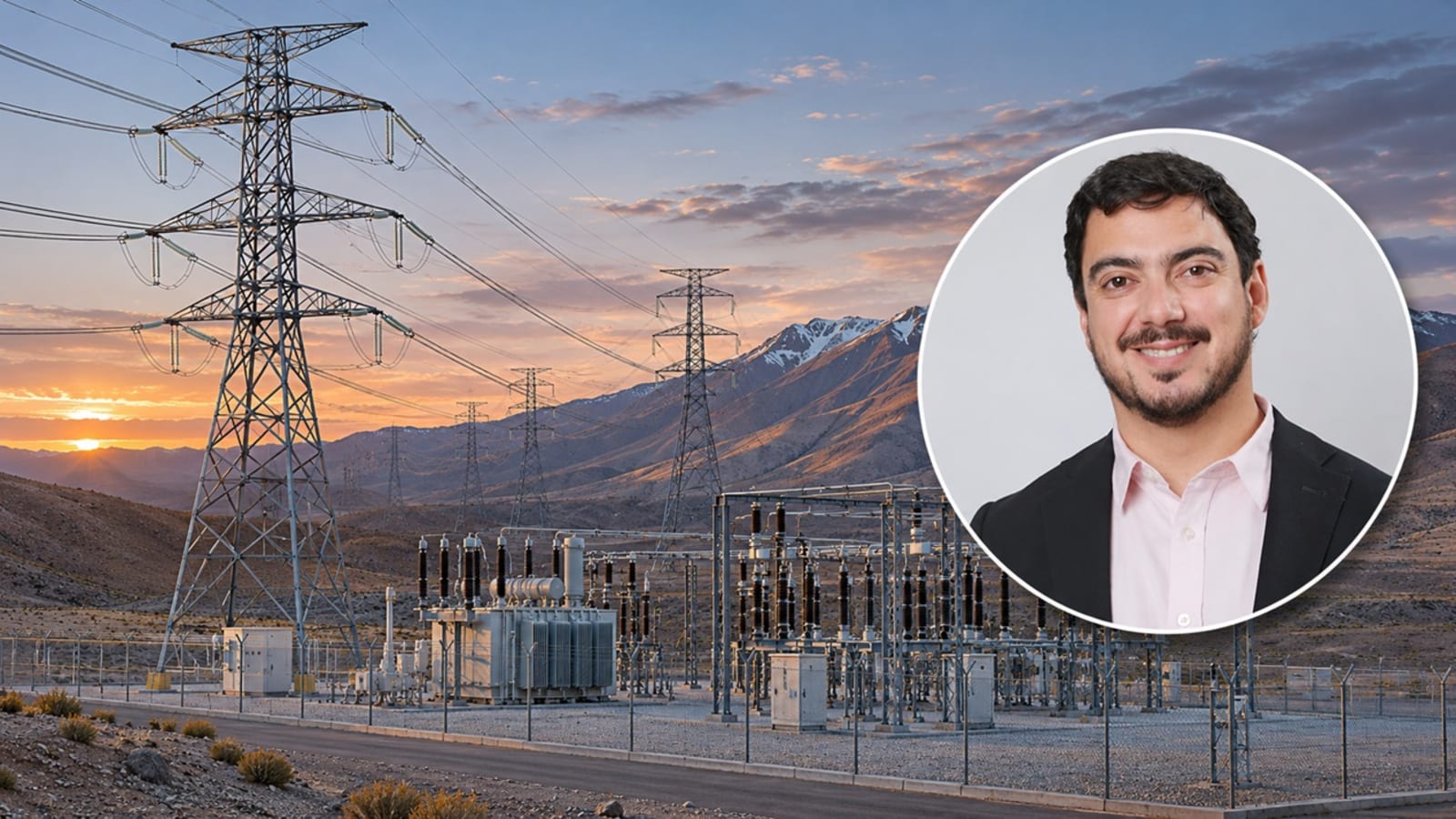
The economic evaluation of new transmission works in Chile does not sufficiently recognize the benefits associated with reducing renewable energy spills, security of supply and network resilience, according to Transmisoras de Chile, which is demanding a change in the criteria used to define investments in the electricity system.
“ We also propose that the works be evaluated as a portfolio, because there are projects that are not justified on their own, but are justified as a whole ,” said Javier Tapia , executive director of the association, in dialogue with Energía Estratégica .
The proposal seeks to ensure that the suitability of an infrastructure does not depend primarily on the operational cost savings it produces individually, but also considers its effects on other facilities and its contribution to energy development.
For renewable energy companies, this change would allow for a more explicit incorporation of the value of expanding transport capacity in areas where network restrictions make it difficult to take advantage of available generation.
However, the union representative believes that the discussion should go beyond modifying economic indicators.
“We need planning that not only responds to current demand, but also considers how we want the electrical system to evolve in the next ten or twenty years,” he said.
The complaint comes at a time when Chile is seeking to accelerate the development of infrastructure whose processes can take between seven and ten years from planning to commissioning, as acknowledged by the National Energy Commission (CNE) in July 2026.
The difficulties in defining which projects should be incorporated into the planning were reflected in the transmission expansion process corresponding to 2025.
At that point, Colbún questioned the exclusion of the expansion of the Llullaillaco substation , linked to the Jadresic area, in the north of the country.
The company requested that a technical and economic evaluation of the initiative be carried out or that the regulatory grounds for its postponement be made explicit.
Transelec also submitted observations regarding solutions planned for the Metropolitan Region and the Jadresic area, while AES Andes objected to decisions related to expansion projects in the latter area.
The CNE rejected the proposals, considering that the areas involved present multiple infrastructure alternatives that must be analyzed together before committing to new developments.
In particular, the regulator identified a high concentration of generation projects, congestion in electrical corridors, and operational interactions that require studying structural solutions.
Their position was that incorporating isolated initiatives, without comparing their effects on the network as a whole, could lead to redundant or economically inefficient investments.
The postponements, therefore, were not attributed exclusively to the individual profitability of the projects, but to the need to determine which combinations offer the best results for the system.
Regarding the difficulties faced by the projects, Tapia warned that the obstacles are not concentrated solely in the evaluation stage.
“We have planning difficulties, bidding processes that don't always come to fruition, and obstacles during the execution of the works,” he noted.
The change that Transmitters seek to promote
Although Chilean regulations already include joint evaluations of complementary or substitute alternatives, the industry considers it necessary to improve the methodologies used to assess their economic and operational contribution.
Among the aspects it proposes to incorporate are continuity of supply, competition, decarbonization, and the reduction of renewable energy wasted due to transmission restrictions.
Tapia also proposes introducing tools to consider different future scenarios, especially given the uncertainty associated with expanding demand and technological changes.
“ Today, projects are chosen that are repeated in several scenarios analyzed separately. The evidence indicates that the cost of falling short is systematically higher than that of anticipating things a little ,” he explained.
The argument becomes relevant due to the time required to complete a large-scale line or substation.
During that period, the conditions that led to its planning may change, particularly with the addition of storage systems, new renewable power plants, and consumption associated with mining, industrial electrification, or data centers.
In this regard, the executive warned about the consequences of waiting for those needs to materialize before starting infrastructure development.
“ If we wait until new demands for electrification, mining, or data centers materialize before we start planning the networks, we’re going to be late ,” he said.
A portfolio of USD 319 million and new works towards 2029
The latest Expansion Plan 2025 published by the CNE includes 23 projects worth approximately USD 319 million , aimed at increasing the capacity, security and resilience of the National Electric System.
Of the total, five initiatives correspond to national transmission, with investments close to USD 95.8 million, while another 18 belong to zonal infrastructure, for around USD 223 million.
The portfolio includes six new facilities and 17 expansions of existing assets.
Among the planned developments is the new Teodoro Schmidt substation and its connection via a 110 kV line to Río Toltén, in La Araucanía, with a reference budget of USD 50.4 million.
The incorporation of a STATCOM reactive compensator at the 500 kV Polpaico substation is also planned, for approximately USD 38 million.
According to the official schedule, new construction could begin during the first half of 2028, while expansions would begin in the first half of 2029.
These commitments are in addition to the awarding of 19 new projects for USD 508 million , announced by the National Electric Coordinator on November 16.
The initiatives correspond to two tenders developed during 2026 and constitute a separate portfolio from the 2025 Expansion Plan.
These include new 500 kV installations between Maule and Ñuble, as well as substations and reinforcements intended to meet the growth in demand in different regions.
Changes that could be implemented before the reform
According to Transmisoras de Chile, some of the requested modifications could be implemented without waiting for the approval of the bill that the Government plans to promote during 2027.
Tapia explained that current regulations already allow for justifying investments through benefits other than operational savings, but that precise methodological procedures are lacking to apply these tools systematically.
“ There are opportunities for improvement that do not necessarily require waiting for a legislative change, because several of the issues addressed depend on regulations, technical standards or the methodology applied by the CNE and the Coordinator ,” he stated.
Alternatives include multivalued analysis, project set assessment, and greater consideration of the uncertainty associated with generation and consumption projections.
The proposal is part of the discussions on the Electricity Network Reform, whose participatory process includes technical working groups and regional meetings to gather the positions of companies, authorities and other stakeholders.
The Ministry of Energy plans to present a conceptual proposal in December 2026 that will serve as the basis for the future legislative project.
In parallel, the Coordinator published on November 16 the Diagnosis of the Expected Use of the Transmission System 2027, which analyzes infrastructure needs until 2047 and will receive comments until November 23.
With these initiatives underway, the sector seeks to ensure that expansion decisions take into account both current grid constraints and the investments that may be necessary to support the growth of renewable energy and electricity demand.

 By Ailén Pedrotti

 By Energía Estratégica

 By Matías Medinilla