
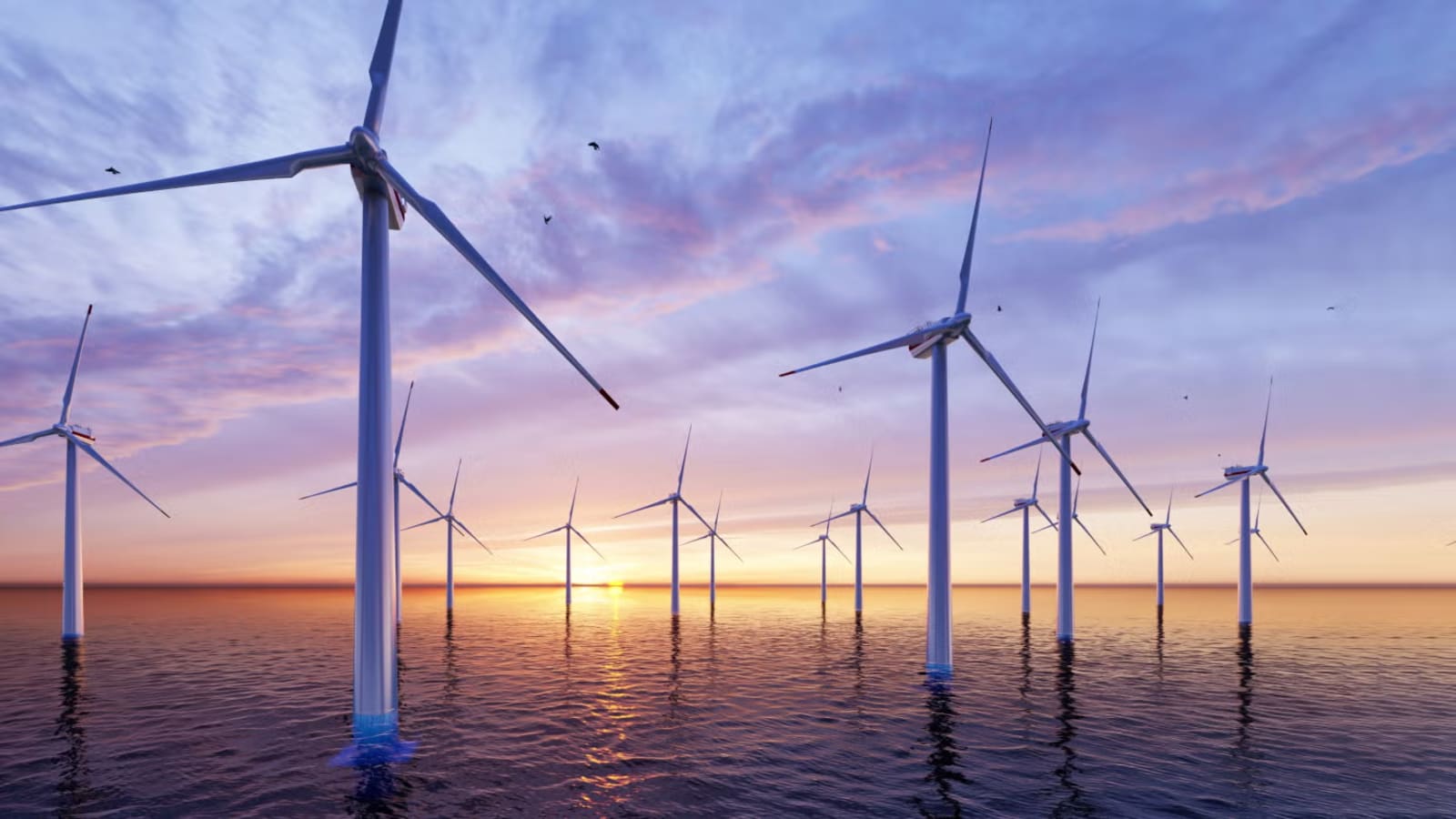
The European Commission (EU) has given the green light to a support scheme of up to €9.45 billion to facilitate the development of 2 GW of new offshore wind capacity in the Netherlands , in a context marked by higher costs and investment risks for this type of project.
The mechanism will be intended for the IJmuiden Ver Gamma-A and IJmuiden Ver Gamma-B parks, both located in the North Sea, which together could generate up to 7441 GWh of renewable electricity per year .
The unique aspect of the scheme is that public aid will not be delivered automatically .
The Netherlands will hold two tenders before July 2027 in which developers can submit bids to build the parks without subsidies , even offering a concession payment to the State for the right to develop the sites.

Only if there are no proposals under that modality will the Government consider offers that request financial support.
In that second scenario, participants will compete based on the lowest required variable premium , which will be added to the revenue obtained from the sale of electricity in the market.
There will be one winner for each location.
The support may be extended for 15 years from the start of the operation , currently planned for 2032.
The scheme, called Tijdelijk Ondersteuningsmechanisme Windenergie Op Zee (TOWOZ) , seeks to reduce some of the risks that currently condition investment decisions in offshore wind.
The premium will be activated when electricity market prices are insufficient to cover the production costs of the projects.
At the same time, the mechanism includes safeguards to prevent overcompensation.
These include a maximum limit for bids and a recovery system that will require developers to return some of the support received when market prices exceed the previously agreed exercise price.
First without subsidies and only later with public support
The scheme's design attempts to preserve competition and limit state intervention to cases where it is necessary.
The European Commission considered the program appropriate to support new offshore investments due to the market risks currently facing the sector.
Furthermore, he noted that the aid is proportional because it will only be granted if the unsubsidized bids are not selected , and the final level of support will be determined through a competitive process.
“Every euro invested in domestically produced clean energy makes Europe more energy independent and our industry more competitive,” said Teresa Ribera, Executive Vice-President of the European Commission for a Clean, Just and Competitive Transition .
According to the official, the decision unlocks support for two projects that will add new clean generation to the electricity system and reduce Europe's dependence on imported fossil fuels.
From the private sector, the Dutch association NedZero highlighted in particular the predictability that the mechanism provides in the face of rising costs and market risks.
Its president, Jan Vos , stressed that the €9.5 billion should not be interpreted as a fixed subsidy.
Instead, it is a maximum support ceiling and a risk-sharing mechanism , the effective cost of which will depend on whether it is ultimately necessary to activate the aid and on the evolution of electricity prices.
The tenders will also seek to strengthen the European supply chain
The competitions will also incorporate criteria linked to the European Union's Net Zero Emissions Industry Law .
Developers will need to meet prequalification requirements aimed at diversifying the supply chain for wind turbines and other strategic components.
The aim is to reduce dependence on imports from outside Europe and strengthen the continent's industrial resilience.
The energy dimension of the program will also be significant.
The Netherlands estimates that IJmuiden Ver Gamma-A and IJmuiden Ver Gamma-B will jointly prevent around 147 million tons of CO₂ equivalent over their lifetime .
The support is part of the Dutch offshore expansion strategy and the European Union's energy and industrial objectives.
EU regulations maintain a binding target that renewables represent at least 42.5% of the EU's energy consumption by 2030 , with the aspiration to reach 45%.
For the offshore wind sector, the Dutch scheme also introduces a relevant signal: in a scenario of greater financial pressure, the development of new wind farms will increasingly depend on mechanisms capable of distributing risks without eliminating competition between developers .
The upcoming tenders will allow us to measure to what extent the market can sustain the 2 GW without direct support or whether, ultimately, it will be necessary to activate part of the public support authorized by Brussels.

 By Ailén Pedrotti

 By Emilia Lardizabal