

Geopolitical tensions in the Middle East are placing new pressures on the Colombian photovoltaic industry. Rising international freight costs and restrictions on trade routes are complicating the supply of components for solar projects, in a scenario where maritime transport capacity has reached 98% saturation, according to PV Hardware.
This phenomenon highlights one of the challenges of the energy transition: dependence on international supply chains subject to geopolitical conflicts, rising costs, and logistical capacity constraints. For technology developers and suppliers, the availability of components and the diversification of their sources are becoming increasingly important.
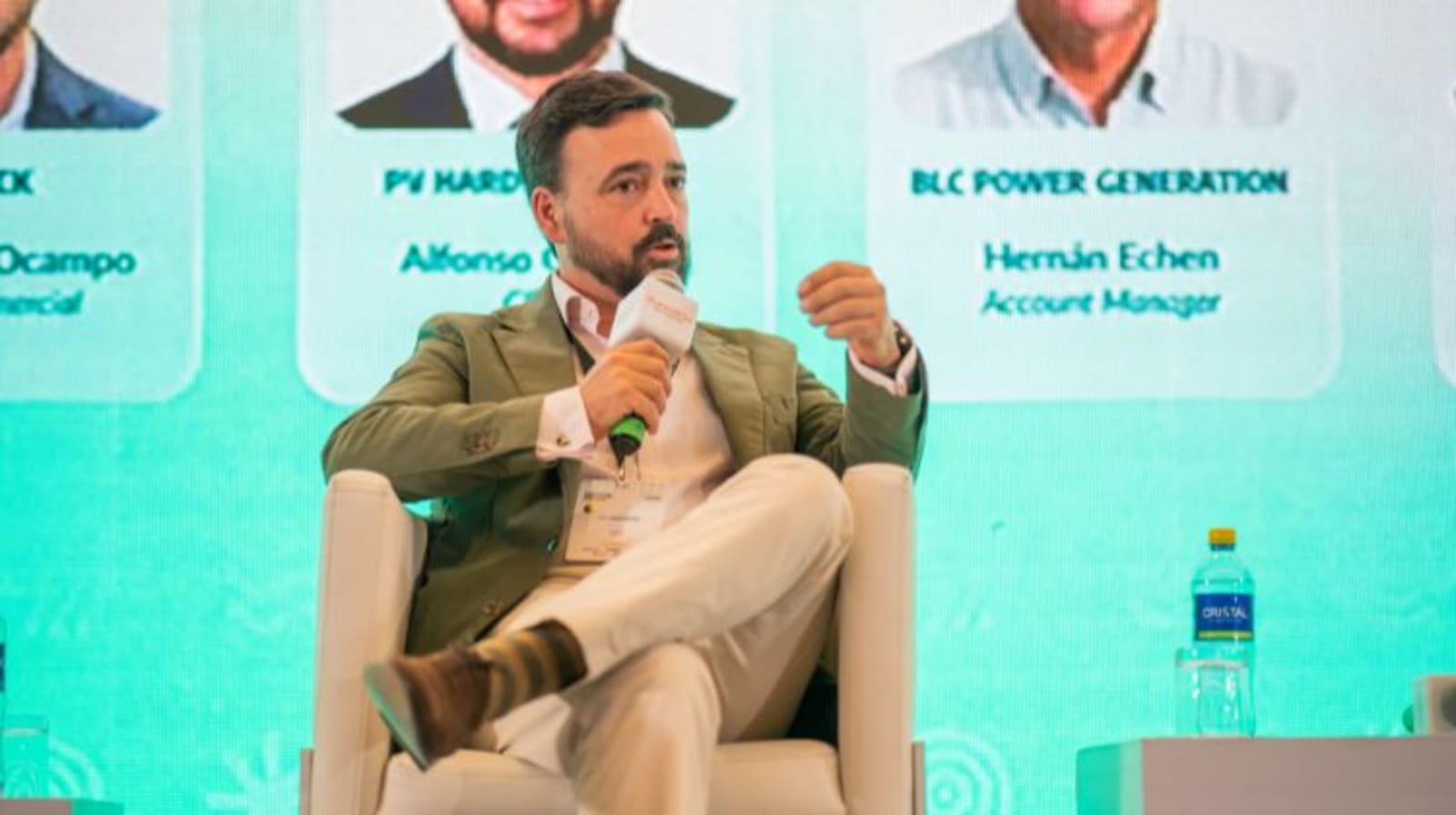
In this context, Alfonso Queipo, CEO of PV Hardware USA , points out that the disturbances linked to the Strait of Hormuz are creating difficulties in responding to the requirements of the photovoltaic market.
“This year, for example, there were extremely high changes in logistics prices due to the Strait of Hormuz, creating needs and truly saturating the logistics markets. In Colombia, we have reached 98% saturation of maritime transport supply,” the executive stated during his participation in the Future Energy Summit (FES) Colombia.
This figure, reported by the company, reflects the magnitude of the restrictions identified by the supplier, although it does not in itself constitute an official statistic of occupancy of the port system or of the national maritime transport as a whole.
This problem arises within a broader international context of increased energy uncertainty. The International Energy Agency (IEA) has warned that trade disruptions stemming from the conflict in the Middle East are altering risk perceptions and investment priorities for governments and businesses.
“We are in the midst of the greatest energy security crisis the world has ever faced, and I believe this will reshape investment strategies globally,” said Fatih Birol, executive director of the IEA, comparing the situation to the transformations following the oil crises of the 1970s.
The organization also identifies an intensification of efforts by producing and consuming countries to reduce their exposure to external disruptions through new infrastructure, greater use of national resources and strengthening of electrical systems.
The consequences for shipping include increases in war risk insurance premiums, navigation restrictions, and higher operating costs. In July 2026, S&P Global reported that additional premiums for certain vessels transiting the Strait of Hormuz had climbed to between 7.5% and 10% of the hull value, according to information from the brokerage firm Marsh.
An analysis published by CheapSun Solar Energy, titled Global Logistics Crisis: What's Happening to Solar Panels, mentions surcharges of between $3,000 and $4,000 per container associated with the conflict in the Middle East.
The publication also estimates that the combination of increased logistics costs and changes in incentives for photovoltaic exports from China could raise the import costs of solar panels between 22% and 27% during 2026. These are sector projections compiled by that company and not proven increases specifically for Colombia.
Exposure to these trade disruptions is also due to the high geographical concentration of renewable technology manufacturing, particularly in China.
According to the IEA's Energy Technology Perspectives 2026 report, the Asian giant concentrates approximately 85% of the production capacity of the photovoltaic solar chain and 95% of the manufacturing of silicon wafers, essential components for producing solar cells.
Faced with this scenario, Alfonso Queipo identifies industrial flexibility and the diversification of supply centers as necessary tools to respond to disruptions in international trade and guarantee the availability of components.
“We have factories all over the world, we have them in Houston, in Spain, in Saudi Arabia, in addition to many others that manufacture for us,” the executive highlighted, referring to the company's ability to adapt to logistical restrictions.
The possibility of using different production locations becomes relevant in a context of rising freight costs and limitations in transport capacity, especially for suppliers who must coordinate the supply of equipment with the construction schedules of photovoltaic parks.
“That really forces you to change and have that availability of where to bring raw materials in order to meet the needs of customers, as well as with other suppliers,” Queipo explained.
In this sense, the manager believes that the capacity for adaptation should also extend to the technological characteristics of the equipment , in order to respond to the requirements of each project and facilitate its integration with the rest of the generation components.
“Having a technology that is integrable and adaptable with the rest of the components within the energy generation system is key,” the CEO added.
Colombia seeks to accelerate its solar expansion amid logistical and tax challenges
International supply difficulties coincide with a stage of development of the Colombian solar market, where the incorporation of new capacity requires not only technological availability, but also electrical infrastructure, logistical coordination and regulatory conditions that accompany the investments .
“It is true that Colombia is very lucky because, starting now, being relatively young in the initial boom, it may not suffer what other markets have suffered,” Queipo stated.
In particular, the executive highlights the evolution experienced by the main components of the generation and storage systems, whose greater technological maturity allows them to take advantage of the experience accumulated in international markets.
However, the availability of equipment alone does not solve the difficulties in incorporating new generation capacity. The development of the electrical system and the time required to expand the networks also affect project implementation.
At this point, the executive points out the importance of adapting technological solutions to the needs of each location , especially when electricity demand requires responses in shorter timeframes than those needed to build new transmission infrastructure.
Continue reading
On the other hand, Queipo identifies regulatory certainty for battery storage as one of the pending aspects to strengthen investment prospects in Colombia and expand grid connection alternatives.
“Regulatory certainty is needed in the area of batteries, both to encourage foreign investment and to truly motivate the diversification of connection points throughout the country,” the executive stated.
PV Hardware expands its presence in Colombia with 155 MW delivered and 350 MW quoted
In the midst of this scenario, PV Hardware is advancing in its positioning within the Colombian market , after approximately three or four years of activity in the country and with a portfolio of projects that reflects a greater participation of the company in local photovoltaic development.
The manufacturer, which claims to have supplied approximately 52 GW of solar trackers worldwide , identifies Atlas Renewable Energy's 200 MW project as a turning point in consolidating its operations in Colombia.
“The reality is that this project has been crucial for our change of position in Colombia,” said Queipo, referring to the impact of this supply on the company’s commercial and operational presence.
The executive explained that, prior to this operation, PV Hardware met some of the needs of the Colombian market by deploying specialized personnel from Chile and Brazil, where it already had a consolidated structure.
However, the execution of the project made it possible to develop a local technical team , intended to support customers during the installation and commissioning stages of the solar trackers.
Among the assistance activities, the most notable is the implementation of the so-called golden row , a reference row used to validate assembly procedures, identify technical particularities and standardize tasks before extending them to the entire installation.
This support aims to reduce construction costs for EPC contractors and prevent difficulties during the operation and maintenance of photovoltaic parks.
Based on this experience, the company continues to expand its operations in Colombia. Currently, according to data shared by Queipo, PV Hardware has a larger pipeline.
“It has opened doors for us, we are currently delivering another 155 MW this year and we currently have a pipeline of around 350 MW under quotation,” the CEO explains.
However, the executive warns that the projects under negotiation will not necessarily result in contracts and maintains that growth must accompany the evolution of demand without compromising the company's ability to respond.
“It’s very optimistic to think that we’re going to acquire everything we’re bidding on; that would be wonderful,” Queipo acknowledged.
PV Hardware's expansion in Colombia is also part of a reorganization of its regional operations. According to the executive, integrating the Colombian market into a structure that covers the entire American continent allows them to strengthen technical support and leverage the experience gained in other Latin American countries.
This organization facilitates support for developers and contractors, although Queipo warns that commercial growth must be based on an operational structure capable of responding to the particular needs of each market.
In parallel, the experience gained in 12 projects in Colombia allowed the company to strengthen its foreign trade procedures: “We have learned a lot about all the tariff documentation, exemptions, and customer support to ensure that the merchandise is correctly submitted before it leaves its port of origin.”
This aspect becomes relevant within the framework of incentives established by Law 1715 of 2014, modified by Law 2099 of 2021 , which contemplates mechanisms to reduce the tax burden associated with investments in non-conventional energy sources.
The benefits provided include the exclusion of value-added tax (VAT) for certain goods and services, exemption from import duties, accelerated depreciation, and the deduction of up to 50% of the investment value from taxable income , in accordance with the limits and conditions established by the regulations.
In particular, the tariff exemption may apply to machinery, equipment, materials and inputs intended exclusively for eligible projects, provided that the legal requirements are met, including the condition that the goods are not produced by domestic industry.
To access these incentives, projects must comply with specific procedures, including the corresponding certification from the Mining and Energy Planning Unit (UPME) .
Regarding tariffs, Law 1715 establishes that the exemption request must be submitted to the National Directorate of Taxes and Customs (DIAN) at least 15 business days before importation , in accordance with the documentation endorsed by the UPME.
The correct identification of equipment, its tariff classifications and supporting documents is relevant to avoid setbacks in foreign trade operations.
In a scenario of rising international transport costs and greater logistical restrictions, customs planning is another factor in controlling costs, taking advantage of available incentives, and reducing risks in the execution of solar projects .
“We believe there is a lot of room for growth, we have to see exactly what is needed at each moment and we have to be very cautious because when you want to grow too fast you can be prone to making mistakes,” the executive warned.
He concluded: “Colombia has every opportunity to grow: the technical capacity behind it, the right people and the right market players.”
Thus, diversifying supply chains, planning imports, and strengthening local technical assistance become relevant for Colombian photovoltaic development, in a context where international geopolitical tensions add to the electrical infrastructure and regulatory challenges facing the market.

 By Emilia Lardizabal

 By Energía Estratégica


 By Matías Medinilla