

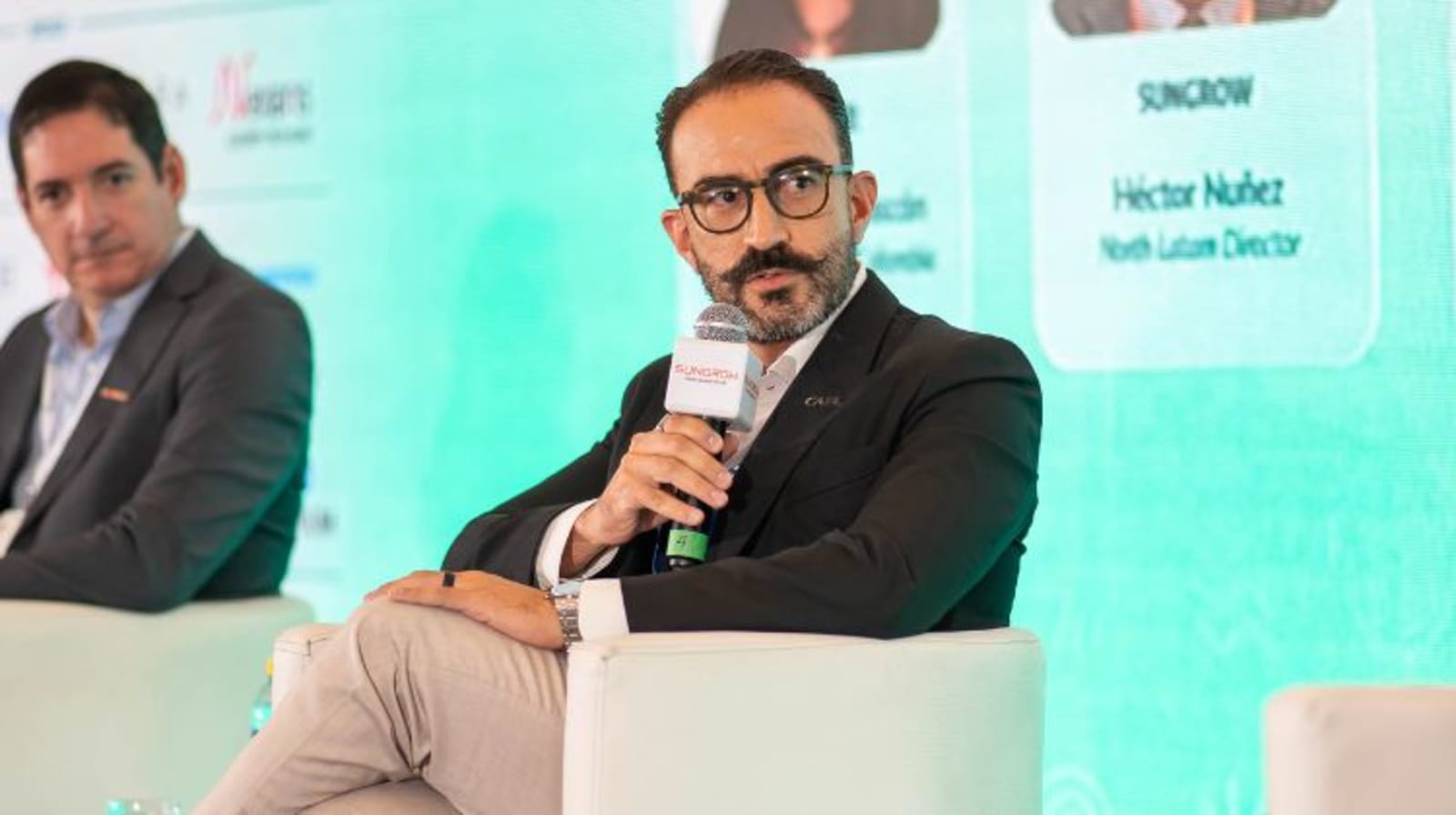
The rising cost of lithium carbonate has put nearly 5% pressure on battery costs, according to CATL, after this raw material practically doubled its spot price in a six-month period. However, the manufacturer maintains that energy storage projects remain economically viable.
"With all these factors putting pressure on some analyses, the projects are viable. The price of the battery itself is already less than 100 per kWh; for example, the price of a complete storage system, according to the number of hours it is implemented and several variables, on a large scale should be less than 150 per kWh," said Ricardo Garro, commercial director for Latin America at CATL , during his participation in Future Energy Summit (FES) Colombia 2026.
“Since the beginning of the year, we were already seeing another phenomenon with the cost of lithium carbonate on the spot market, where in a matter of 6 months it practically doubled. This doesn't mean that the cost of the battery doubles because it is then processed and a final product is obtained, but we did see an increase of around 5%,” the executive added.
However, the most recent data from Trading Economics shows a correction in the price of this commodity. As of October 26, 2026, battery-grade lithium carbonate in China stands at 98,300 yuan per ton , representing a 22.20% drop in the last month, although it still shows a year-on-year increase of 28.41%.
According to the platform, during October prices fell to levels close to 100,000 yuan per ton, a low of almost ten months , amid expectations of lower demand and greater supply availability in the Chinese market.
This trend indicates a shift from the upward pressures described by CATL during the first months of the year. However, the recent drop in lithium carbonate prices does not necessarily imply an equivalent and immediate reduction in the final cost of batteries , given the involvement of other components, industrial processes, and supply conditions.
China will eliminate the 6% tax benefit in 2027 and put pressure on battery costs.
Adding to this dynamic is another factor that could affect the acquisition costs of BESS systems from 2027 onwards : the elimination of tax incentives that China grants to manufacturers, a country where a significant part of the world's battery production is concentrated.
The tax benefit known as the tax rebate was originally set at 9%, but was reduced to 6% in April 2026 and will disappear completely on January 1, 2027 .
“This has meant that projects have to consider this approximately 6% increase as a very specific one,” warned the CATL representative.
Consequently, developers will need to consider this change in the economic evaluation of their investments, especially in those initiatives that involve the purchase of equipment during the next year.
However, these pressures come after a sustained reduction in battery manufacturing costs over the last decade, driven by technological advances and the expansion of production capacity.
“We can see that in the last 10 to 12 years the cost of manufacturing the cell has fallen by more than 90%, which is why today it is practically considered a totally viable solution to implement in any new renewable project, both solar and wind,” Garro highlighted.
In this context, CATL argues that the competitiveness of storage projects should not be evaluated solely based on their initial investment , but also considering the lifespan of the cells, their degradation, and the performance they can maintain during their operation.
“Now we have a different perspective where we, as a leading cell manufacturer, see that this is not purely a CAPEX game, this is not about price,” the executive said.
CATL anticipates new technologies that will modify long-term costs
The company continues to develop fourth and fifth generation lithium ferrophosphate (LFP) solutions, with performance improvements and lower degradation rates that could modify the financial projections of large-scale facilities.
In particular, after implementing a technology with zero degradation during the first year, CATL plans to introduce new cells with zero degradation during the first three years of operation in 2027 .
“Starting in 2027, we will have a cell with zero degradation for 3 years,” Garro predicted.
This evolution could improve capacity conservation during project operation and reduce replacement needs, although its economic effects will depend on the usage conditions and technical characteristics of each system.
Continue reading
In that regard, the executive points out that the new features would allow, in certain cases, the batteries to maintain a state of health (SoH) above 75% after 20 years .
Meanwhile, CATL is moving forward with the international launch of its Tor Sodium storage technology, scheduled for 2027. According to Garro, the manufacturer is announcing a production scale of over 200 GWh for this solution, with a projected lifespan of 30 years, less degradation, and lower auxiliary consumption.
“It is not a pilot project, but a massive scale where internationally we will have this product with other features starting next year: a useful life of 30 years, less degradation and less auxiliary consumption, among others,” he said.
Thus, while the rising cost of certain raw materials and tax changes introduce new pressures on costs, CATL is committed to technological improvements to sustain the competitiveness of energy storage and expand its incorporation into renewable projects.
Projection of several GWh of storage in Colombia towards 2030
Alongside this evolution of costs and technology, Garro identifies opportunities to expand energy storage in Colombia, although he warns that the lack of regulatory predictability continues to condition investment decisions .
The executive argues that the Colombian market went through periods of growth expectations that did not fully materialize, due to political changes and the absence of sufficiently clear rules.
In his diagnosis, he mentions the expectations for the installation of 6 GW of renewable capacity and the precedent of a 2021 battery process that ultimately failed to be implemented.
“We need a more predictable regulatory framework and clearer rules,” Garro pointed out.
While acknowledging progress in storage regulation, he believes it is necessary to define remuneration mechanisms and continuous bidding schedules that allow manufacturers and developers to plan long-term investments.
“We see that the process was just awarded in July for the first time with storage, but it's a one-time thing and we don't know when it will be held again,” he said in relation to the last long-term contracting auction in which 995 MW of solar and 100 MW of storage were awarded.
According to the CATL representative, one of the pending mechanisms is the remuneration of auxiliary services , along with the incorporation of independent or standalone batteries as network assets.
In this scheme, tenders could be directed towards critical points and saturated nodes of the transmission system, with the aim of resolving operational constraints and facilitating the connection of new renewable generation.
“That would significantly boost battery penetration and provide a solution for integrating even more renewables by addressing critical points and saturated nodes in the transmission network,” he stated.
Garro points out that developers like Ecoener and ISAGEN are already evaluating the incorporation of batteries in new renewable projects, while other clients are studying solutions to supply large consumptions through time-shifted energy use.
“I am hopeful that by 2030 this will be a market with several GWh already implemented. That is what I believe Colombia can truly implement, and it will be a long-term solution,” he projected.
As a local precedent, Garro mentions an 8 MW storage system at El Dorado Airport , installed by Skysense and which, according to the executive, is already in operation.
At the Latin American level, CATL also records experiences with independent and hybrid projects, which the executive presents as references to expand the implementation of these solutions in the Colombian market.
“We have over 1 TWh of annual production, over 6 GWh supplied in Latin America and over 300 GWh worldwide,” he said.
Thus, despite recent pressure on costs and regulatory challenges, CATL maintains its growth outlook for storage in Colombia and Latin America , supported by technological evolution, new commercial configurations and the possibility of integrating larger volumes of renewable generation.

 By Emilia Lardizabal

 By Energía Estratégica

 By Matías Medinilla