On June 18, 2026, the Ministry of Energy (SENER) released the long-awaited Guidelines for the Voluntary and Expedited Migration of Self-Supply and Cogeneration. These regulations outline the definitive path for projects developed under the former Public Electricity Service Law (LSPEE) to transition to the new Wholesale Electricity Market (MEM) mechanisms established in the Electricity Sector Law (LSE).
In a context where the industry seeks certainty, this temporary and exceptional program promises to resolve bottlenecks through criteria of "administrative simplification and technical agility".
Below, we break down the key points of this document and what it truly represents for power generators, large consumers, and the development of energy storage in Mexico.
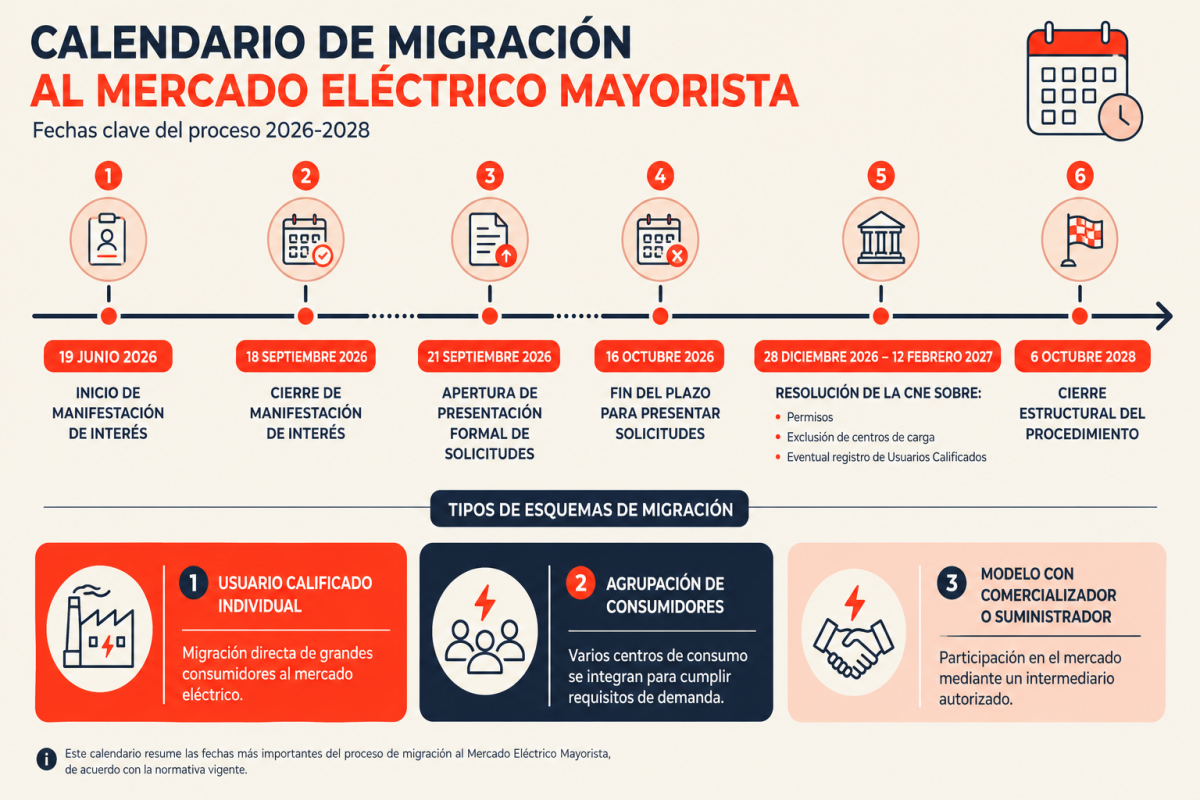
Key dates
To incentivize the transition to the Wholesale Electricity Market (MEM), the government has introduced a significant "fast-track" process. Signing new interconnection contracts will not require additional studies, reinforcement works, or payments associated with such works , provided the entity being migrated already has a Legacy Contract. No new fees or charges will be levied for these procedures.
Power plants may choose between Generation schemes for the MEM, Isolated Self-Consumption or Interconnected Self-Consumption.
Companies wishing to participate should schedule the following deadlines:
- June 19 to September 18, 2026: Registration of the expression of interest at the "Migration Window".
- September 21 to October 16, 2026: Official submission of the migration application.
- February 15 to March 5, 2027: Pre-registration of physical assets by Market Participants.
- October 6, 2028: Formal conclusion of the Migration Procedure. On this date, the status of the physical asset registration will be changed to "Enabled," marking the official start of commercial operations in the MEM.
Where can Legacy Figures migrate to, and what will happen to the fees?
The new guidelines establish clear pathways for self-supply and cogeneration projects to transition to the Electricity Sector Law (LSE). Specifically, three main alternatives are opened up:
The first option is to migrate to isolated self-consumption . This scheme applies when generation and consumption are organized without relying on full grid interaction for commercial purposes. In this case, the administrative procedure is much more limited: the guidelines stipulate that migration applications for these generation permits will only cover the first four stages of the official schedule established by the Ministry of Energy.
The second option is grid-connected self-consumption . This allows a power plant to maintain a connection to the grid and supply local loads under a self-consumption model. For the renewable energy sector, this is a particularly sensitive issue because it can streamline existing systems, but it also requires new contracts and strict technical compliance. If there is a sale of surplus energy, the process becomes more complex: the plant must relinquish or manage this sale, formalize contracts with CFE (the Federal Electricity Commission), and meet additional requirements with the National Energy Control Center (CENACE) to obtain dispatchable status.
Continue reading
The third option is generation for the Wholesale Electricity Market (MEM) . In this scenario, the power plant must be represented by a Market Participant in the Generating modality. In turn, load centers (large consumers) can group together and become Qualified Users, represented by a qualified service provider.
A crucial development for the technology market and grid modernization: renewable energy plants will be able to request the integration of Electrical Energy Storage Systems (EES) within their migration application. The only condition is that the plant's installed capacity is not increased, nor is the capacity established in its original interconnection agreement modified. This opens a vital business opportunity for battery developers in the country.
What will happen to large industrial consumers?
Load centers (industries and large users) that are part of self-supply cooperatives will have to make a decision. They can pool their demand and register as Qualified Users to receive Qualified Supply in the Wholesale Electricity Market (MEM) (applicable for demands of 1 MW or greater). Alternatively, they can choose to opt out of the existing cooperatives and migrate to receive Basic Supply provided by the CFE (Federal Electricity Commission).
It is important to note that they will need to adapt their measurement systems to comply with the five-minute profile and GPS synchronization required by the Market Rules.
Migration is strictly voluntary . Those holders of permits, contracts, or instruments granted under the old law who choose not to make the switch will continue to be governed by the terms and provisions of the LSPEE until its expiration.
With this publication, the Mexican government gives a temporary ultimatum to regulate the market, leaving it up to developers and offtakers to decide to restructure their portfolios and secure their position in the new era of the Wholesale Electricity Market.
The appetite for adapting to the new market structures is already palpable, and self-consumption is beginning to take off in Mexico. A clear example of this dynamism is the 20 MW contract signed by 360Energy under the new market rules, which has begun to leverage its track record to capitalize on these self-consumption opportunities.
At the same time, the Mexican electricity market (MEM) is experiencing an industrial exodus. The figures demonstrate a clear trend: Mexican industries are migrating at a rate of 1.5 GW per year to become Qualified Users, according to Darío Leoz , CEO of Tuto Power . This enormous volume of energy transitioning to the new model is not only seeking better rates through qualified supply, but is also triggering an unprecedented demand for battery energy storage and storage (BESS) systems to ensure their stability and efficiency in the nascent Mexican electricity market.