

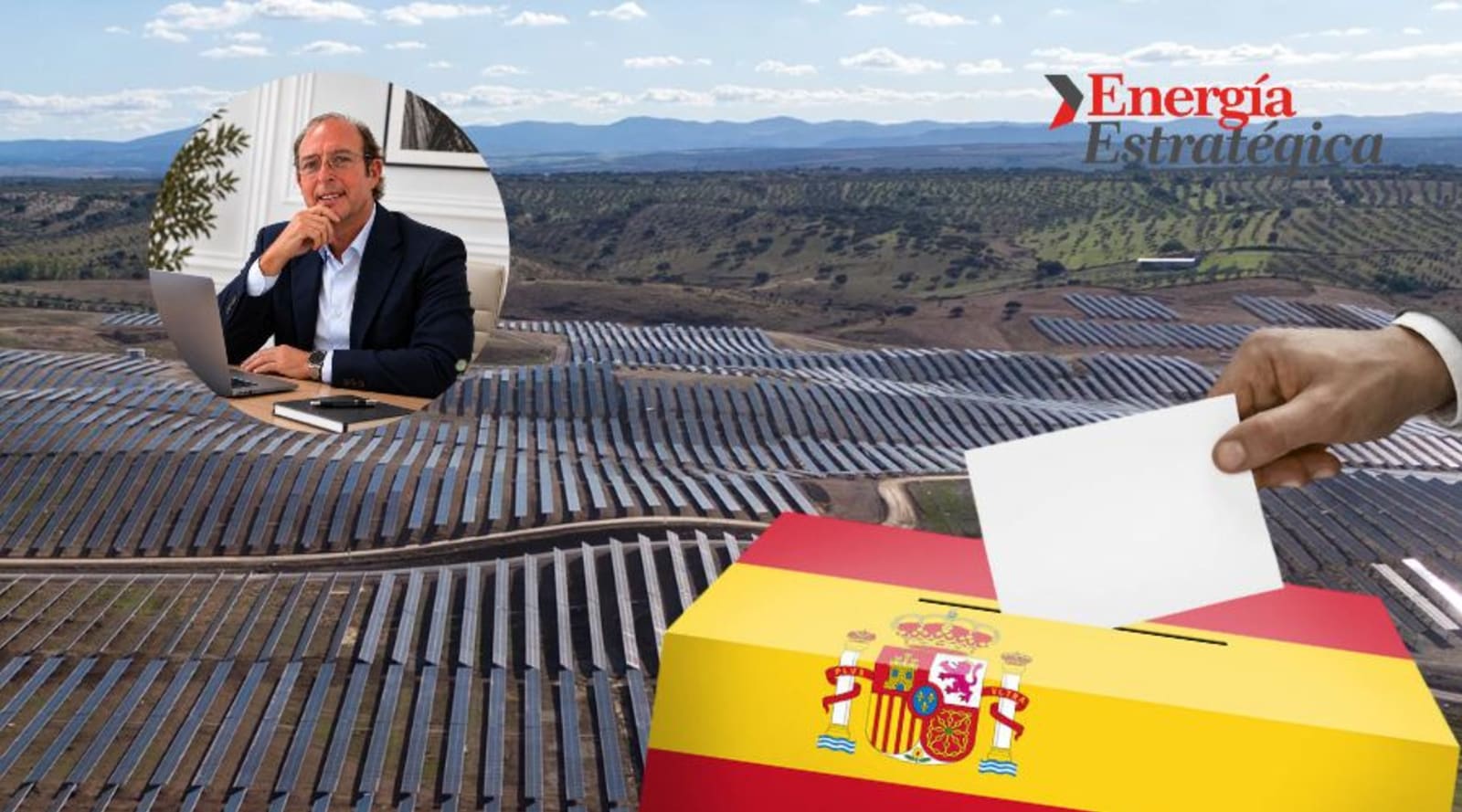
The election has opened a new front of uncertainty for renewable energy developers in Spain, who already face grid access restrictions, lower prices captured by photovoltaics, and greater demands to secure financing for their projects.
The November 29 elections, called early by Pedro Sánchez's government, will determine the composition of the next Spanish government, in a contest between the Spanish Socialist Workers' Party (PSOE) and the People's Party (PP), Vox , and other political forces. The outcome could alter regulatory priorities and the implementation timelines for pending measures in the energy sector.
However, the sector's uncertainty did not arise in step with the electoral fanfare: investors had already been putting on the brakes.
Difficulties in financing certain merchant projects, the effective availability of connections, and uncertainty about future storage revenues were already influencing developers' decisions.
In a dialogue with Energía Estratégica , José Luis Bernal Albendín, an expert and communicator in energy , warned that the political situation could deepen this selection of investments during 2027, although he ruled out a generalized paralysis of the market.
“Yes, there is more caution, but not a standstill,” he stated.
He explained that investors are not reacting to a specific election proposal, but to the possibility of changes in priorities, timelines, and the implementation of pending regulations.
In that scenario, Bernal anticipated “a two-speed market” by 2027 and warned:
“Mature projects will maintain their schedule. Those that still need to establish a connection, complete some paperwork, or develop a credible revenue structure will require more time and will face more demanding financing requirements.”
Here, the decisive indicator will not be the volume of megawatts announced, but how many projects reach the final investment decision (FID), close their financing and actually begin construction.
The latest survey by Energía Estratégica on the Official State Gazette (BOE) reflected this contrast: during September, ten files linked to BESS systems were identified, with at least 334.8 MW of storage , while five renewable projects totaling 401.9 MW were left out of the portfolio due to dismissals or withdrawals .
The monitoring also revealed a greater emphasis on hybrid projects using existing electrical infrastructure or permits, a strategy that allows developers to leverage existing connections and reduce certain processing times. However, the administrative progress of these projects does not yet guarantee their construction or financial closure.
Without losing sight of this data, the specialist was able to warn:
“If the new government is formed soon and maintains a clear regulatory timetable, some of the postponed operations can be recovered during 2027. If the interim period is prolonged, some projects will have to renegotiate deadlines, supply contracts, purchase agreements and financing conditions.”
He also concluded without hesitation: “ The real risk lies in how long it will take us to turn the capacity market into a fully operational mechanism.”
Capacity market, networks and nuclear power: the definitions that will shape the next government
“Can we have a first auction in 2027? Yes, it’s still possible, but I wouldn’t take it for granted,” anticipated José Luis Bernal Albendín.
It is worth reviewing and remembering that the capacity market was formally created with Order TED/966/2026, published in the Official State Gazette (BOE) on September 17 and in force since the 18th . The instrument contemplates remunerating the availability of firm power through auctions in which generation, storage and demand can compete, with contracts of up to 15 years for certain new investments.
However, the schedule still has a list of pending items. It must finalize the rules for the first call for bids , including firmness coefficients, contracted power, reserve prices, and the guarantees required from participants.
It is a fact that the Government is looking to accelerate the timeline. According to comments within the sector and in local media, the Ministry for Ecological Transition, headed by Sara Aagesen, intends to finalize the first auction before the November 29th elections , while simultaneously working to approve the 2025-2030 Electricity Plan.
So, should the sector fear that a shift in political orientation could jeopardize the mechanism's continuity? While a review of its conditions cannot be ruled out, the capacity market would not necessarily be a point of contention between the main parties. In fact, the People's Party (PP) already included promoting this instrument in its 2023 electoral program to encourage renewable energy storage.
According to the specialist, “a possible review of the design or a prolonged formation of the next Executive could postpone the first calls for applications, even if the technical work continues during the election period.”
The capacity market will not be the only outstanding issue. The transmission network plan includes investments exceeding €17 billion by 2030 , while flexible access, regulated by the CNMC on July 31, will have to demonstrate its operational and financial viability for new demand and storage projects.
Added to this is the extension of Almaraz until June 2030 , which modifies firm power requirements and raises questions about the future of the nuclear fleet.
“If the lifespan of more power plants is extended, the need for new firm power and the planned use of combined cycle plants will change. If the closure schedule is maintained, storage, flexible demand, and dispatchable backup will have to be implemented more quickly,” Bernal explained.
Energy taxation, subsidies, self-consumption and renewable permits complete the issues that could be reviewed after the elections.
BESS, wind power and self-consumption: where will the investment opportunities be in 2027?
Looking ahead to next year, energy storage is shaping up to be one of the segments with the greatest growth prospects in Spain , although its profitability will increasingly depend on location, battery life, replacement costs and revenue strategy.
“Not just any battery will be a good investment and not just any node will be suitable for installing it,” Bernal warned Energía Estratégica , highlighting the advantages of hybridizing with renewable power plants that already have a connection versus developing projects in saturated nodes.
In the photovoltaic business, the challenge will be to improve the prices captured and reduce exposure to peak solar generation hours , when the concentration of supply puts downward pressure on prices. Projects with storage, PPAs, or associated consumption could offer better economic conditions, while renewable energy grid inflows will add risks in areas with grid congestion.
Industrial self-consumption will also present opportunities, especially in facilities with stable demand during daylight hours. However, system sizing must correspond to actual consumption patterns to avoid surpluses of little economic value.
Meanwhile, onshore wind power could regain prominence through the repowering of older wind farms , an alternative for increasing production with fewer turbines. However, Bernal ruled out commercial offshore wind generation during 2027, although he anticipated possible progress toward the first competitive bidding process.
“Spain has a significant industrial opportunity due to the experience of its shipyards, ports, engineering firms and manufacturers,” he noted regarding offshore development.
Flexible demand management will open up another business opportunity for industrial consumers who can shift part of their consumption and earn revenue by providing services to the grid. This will be complemented by opportunities in substations, power electronics, digitalization, and control systems.
However, the growth of these segments will also depend on whether connection requests from new industries, data centers, and hydrogen projects translate into effective electricity consumption, capable of absorbing part of the new renewable generation.
“In 2027, the valuable asset will not simply be the one that has a permit. It will be the one that can be connected, built, and economically sustained throughout its useful life , ” concluded José Luis Bernal Albendín.

 By Emilia Lardizabal

 By Florencia Guglielmetti

 By Matías Medinilla
 By Ailén Pedrotti

 By Energía Estratégica