
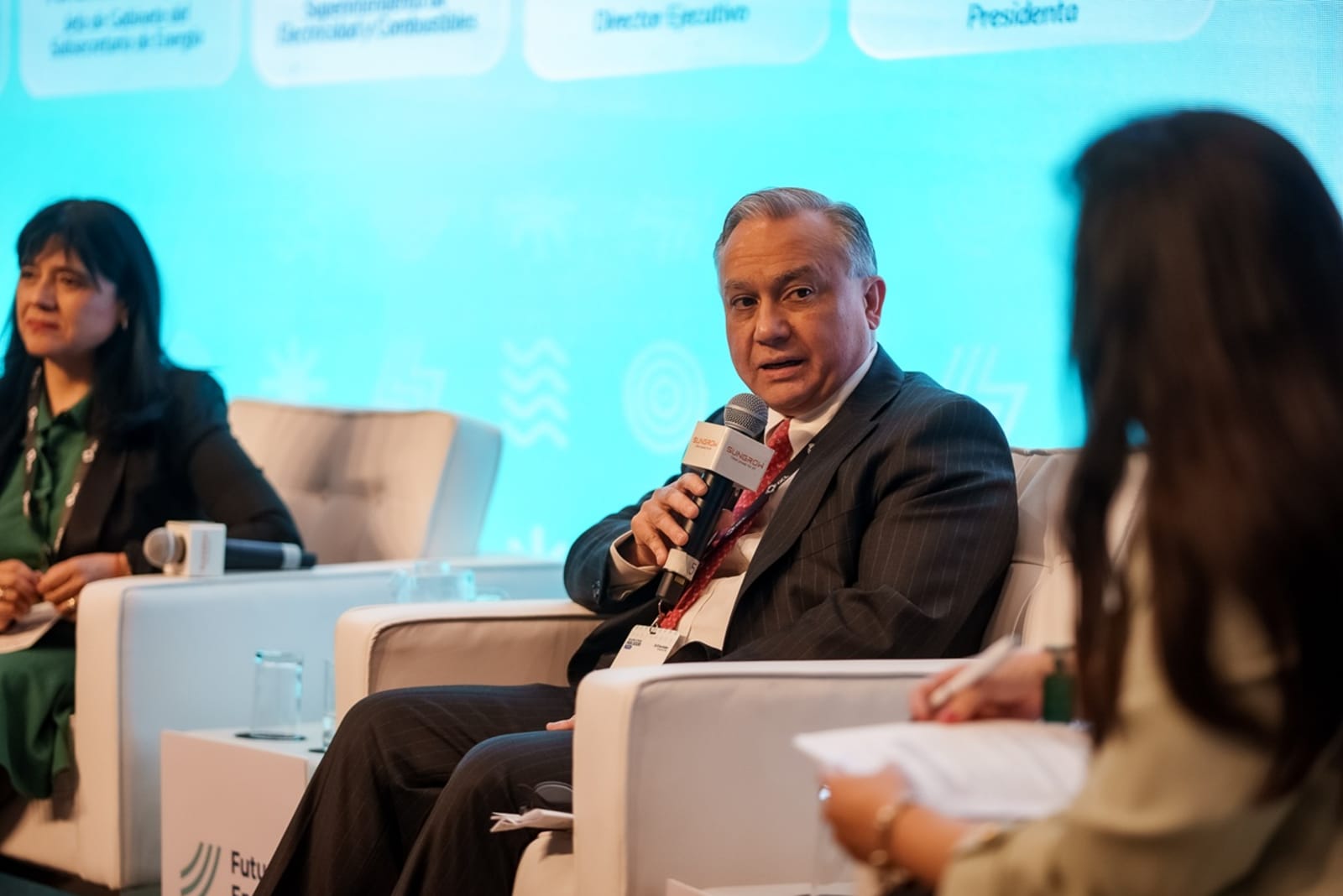
With 5,130 MW of battery storage under construction and another 3,125 MW already operational , Chile faces the challenge of integrating a growing storage capacity. In this context, Ramón Castañeda , executive director of the National Electric Coordinator (CEN), raised a question that goes beyond the current dispatch: how will the contribution of these assets evolve as new projects come online?
“There could come a time when this possibility, or this benefit, also begins to saturate, begins to stop increasing,” he warned during his participation in Future Energy Summit (FES) Chile 2026 , referring to the capacity of BESS systems to recover renewable generation that would otherwise be fed into the grid.
The executive explained that the pace of expansion observed over the past year could continue for another 12 to 18 months , based on the planned infrastructure portfolio. This outlook presents immediate challenges for the management of the National Electric System (SEN).
“In the short term we are focused on the operation, on making it integrate better and better,” he said.
According to the latest statistics from the Chilean Renewable Energy and Storage Association (ACERA), as of the end of September 2016, the country also had 3,017 MW and 13,735 MWh of batteries under testing . In terms of energy capacity, operational systems reached 13,555 MWh, while projects under construction totaled 22,123 MWh.
The addition of these facilities coincides with a reduction in renewable energy cuts. Between January and September, solar and wind energy curtailments totaled 3,546 GWh, 4.6% less than in the same period of 2025 , according to ACERA. However, this trend cannot be attributed solely to BESS technology, as generation, transmission, and demand conditions also play a role.
Castañeda pointed out that one of the first results of incorporating this equipment was to take advantage of electricity that was previously wasted, something that is already being observed in the daily dispatch curves.
However, he explained that as the volume of energy shifted to other times increases, the margin for continuing to obtain additional benefits through this mechanism could be reduced.
The warning does not imply that batteries will lose their usefulness , but rather that the recovery of surplus energy may no longer be sufficient to account for their full economic and operational contribution. Consequently, other benefits would become more important to sustain the projects' prospects.
The head of the CEN pointed to international experience to explain how the storage business model could evolve in this scenario.
"It is also beginning to incorporate other types of income for these assets, such as complementary services," he noted, referring to services that contribute to the safety and stability of the electrical system.
“From the perspective of offerings to customers, this hybridization or blending of batteries with variable renewable assets is also beginning to emerge,” he added. This combination allows for the support of supply contracts and facilitates project financing, reducing their dependence on revenues associated with hourly dispatch.
The transmission also incorporates new solutions
Beyond its commercial applications, energy storage is acquiring a role within electrical infrastructure planning, particularly in areas where there are restrictions on transporting energy.
“In practice, this is already happening,” Castañeda stated when asked about the possibility of considering batteries as an alternative to certain transmission works and not just as a complement.
As an example, he mentioned the existing limitations south of Valdivia, where the National Energy Commission (CNE) has studied projects that incorporate these systems to support the available facilities.
One of the backgrounds is the preliminary proposal of Necessary and Urgent Works published on October 7, which includes a BESS of 200 MW and 400 MWh in the Tineo substation , intended to strengthen the security and reliability of the supply to the south of the Cautín substation.
The portfolio also includes the capacity increase of the 2x66 kV Lastarria–Loncoche line. Both projects represent a combined reference investment of USD 77.1 million , under a mechanism that seeks to accelerate solutions to needs that cannot wait for the usual planning timelines.
“We will surely see more of that in the future,” the CEO predicted, also mentioning the possibilities offered by artificial intelligence and so-called grid enhancing technologies to optimize the flows of existing lines.
However, he clarified that these alternatives must be evaluated under a criterion of technological neutrality, considering both future supply needs and the continuity standards required of the system.
“Rather than focusing on a single technology, because it might seem like we are choosing, we need to have a neutral perspective,” he said.
Along those lines, he indicated that the Coordinator is working on expanding its analytical capabilities to incorporate a greater number of scenarios within the available timeframes.
“We hope that next year it will begin to give us additional capabilities beyond those we have traditionally had,” he stated.
Thus, 2027 appears as a horizon for perfecting planning and operation mechanisms , in parallel with the incorporation of new facilities that will require taking advantage of batteries not only to displace renewable surpluses, but also to provide other services and reinforce the electrical infrastructure.

 By Emilia Lardizabal

 By Energía Estratégica

 By Matías Medinilla
 By Ailén Pedrotti