


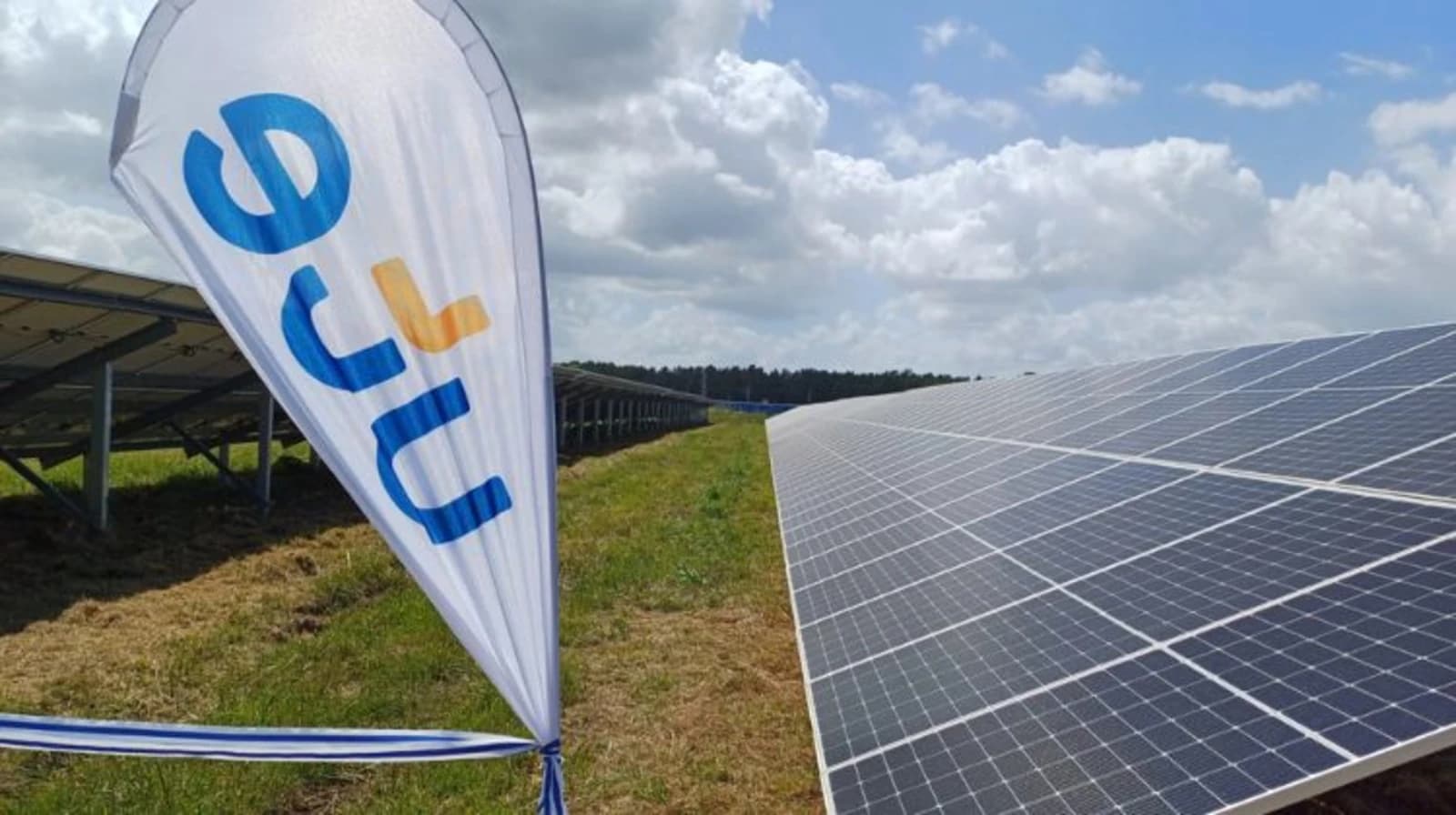
Uruguay's National Administration of Power Plants and Electrical Transmissions ( UTE ) is preparing a tender to purchase electricity produced by three new photovoltaic solar parks , which will have a combined capacity of 99 MW . The projects will be developed by companies that will sell all of their generation to the state-owned utility through 20-year power purchase agreements.
The tender, identified as Public Tender P104220 , will be divided into three independent projects of 33 MW each, located in predefined areas of Tacuarembó, Florida, and eastern Uruguay. The winning bidders will have 24 months to construct and commission the power plants .
According to the presented schedule, the tender would be published around October 28, 2026 , while the opening of bids is planned for the last week of January 2027. The final dates and conditions will depend on the publication of the tender documents.
The main guidelines were presented on October 9 by UTE and the Ministry of Industry, Energy and Mining (MIEM) , during a technical conference held in Montevideo.

The initiative is part of Uruguay's electricity expansion plan, which includes the addition of new photovoltaic capacity to meet the system's future needs.
According to the official presentation, the share of renewable energy sources in the electricity mix reached an average of 95% in recent years . Furthermore, the 2024-2043 Indicative Plan for the Expansion of the Electricity Generation Park identified the need to continue incorporating solar technology.
In this context, the new contract seeks to expand generation capacity through private investments and establish mechanisms that take into account both the evolution of technological prices and the operational needs of a network with a high penetration of renewable energies.
Three 33 MW parks and 20-year purchase agreements
The bidding process includes three items of 33 MW of active power to be injected into the grid , which will be awarded independently and will be associated with specific connection zones and nodes.
The first one corresponds to Tacuarembó , where the Chamberlain, Cuchilla Peralta A and Cuchilla Peralta B substations will be enabled, with connections planned at 150 kilovolts.
The second node will be located in Florida , with potential connections in Colonia Sánchez, Pintado A, Pintado B, Florida, and Durazno. Depending on the selected node, connections are planned at 150 kilovolts and at medium voltage levels.
Finally, the third project will be located in the East zone , with alternatives in Carapé, La Plata, San Carlos and Rocha, in addition to other nodes identified in the call documentation.
The selection of these locations is based on electrical grid capacity studies conducted by UTE, which identified the points suitable for receiving the energy injection from the new power plants. Each plant must locate its connection point within a maximum radius of five kilometers from the selected node .

Interested companies may participate in one, two or all three items, but must submit a single quote for each chosen project and select only one connection node for each area.
The contract will be awarded solely based on price among the bids that meet the established requirements. Therefore, a single company could be awarded all three parks.
One of the key aspects of the tender will be the economic structure of the contracts. Although UTE will purchase 100% of the energy generated for 20 years , the remuneration will not be uniform throughout the entire period.
During the first 15 years , the state-owned company will pay the price offered by the winning bidder, while in the last five years it will pay 40% of that value , subject to the corresponding updates.
For example, if a developer submits a bid of $50 per megawatt hour and is awarded the contract, they will receive a base payment of $50 for the first 15 years and $20 for the remaining five years, before applying the planned adjustments.
This modality introduces a relevant variable for financial models, since the income derived from the sale of electricity will be treated differently during the last contractual period.
In addition, prices will be expressed in dollars per megawatt hour and will have annual update mechanisms during January , through formulas that take into account US and Uruguayan price indices, as well as the evolution of the exchange rate.
For the first 15 years, 60% of the price will remain fixed and the remaining 40% will be subject to adjustment. In the last five years, the adjustment formula will be applied to the entire reduced price.
Another point addressed is the treatment of energy that cannot be delivered due to operational network constraints. In such cases, UTE will pay for the unsupplied energy at the current contractual price , according to the announced guidelines.
This provision is relevant for generators, as it establishes remuneration in the face of certain operational limitations that may prevent the injection of electricity.
Continue reading
New technical requirements, guarantees and conditions for investors
The tender also incorporates requirements related to the electrical infrastructure and the services that the power plants must provide to the system.
The price offered must include the energy delivered, the firm power, the connection works and the auxiliary services , in addition to the other recognized contractual attributes.
Among the technical requirements is the provision of reactive power even at night , a feature called Q at Night , which allows contributing to the control of the grid voltage even when the panels are not generating electricity.
Therefore, companies must consider the equipment and capabilities necessary to provide these services within the price presented, without any specific additional remuneration.
Furthermore, the projects must exclusively use photovoltaic solar technology and may not incorporate battery storage systems .
The connection facilities will also have to be exclusive and independent for each power plant, with the measurement and sectioning requirements established by UTE.
Regarding the electrical works, the state-owned company will include a general preliminary connection plan and will prepare specific proposals for the winning bidders.
UTE will also be responsible for managing easements, rights of way and other property encumbrances necessary to build the connection lines.
However, the corresponding compensation must be assumed by the generators , which introduces another economic component that will have to be considered when preparing the bids.
Regarding the deadlines, the power plants must be built and operational within two years of the signing of the contract .
Another important element is that the call for bids would not require specific background information from the bidder or the construction company. Nor would it be necessary to have all the required environmental permits at the time of submitting the proposal.
However, the projects will subsequently have to meet the regulatory, technical and environmental requirements demanded to obtain their authorization.
Regarding guarantees, participants will have to provide $300,000 for each item as a bid security .
Additionally, a performance guarantee equivalent to 1% of the estimated potential turnover during half of the supply period will be required, calculated with a utilization factor of 0.26.
The documentation presented by UTE also establishes a guarantee of good execution equivalent to four times that of faithful compliance and another linked to the obligations provided for in the legislation of outsourcing.
Unlike certain previous renewable generation contracting schemes, the new procedure would not allow UTE to acquire the shares of the generating company in the event of potential breaches.
Instead, a system of economic penalties, enforcement of guarantees and possible contract terminations is foreseen, depending on the nature of the breach.
Furthermore, the tender will incorporate criteria related to the national component of the investment , with the aim of promoting the participation of Uruguayan workers and suppliers.
The official presentation includes 80% national labor , in addition to specific provisions to encourage the hiring of women, people over 50 years of age and under 24 years of age.
Goods of national origin are also considered, although the final methodology will be communicated through a circular and will be subject to the approval of the Ministry of Industry, Energy and Mining.
Under these conditions, UTE seeks to contract new solar generation through long-term agreements , transferring to private developers the construction and operation of the parks, as well as certain obligations of connection and provision of services to the grid.
The publication of the final tender documents will be the next step in establishing the participation requirements and allowing interested companies to evaluate the costs, guarantees, technical obligations and economic conditions of the three projects included in the call for proposals.