


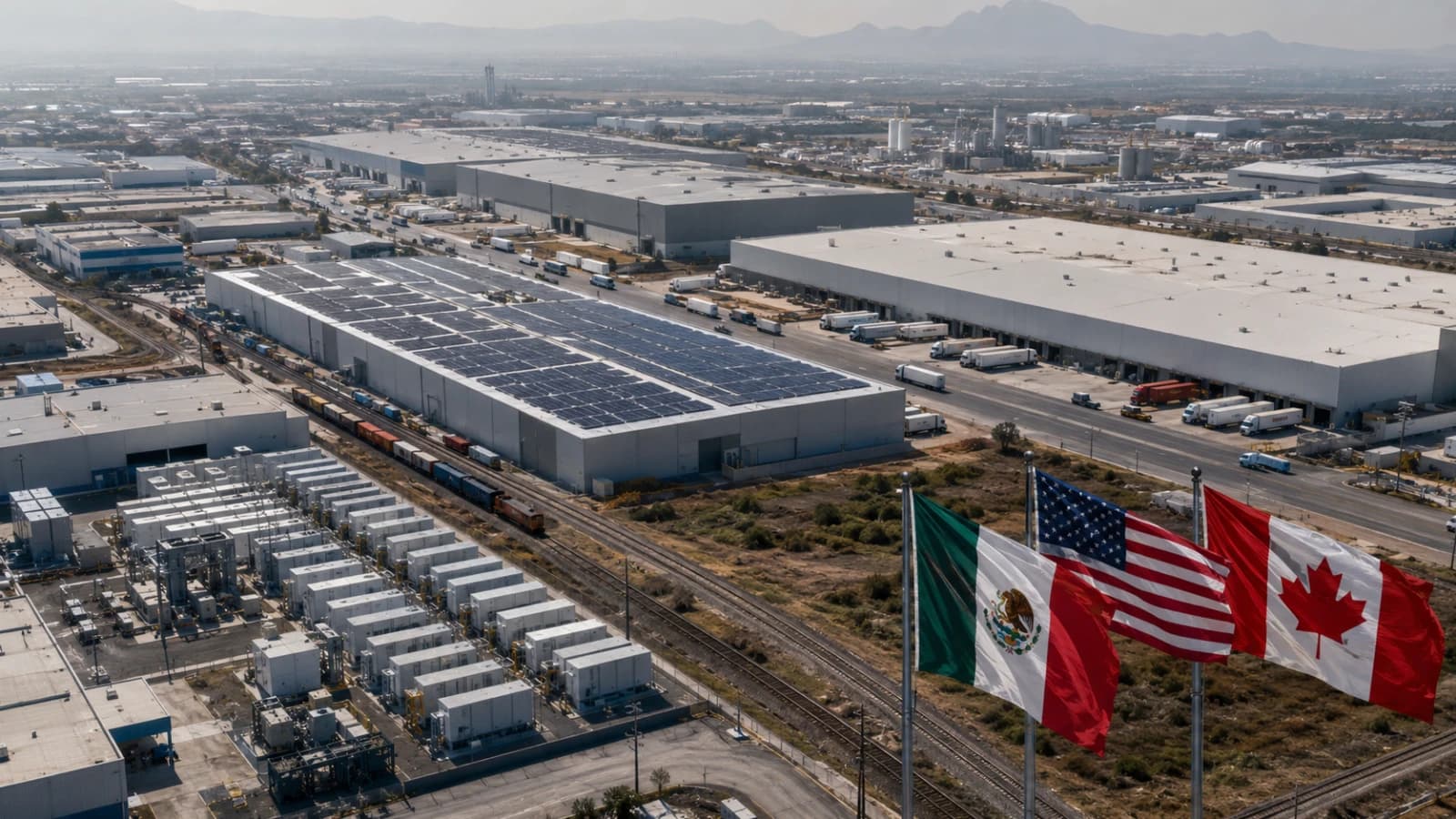
The review of the United States-Mexico-Canada Agreement (USMCA) opens a new chapter for Mexican industry. The process does not imply the suspension of the agreement, but it does require large corporations to recalculate investments, review supply chains, and more accurately assess trade, tariff, and operational risks .
Mexico retains a significant advantage: 85% of its exports maintain zero tariffs when it complies with the USMCA rules .
Nevertheless, negotiations on sectors that will maintain 10% tariffs, such as steel, aluminum, copper, and automotive, introduce uncertainty into activities directly linked to the construction of factories, industrial parks, and new energy infrastructure.
“We see that investments are arriving with greater caution, with much deeper and more rigorous analysis processes. I wouldn't say there's a halt. There is a slowdown, though,” said Víctor Gómez Aranzubia , industrial broker at Colliers, in an interview with Energía Estratégica .

However, the executive identifies a slowdown compared to the pace of decisions recorded during the first years of the decade.
“Investments aren’t being made as quickly as in 2020 and 2021, when it was more like, ‘Yes, it arrives, buy it.’ Now it’s more like, ‘Let’s analyze it first,’” explained Gómez Aranzubia. This trend even extends to projects whose disbursement won’t be made immediately, but rather after the North American trade landscape clears.
In this context, companies are not abandoning their installation or expansion plans, but they are extending decision-making periods and conducting more in-depth preliminary studies . This increased commercial caution is compounded by another, increasingly crucial factor: energy availability .
For companies considering setting up or expanding operations in Mexico, simply finding a well-located, connected, and cost-competitive facility is no longer enough. They also need to know the available power capacity, the connectivity offered by the area, and what options they have to reduce their exposure to electricity prices.
According to Gómez Aranzubia, when a company is looking for a distribution center or a production plant, one of the first requirements is knowing the available space. The next is determining how much electrical capacity the project can handle . This trend is forcing the real estate market to move beyond offering only square meters.
Specialized companies will need to integrate information on consumption, electrical infrastructure, self-consumption possibilities and connection capacity from the early stages of analysis.
“We are already integrating the square meters you need with your energy consumption in order to offer a service and a product that is aligned and that is operational and functional,” Gómez Aranzubia said.
The change particularly affects sectors with intensive demand, such as data centers, automotive, advanced manufacturing, medical devices, and aerospace. In these projects, the available megawatts can determine whether an investment goes ahead, is postponed, or seeks another location .
This strategy is also linked to the integration of Astris Finance into Colliers' global platform. The firm, specializing in infrastructure and energy transition, brings capabilities in project finance, mergers and acquisitions, capital raising, and strategic financial advisory services .
While new projects are proceeding with greater caution, some established industries are moving forward with their own solutions. Companies are incorporating solar panels and battery storage systems to reduce costs, improve operational continuity, and lessen their exposure to external constraints.
“ It’s no longer just about spending money to look good and meet sustainability criteria, but it’s actually becoming a financial benefit that allows them to be more efficient, more operational, and have better profit margins ,” said Gómez Aranzubia.
Continue reading
The decision between installing own assets or entering into a power purchase agreement depends on each company's profile, its consumption, management structure, capital availability, and the characteristics of the property.
For facilities with large surface areas, the roof is beginning to be seen as a productive asset. Colliers offers a tool that allows users to define the roof area of a building and calculate its photovoltaic generation capacity.
In one of the cases analyzed, a 38,376.9 square meter facility would have the capacity to generate approximately 7,039.4 MWh annually , equivalent to an average of 586.6 MWh per month. The system would prevent the emission of approximately 3,125.5 tons of carbon dioxide equivalent per year .
A potential of 41 GW on existing infrastructure
The national scale reveals a much greater opportunity. Colliers Mexico's Industrial Intelligence area monitors more than 18,000 warehouses and industrial buildings daily, representing approximately 184 million square meters.
The inventory is distributed among the country's main manufacturing markets, including Tijuana, Mexicali, Ciudad Juárez, Nuevo Laredo, Reynosa, Matamoros, Monterrey, Saltillo, Torreón-Gómez Palacio, San Luis Potosí, Guanajuato, Aguascalientes, Guadalajara, Querétaro, Mexico City, Toluca, Puebla, and Mérida.
The Colliers representative says that if 90% of that surface area were fitted with 670W photovoltaic modules, the installed capacity could approach 41,250 MW .”
This figure would make industrial rooftops one of Mexico's largest potential reserves for distributed generation. Furthermore, it would utilize existing surfaces without requiring new land or processes associated with land-use change.
That volume would far exceed the peak demand of several industrial states and could support the expansion of electricity-intensive sectors. However, its implementation will depend on regulation, permits, financing, local consumption capacity, and grid conditions.
Gómez Aranzubia believes that self-sufficiency through clean technologies is no longer a distant prospect. Cost reductions, increased technical knowledge, and the availability of suppliers are accelerating their adoption in plants.
“ We are no longer talking about what will happen in 10 years, but about what is already happening today in Mexico ,” he emphasizes.
The main challenge arises when generation exceeds user needs. Rooftops could produce electricity for schools, hospitals, sports facilities, or other nearby factories, but regulations and infrastructure still limit that possibility.
Therefore, the industrial future associated with the USMCA will not depend solely on tariffs and rules of origin. It will also be conditioned by the availability of megawatts, the expansion of grids, the regulation of self-consumption, and the capacity to finance generation and storage systems .
The trade review introduces caution, but does not eliminate the country's appeal. " We are seeing that large corporations of major international companies continue to view Mexico as a strategic platform due to its proximity to the United States, which is the largest consumer, and because of their market diversification strategy ," Gómez Aranzubia stated.
The change lies in the decision-making process. Before committing to a location, companies are more thoroughly analyzing construction costs, labor availability, logistical requirements, tariff exposure, and compliance with rules of origin.
In this scenario, the 41 GW identified on rooftops represent a concrete, albeit still potential, alternative. Their development would allow industrial buildings to cease being solely production and storage spaces and become energy assets capable of strengthening Mexico's competitiveness.