


The UK took a decisive step to accelerate the rollout of long-duration energy storage (LDES) with the release of preliminary decisions for the first window of the "Cap and Floor" scheme promoted by Ofgem, Britain's electricity and gas markets regulator.
The selected portfolio includes 16 projects totaling 7645 MW, of which 11 correspond to battery storage systems with lithium-ion batteries (BESS) totaling 3630 MW and 47.7 GWh, with autonomy reaching 18 hours, an unprecedented milestone for storage in Europe.
The award sends a market signal that goes beyond the selected capacity. While the program was launched to promote long-duration storage technologies like pumped hydro, the first call for proposals ultimately confirmed lithium's competitiveness in a segment that until recently seemed reserved for other solutions. The portfolio includes projects with durations ranging from 8 to 18.03 hours, demonstrating that batteries are beginning to expand their role in the energy transition.
The decision also comes amid strong expansion in the British energy storage market. As of September 2025, the UK had 6,872 MW of operational capacity in BESS systems , consolidating its position as one of the most developed markets in Europe for this technology. However, most of these installations were designed for short-term applications. The LDES scheme now opens a new chapter by incentivizing projects capable of providing flexibility over much longer periods.

47.7 GWh of BESS and durations of up to 18 hours
The preliminary portfolio selected by Ofgem includes 11 Li-ion BESS projects , totaling 3,630 MW of power and 47.7 GWh of energy capacity .
The selected projects are:
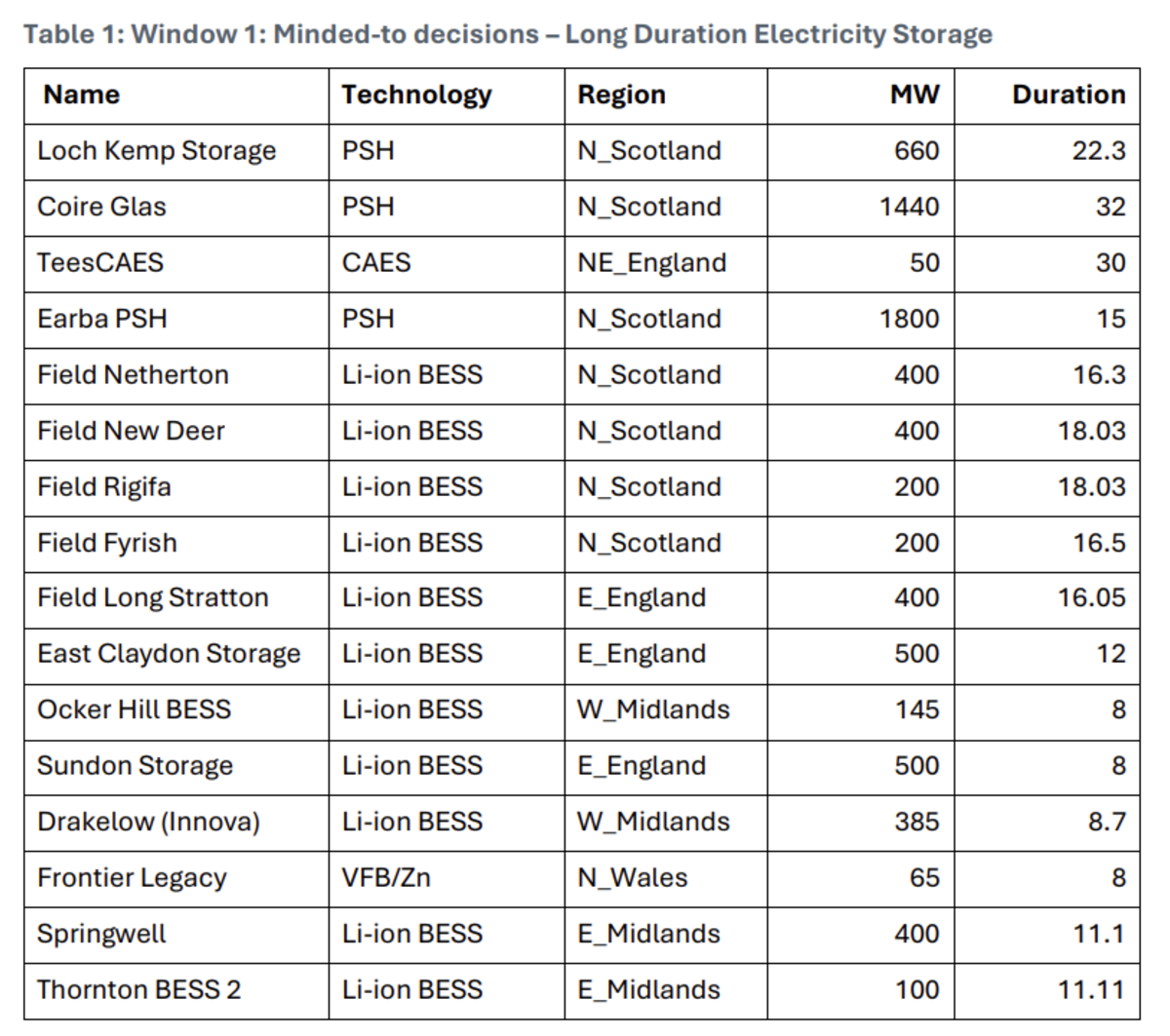
One of the major players was Field , which secured five projects totaling 1.6 GW and 26.8 GWh , with an average runtime of 16.75 hours . Following the announcement of the selection, the company's CEO and co-founder, Amit Gudka, stated that the UK's LDES "Cap and Floor" scheme has become a global benchmark for long-duration energy storage and emphasized that the awarded batteries, with runtimes of between 16 and 18 hours, will be among the longest-lasting in the world, helping to address the challenge of managing daily electricity supply.
Competition for access to the scheme was fierce. Of the 77 projects initially considered eligible, four withdrew before the evaluation began, so Ofgem ultimately analyzed 73 proposals. Of these, only 16 received a favorable preliminary decision, while 57 were excluded from this first round, primarily due to lower economic performance compared to the selected projects and a lack of sufficient strategic benefits to justify prioritization.
Unlike contracts for difference (CfD) or other tenders with a guaranteed price for energy, the British program does not set a tariff per megawatt-hour.
The scheme works through a mechanism called "Cap and Floor" , designed to reduce the financial risk of projects with long payback periods.
In practice, if the project's revenue falls below the "Floor," consumers cover the difference. Conversely, if revenue exceeds the "Cap," the developer returns the surplus to consumers.
The scheme has a standard duration of 25 years and the income thresholds are calculated from the specific costs of each project and financial parameters defined by Ofgem.
Where will the revenue come from?
The official document makes it clear that regulatory support does not replace the market. The main source of revenue will continue to be time arbitrage, that is, charging the batteries when electricity prices are low and discharging the energy when the market registers high values.
This is in addition to revenue from the Capacity Market , as well as other services provided to the electricity system. However, the regulator acknowledges that future prices for these activities remain uncertain.
To calculate the levels of financial protection, Ofgem uses predetermined rates of return , rather than setting a price for energy. Thus, the Floor guarantees a real return of 4.47% , while the Cap limits gains to a return of 7.48% , both adjusted for inflation using the CPIH index.
For investors, the main appeal of the mechanism lies in the reduction of uncertainty. Unlike other support models, the scheme does not guarantee a price for energy, but rather a range of revenues that improves the bankability of projects with high initial costs, while maintaining exposure to signals from the electricity market.
However, the award does not guarantee definitive access to the support scheme. Ofgem conditioned the "Cap and Floor" agreements on the fulfillment of a series of technical, regulatory, and financial milestones. Developers must demonstrate progress in securing financing, ensuring grid connection, achieving the Final Investment Decision (FID), meeting construction and commissioning deadlines, obtaining all required permits, and periodically reporting on the progress of each project. In case of non-compliance, the regulator may revoke the benefit.
In addition to providing security of supply, Ofgem expects these projects to reduce waste of renewable generation , especially in Scotland, where wind power production frequently exceeds the transmission capacity of the electricity grid.
By storing these surpluses and avoiding curtailment, the regulator believes that future "strike prices" that renewable developers will need to request in upcoming government auctions could also decrease, thus reducing system costs in the long term.
Britain's commitment to storage is not limited to the LDES program.
Meanwhile, the country continues to develop some of Europe's largest BESS projects. One of these is the Thorpe Marsh Green Energy Hub, where Sungrow will supply the technology for a 1.4 GW, 3.1 GWh storage system, developed by Fidra Energy and considered the UK's largest BESS project once operational.
This type of development shows that the British market continues to increase the scale of its assets while exploring configurations capable of providing greater flexibility to the electricity system, a trend that is now receiving strong regulatory support with the LDES scheme.
There will be new rounds
The public consultation on these preliminary decisions will remain open until August 7, 2026 , while the final awards will be published during the British autumn of 2026 .
Ofgem also confirmed that it plans to open new application windows , subject to consultation during 2026, with the aim of launching a second call in 2027 to continue expanding the long-duration storage capacity that the British electricity system will require in the coming years.
Industry experts warn that falling battery costs and the development of longer-lasting configurations are making lithium-ion increasingly competitive in applications that previously seemed reserved for traditional long-life storage technologies, such as pumped hydro or compressed air.
Beyond the allocated capacity, the first phase of the scheme raises a question for the global market: if lithium-ion batteries have already proven to be competitive in projects lasting up to 18 hours, are they marking the beginning of a new trend in long-duration energy storage?