


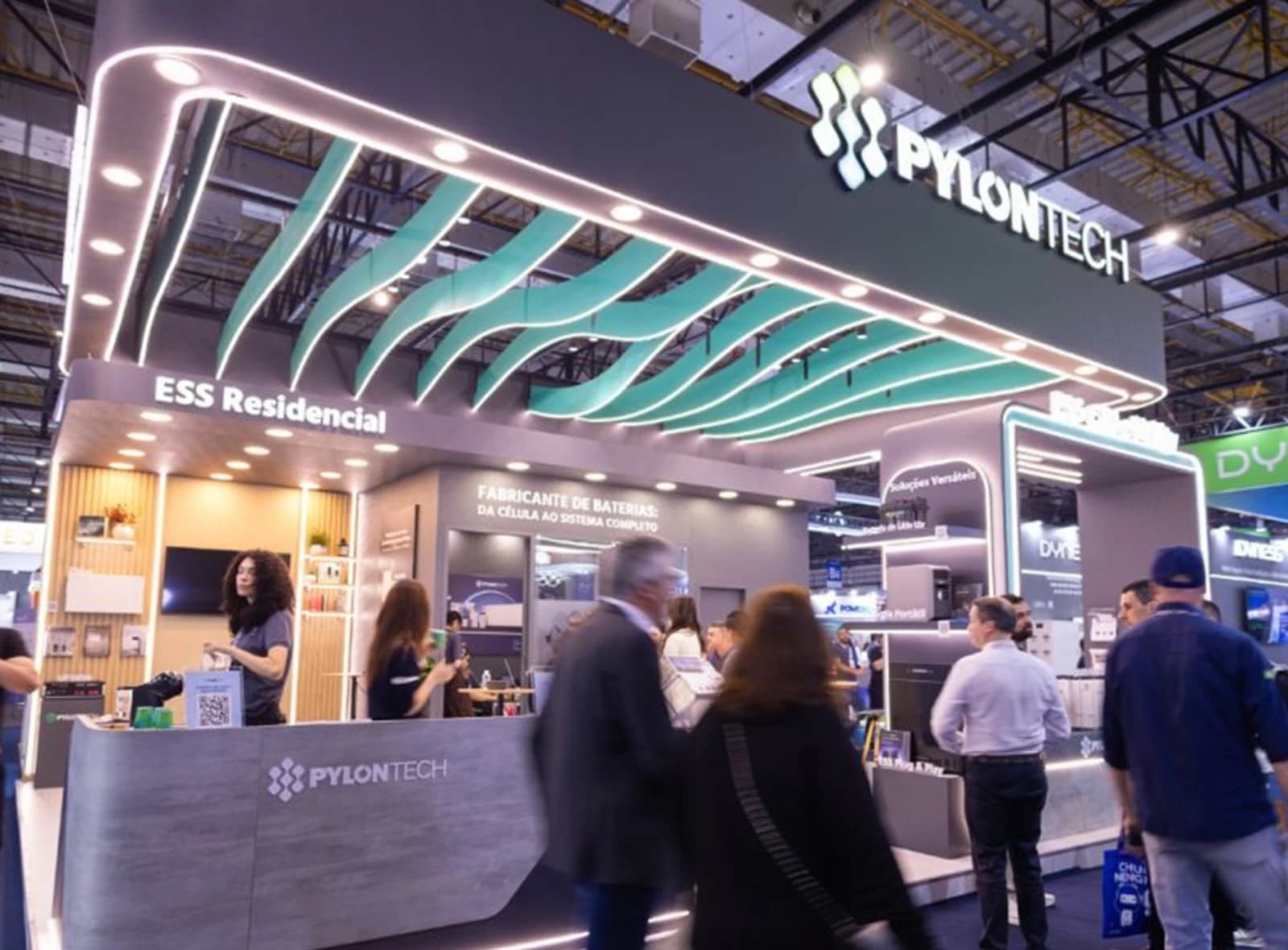
Pylontech expects its energy storage project portfolio in Brazil to reach approximately 2 GWh by 2027 , with opportunities encompassing residential, commercial and industrial (C&I) projects and large-scale projects.
These prospects arise against a backdrop of accelerating commercial activity in the Brazilian battery storage market. According to a survey by the consultancy Greener , the country had accumulated almost 1.9 GWh of battery energy storage systems (BESS) sold or contracted by the end of the first quarter of 2026. In 2025 alone, 730 MWh were traded, a volume equivalent to the total sold during the previous five years combined, while another 504 MWh were added between January and March of this year.
“Brazil is extremely important to Pylontech’s global strategy. We believe it has the potential to become the largest energy storage market in Latin America, and we see great potential for Brazil to become a regional hub for our business,” said Ricardo Seixas , regional manager for Brazil, in an interview with Energía Estratégica during Intersolar South America. 
The company's project portfolio is not focused on a single application. Pylontech sees opportunities in both facilities management and large-scale systems that are beginning to gain traction in the Brazilian energy sector.
One of the segments in which the company sees particularly strong prospects is C&I (Commercial and Industrial) .
This market is also supported by a growing distributed generation base that can increasingly be combined with battery storage. During the first half of 2026, Brazil's micro and mini-distributed generation exceeded 50 GW of installed capacity , according to official data from the Ministry of Mines and Energy.
For Pylontech , however, the change is not just quantitative.
“The market is reaching a much higher level of maturity,” Seixas said.
The executive explained that two years ago, many conversations with customers focused primarily on understanding the technology itself and determining whether battery storage could generate a viable return on investment. Today, customers are looking for a broader range of benefits.
“Commercial and industrial customers are increasingly focused on the added value that storage can generate, including backup power supply, energy management, savings, and the ability to combine multiple revenue streams,” the regional manager noted.
This change is also giving rise to new business models.
Seixas highlighted the concept of Energy Storage as a Service , in which developers finance and operate storage systems for end users and share the resulting long-term savings.
This type of model can reduce the initial investment that customers must make and provide another way to accelerate the adoption of batteries in commercial and industrial facilities.
Energy security is also driving investment.
Savings are not the only factor that Pylontech believes drives market growth.
For certain commercial and industrial activities, energy security and reliability of supply are increasingly relevant when evaluating investment in battery energy storage systems .
“Today, energy security and reliability are among the most important factors, especially for businesses, where an interruption in the electricity supply can have a significant operational or financial impact,” Seixas explained.
However, the economic aspects vary considerably depending on the region and the customer profile.
In some cases, backup power and operational continuity are the top priorities. In others, the value proposition may be linked to higher electricity prices during peak periods, energy optimization, or the ability to combine different sources of savings and revenue.
“That’s why we believe there isn’t a single business model for commercial and industrial storage in Brazil. The value of the system must be designed based on the specific characteristics of the client, the region, and the application,” the executive emphasized.
This diversity of use cases also helps explain why Pylontech's 2 GWh projection does not depend solely on the future expansion of large-scale projects.
The scale of public services opens another avenue for growth.
Alongside the evolution of energy storage at user facilities, Brazil is beginning to develop a specific market for large-scale battery systems .
Continue reading
The country is expected to hold its first two capacity reservation auctions, specifically for battery energy storage, on December 2 and 4 , with supply starting in August 2028.
Interest from developers has already reached an unprecedented level. Brazil's Energy Research Bureau (EPE) registered 6,091 projects totaling 296,807 MW , setting a record for the number of projects registered in Brazilian electricity sector auctions.
This figure does not represent installed, qualified, or contracted capacity, but rather the volume of projects registered to participate in the bidding processes. Even so, it highlights the interest generated by the opening of a new market access route for battery energy storage systems (BESS).
Furthermore, the Ministry of Mines and Energy has established an indicative schedule for capacity reservation auctions in 2027, 2028, and 2029 , providing greater visibility into future capacity acquisition opportunities. The role of storage in these processes will depend on the needs and rules defined for each auction.
For Pylontech, the development of the large-scale installation segment therefore complements the opportunities it already sees in the residential, commercial, and industrial markets.
More renewable energy, greater need for flexibility.
The opening of the large-scale storage market also coincides with a growing need for flexibility in Brazil's electricity system.
The National System Operator (ONS) has warned that the high penetration of variable renewable generation, especially solar during peak hours, is increasing periods of excess generation. For the period 2026-2029 , the operator estimates that, in the most critical scenarios, production limitations could exceed 40 to 50 GW during certain periods, particularly on weekends and holidays.
Storage is among the tools identified to help address that challenge.
This week, the issue gained greater relevance after ANEEL approved a new regulation on October 6 to organize mandatory cuts in power generation , in a context of growing oversupply of renewable energy.
Seixas also identified this need for flexibility as another opportunity for large-scale battery energy storage systems.
Large-scale storage can help improve the utilization of renewable generation, while providing greater flexibility to an electricity system with an increasing proportion of variable resources.
For Pylontech, the Brazilian market is therefore creating different opportunities depending on the scale: backup power, energy saving and management in commercial and industrial applications, and flexibility and integration of renewable energy in larger projects .
From pilot projects to a greater local presence.
Pylontech's interest in Brazil predates the current market acceleration.
According to Seixas, the company has a presence in Brazil and has been involved in pilot projects since 2018. These include an R&D initiative encompassing battery technology research, one of the country's first virtual power plant (VPP) projects, and a microgrid application for agriculture that combines energy storage with a small hydroelectric system and photovoltaic power.
The strategy is now entering a new phase.
“ We are entering a new phase, moving from initial market development to consolidating our presence and building a stronger local platform to support customers and partners ,” the executive stated.
Pylontech aims to work across the entire value chain with developers, engineering, procurement and construction (EPC) companies, distributors, installers, utilities and end users, covering applications ranging from distributed solutions to large-scale systems.
Among the solutions that the company is positioning for the market is the L260-HY , designed for commercial and industrial applications and capable of integrating photovoltaic generation, battery storage and diesel generation into a coordinated energy system , with switching times of less than 10 milliseconds .
Pylontech also presents its latest high-capacity modular solution, offering up to 6.4 MWh of energy capacity for large-scale applications.
Given the increased commercial dynamism of the Brazilian market and the emergence of new opportunities in different segments, Pylontech anticipates that its diversified portfolio of projects in the country will reach approximately 2 GWh by 2027 .
“We believe that the next stage of Brazil’s energy transition will require greater collaboration across the entire value chain, and Pylontech is committed to being part of that process,” Seixas concluded.