


Mexico is not only reactivating its energy market. It is also changing the profile of those competing to develop new projects , with EPC contractors beginning to occupy positions traditionally reserved for developers and investors.
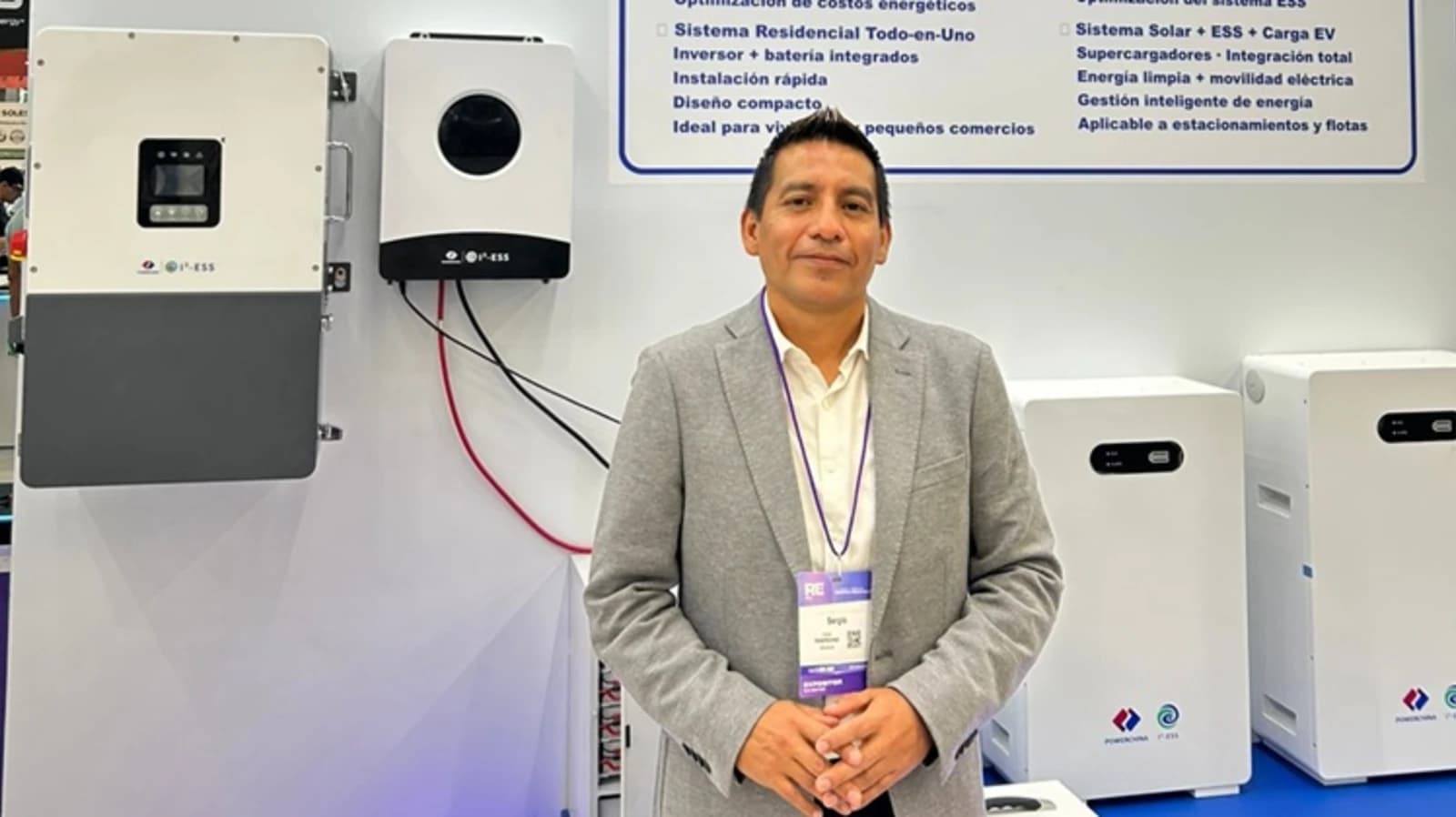
This change is one of the signs that most catches the attention of Sergio Linares, country manager of I²-ESS Mexico and head of the storage division , who observes that the latest calls for tenders have begun to draw a competitive map different from that known during the previous stage of the renewable energy market.
“ Yes, some of the winners surprised me ,” Linares acknowledged during the streaming event “It had to be said and it was said,” organized by Energía Estratégica, in which Andrés Cabrera, Commercial Director of AES Mexico, also participated.
The surprise, he clarifies, does not lie with the actors who maintained active projects during the years of less dynamism, but with companies whose business has historically been concentrated on the construction of infrastructure for third parties.
“ There are EPC companies that enter into these schemes; they are playing in other leagues ,” the executive argues.
The report finds concrete examples among the winners of mixed and private tenders. Companies like Aselco, Elecnor, and Solarig, traditionally linked to the EPC business, are now taking positions within project development , a sign of how the Mexican energy value chain is beginning to be reconfigured.
For Linares, this leap opens up a central question: experience as an EPC contractor does not necessarily guarantee financial capacity, bankability, or sufficient corporate structure to undertake the complete development of a generation asset.
The point will be especially relevant as the awarded projects move towards their next contractual milestones.
From EPC workers to developers: the new landscape created by the calls for applications
The shift is occurring in a market that has experienced several years of regulatory uncertainty and a slower pace of private investment. According to Linares, between 2019 and 2024 Mexico went through a period in which various companies reduced their activity or left the country altogether, while projects remained at different stages of development.
“ Many of them left Mexico and to this day have not returned to Mexico ,” he noted.
The new phase begins with binding planning and schemes that reopen the market to private participation. For I²-ESS, the difference compared to previous years is that the market now has rules that are once again generating interest among developers, investors, and suppliers .
“This new scheme that the Mexican government is implementing for binding planning will, in some way, allow this market to be reactivated,” Linares stated.
This return does not imply, however, that all submitted projects have the same probability of achieving commercial operation. The first mixed scheme sent a clear signal: compared to approximately 7,400 MW ultimately awarded, expressions of interest totaled around 38 GW. In other words, the volume initially submitted was more than five times the capacity that ultimately advanced through the process.
For I²-ESS, this gap clearly shows the distance between market appetite and the number of projects with real execution conditions.
“ I think so, 20, 25% are the ones that can really reach a successful conclusion ,” Linares stated.
In addition to the emergence of new players, another variable caught the attention of I²-ESS: the prices observed in the awards, which were in ranges close to 40 and 50 dollars per MWh .
“ As for the price, obviously it’s also a price that, from my point of view, I didn’t expect. It’s truly surprising ,” he admitted.
One of the first tests already appeared with the letters of guarantee, where some awardees needed more time to formally support the execution of their projects.
Guarantees are starting to separate solid projects from projects on paper.
Once certain projects were awarded, CFE required guarantees to support their execution. According to Linares, this step quickly revealed which developers had sufficient financial capacity and which faced greater difficulties.
Continue reading
“Many of the awarded projects did not provide the letter of guarantee and it took about two or three more weeks for them to be able to deliver it to CFE,” he explained.
The delay is not insignificant. “ It suggests that perhaps some projects, even though they had been awarded, didn't have the necessary resources to secure the required letters of guarantee from banks, credit institutions, or whatever they might need, ” the executive added.
The question is no longer just who gets the contract, but who has enough financial muscle to back it, structure the project and sustain it until commercial operation .
This is precisely one of the points where Linares observes risks regarding some of the new participants.
“ I don’t know if they will have the financial resources to be able to do them ,” Linares stated when analyzing, in general terms, the challenge faced by some of these new participant profiles.
However, the executive believes that the binding nature of the new planning should reduce the number of projects that ultimately fall by the wayside.
“ I believe that out of ten projects, nine will have to be done ,” projected the I²-ESS representative.
On the other hand, I²-ESS warns that Mexico's renewable energy expansion risks advancing faster than the infrastructure needed to transport that new electricity.
Each project will need to analyze nodal availability, evacuation capacity, and future network investments. This implies that the new wave of renewables could open up a second market of opportunities around lines, substations, network reinforcements, and storage solutions .
I²-ESS wants to move beyond being just an EPC provider and compete as a BESS technology company
This positioning also comes at a time when Mexico is opening a specific window for large-scale energy storage . In addition to the 30% battery requirement associated with new generation energy , there is a call for proposals for stand-alone BESS systems of nearly 1 GW , which is beginning to shape a dedicated market for this technology.
The company seeks to transfer to Mexico the experience gained in storage in China, where Linares points out that this technology began to gain more prominence from approximately 2015. Now, I²-ESS wants to use Mexico as a platform to expand its technological offering in Latin America.
“ We also manufacture the entire system ,” the executive stated, describing the company’s capabilities in utility-scale storage.
The strategy has a unique feature: I²-ESS doesn't want to compete exclusively as an EPC (Engineering, Procurement, and Construction) company, nor does it simply want to sell third-party equipment . Its aim is to position itself as a provider of comprehensive storage solutions, supported by its own engineering, integration, and operational capabilities.
“ One thing that sets us apart is that we understand the EPC (Engineering, Procurement, and Construction) aspect. In our projects in China, it was very common to find that batteries or BESS (Battery Energy Storage Systems) were already being used. So, what the group did was develop the entire BESS component in-house, with technological development within the company, to supply our own projects ,” Linares emphasized.
The advancement of storage is also generating another dynamic: increasingly aggressive competition among BESS providers .
That battle shouldn't be reduced to price. Linares argues that many manufacturers already present similar arguments regarding cycles, PCS, warranties, and performance, so competing solely on those parameters could end up eroding value.
“ We are not going to have a price war. What we want to do with our clients is: what problem do you have? How can we solve it? ” the country manager summarized.
This philosophy is directly linked to the scenario created by the calls for proposals. If the coming years will be defined by projects that require securing land, permits, financing, EPC, supply, and connectivity, suppliers capable of integrating complete solutions may gain relevance compared to those who compete solely with equipment .
Mexico has already proven that there is an appetite for new projects. Now a more demanding phase begins, where each award will have to demonstrate financial capacity, guarantees, infrastructure, and real viability to bring the projects to development and commercial operation before 2030.