


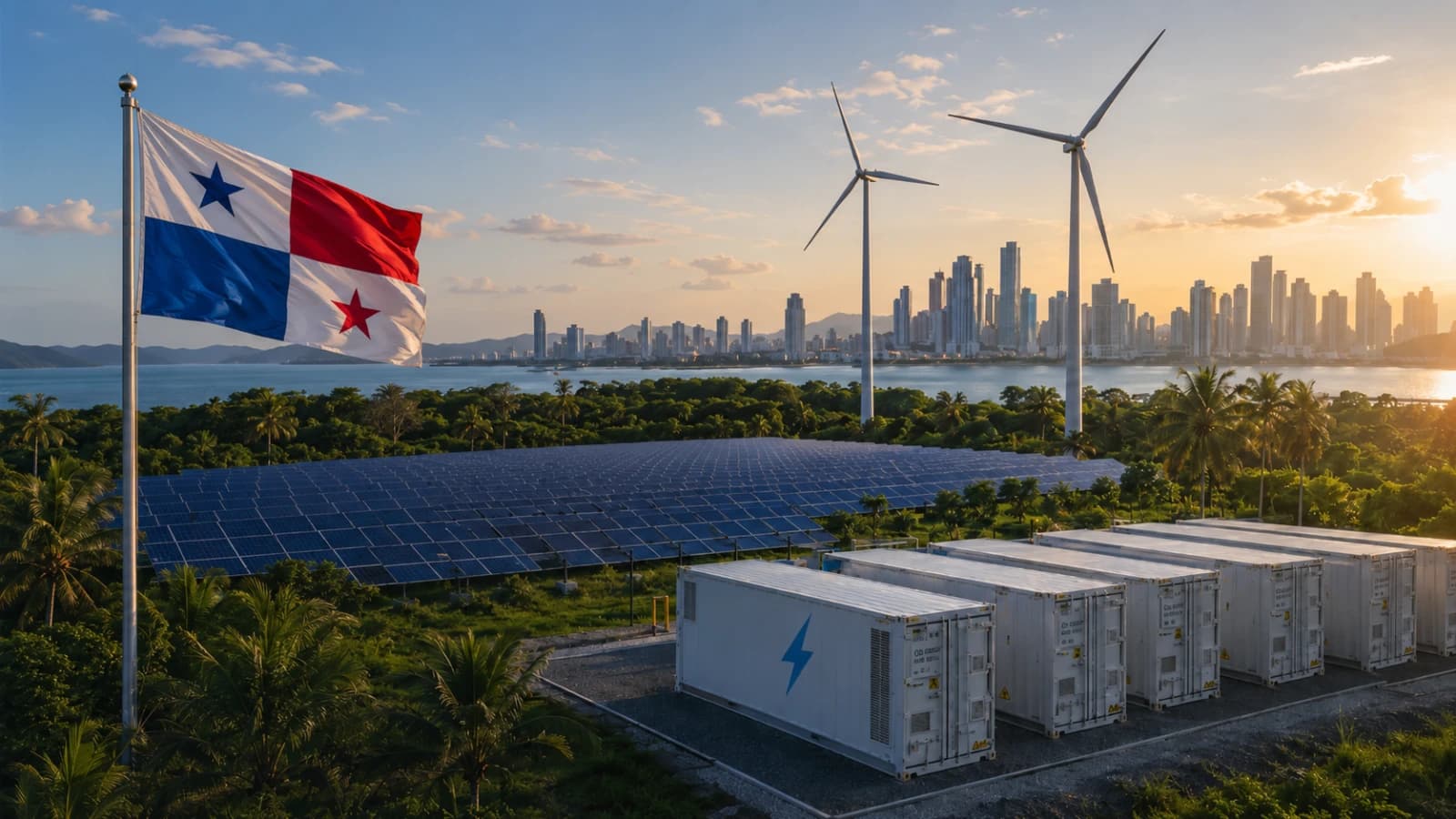
Panama ended June 2026 with 5120.19 MW of installed electrical capacity, of which 2954.22 MW came from renewable sources. Thus, hydroelectricity, solar photovoltaics, and wind power now account for approximately 57.7% of the national generation capacity .
The growth coincides with a transformation in the contracting of new supply: the last two renewable tenders awarded energy at average prices of 23.86 and 33.7 USD/MWh , through long-term agreements that seek to reduce exposure to the spot market and give greater predictability to investments.
The next phase presents a different challenge. With solar and wind power totaling 1106.65 MW , peak demand reaching 2161 MW, and new projects underway, battery energy storage systems (BESS) are beginning to gain traction in electricity planning.
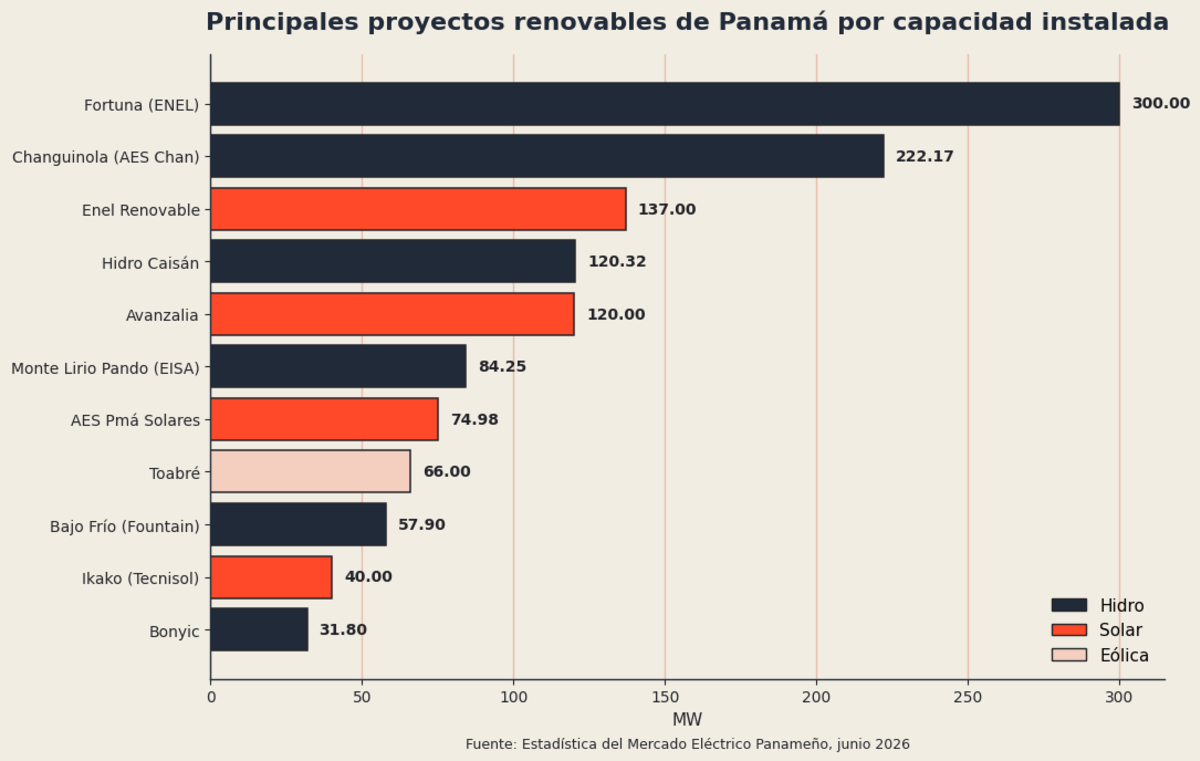
According to official market statistics, hydroelectricity remains the largest renewable energy source in terms of installed capacity , with 620 MW from reservoir plants and 1227.57 MW from run-of-river plants. Together, these two types account for 1847.57 MW, equivalent to 36.08% of the total capacity.
Photovoltaics already contributes 770.65 MW, 15.05% of the total installed capacity , while wind power accounts for another 336 MW, representing 6.56%. Thus, these two variable technologies represent approximately 21.6% of Panama's installed capacity .
This progress is unfolding in parallel with a new contracting dynamic. The ETESA 01-25 LPI marked the return of large-scale renewable energy tenders and committed approximately $441.1 million through long-term contracts.
The process left as one of its main signals an average price equivalent to 23.86 USD/MWh under the financial methodology foreseen in the tender and had a marked presence of wind projects, which displaced photovoltaics due to their capacity factors and generation profile.
Four companies concentrated most of the awarded energy, a result that confirmed private interest in the Panamanian market and opened a new stage of expansion based on contracts capable of providing greater financial certainty to developers.
The LPI ETESA 01-26 subsequently expanded upon this strategy. The call for tenders awarded approximately 22.6 TWh of renewable energy through contracts of up to 20 years , with AES leading the distribution and participation of solar developers, independent hydroelectric companies, and regional companies.
The bidding process received over 70 offers from 42 companies and closed with an average price of approximately $33.7 USD/MWh , below an initial reference price of $47.8 USD/MWh. Some proposals even fell below $30 USD/MWh, while several photovoltaic projects were priced around $32-$34 USD/MWh.
The results added a new signal to the market: the competitiveness of renewable generation no longer depends solely on adding capacity, but also on the ability to deliver energy with profiles compatible with the needs of the system .
Solar and wind power increase their weight in the energy mix
The detailed capacity figures reveal the scale achieved by some of the major projects. Among the solar assets are Enel Renovable, with 137 MW; Avanzalia, with 120 MW; AES Panamá Solares, with 74.98 MW; and Tecnisol, with a presence in various facilities within the system .
Monthly production also reflects an increasingly diversified photovoltaic base. Campo Solar generated 10,258.87 MWh during June , while Photovoltaics Eco Solar 1-6 contributed 6,068.48 MWh and the Tecnisol 1-4 facilities reached 5,584.47 MWh.
Other significant contributions included Universidad Panamá, with 3507.71 MWh; Baco Solar, with 3268.13 MWh; Alanje 1-2-3, with 3220.33 MWh; and Madre Vieja, with 3126.89 MWh . The document identifies dozens of photovoltaic installations operating in the country.
The wind power segment reached 336 MW of installed capacity . Within the generation reported for June, UEP II produced 33,000.13 MWh, Toabré contributed 16,138.78 MWh, and UEP I registered 7,493.75 MWh.
The combination of both resources is gaining importance for planning. The differentiated hourly profiles of photovoltaics and wind allow for complementary production , although a sustained increase in variable technologies also increases the need for resources that provide flexibility.
Hydropower, meanwhile, maintains the largest share of renewable energy production. Fortuna generated 139,928.79 MWh in June, accounting for 11.74% of total monthly electricity production , while Changuinola added another 65,630.06 MWh.
Estí reached 31,135.82 MWh; Monte Lirio, 28,979.06 MWh; El Alto, 22,944.83 MWh; Bajo Frío, 12,854.71 MWh; and Bonyic, 11,469.71 MWh. These plants were complemented by a set of smaller hydroelectric projects distributed throughout the system.
Among them, Barro Blanco produced 5464.54 MWh; Perlas Sur, 4400.74 MWh; Perlas Norte, 4326.04 MWh; and Concepción, 4167.95 MWh during the analyzed period.
Continue reading
Hydropower capacity continues to provide a relevant backup component for Panama, but the increase in solar and wind power raises the value of tools that allow managing surpluses, shifting generation between time slots, and responding more quickly to changes in demand .
BESS enters the next stage of bidding
Panamanian planning has already begun to incorporate this need. The country has reconfirmed two new tenders for 2027 and placed BESS systems among the priorities for the next stage , following two procurement processes that solidified interest in new renewable energy generation.
Before defining the conditions of these calls for tenders, the authorities plan to review the system's energy and power needs and submit the corresponding requirements before the end of 2026.
The timeline is part of a broader roadmap that includes four new tenders between 2026 and 2028 , with the aim of incorporating generation in a phased manner, reducing distributors' exposure to spot market volatility and ensuring future supply.
The strategy also projects a greater share of energy storage by 2029 , accompanied by investments in transmission. BESS thus emerges as a tool to facilitate the integration of new clean energy plants, strengthen grid reliability, and improve demand management.
This challenge becomes more significant as consumption increases. Peak monthly demand rose from 1778 MW in January 2026 to 2161 MW in June , representing an increase of 383 MW in five months.
Meanwhile, total capacity reached approximately 5120 MW , compared to a firm capacity of 3053 MW. The gap between these two indicators demonstrates why the upcoming expansion cannot be analyzed solely based on the nominal power entering the market.
With greater participation of solar and wind power, storage can shift energy towards peak consumption times, reduce potential spills, deliver power during critical periods, and provide services associated with grid stability .
The recent competitive bidding processes further intensified the regulatory debate. Various stakeholders in the sector anticipated that Panama will need to establish mechanisms capable of recognizing the value of energy storage and defining how this technology will participate in future tenders.
A specific framework will be relevant for financially structuring the projects and determining which services can be remunerated. The challenge includes reconciling this new capacity with long-term contracts, power requirements, and the overall functioning of the electricity market.
The evolution of marginal cost adds another element to this discussion. The indicator rose from 60.25 balboas/MWh in January to 105.65 balboas/MWh in June , after standing at 78.86 balboas/MWh during May.
The June value was also the highest of the 12 months included in the report , exceeding the 85.86 balboas/MWh recorded in September 2025.
The difference between prices for new renewable energy contracts below 35 USD/MWh and a marginal cost above 100 balboas/MWh in June reinforces the interest in contracting mechanisms capable of reducing buyers' exposure to the spot market.
The currently valid contracts present other economic references. During June, the three distributors contracted 427,602.69 MWh of hydroelectric power , with a total cost of 40.53 million balboas and an average monometric price of 94.78 balboas/MWh.
Wind and solar power accounted for 51506.61 MWh , with a total expenditure of 5.06 million balboas and an average mononomic price of 98.29 balboas/MWh.
These figures are not directly comparable with the prices of recent tenders, as they correspond to different contracts, periods, and structures. However, they do allow us to gauge the gap between the costs of the currently contracted fleet and the economic signals emerging from the new calls for tenders .
Panama thus reaches the second half of 2026 with more than 57% of its installed capacity concentrated in renewable sources, 2954.22 MW between hydroelectric, solar and wind and a contracting scheme that is incorporating new supply at competitive prices .
The upcoming tenders will determine the extent to which this expansion can be complemented by storage. The addition of BESS would allow the next stage to move beyond simply adding megawatts and towards a market where flexibility, time-of-use management, and backup capacity become increasingly important.