


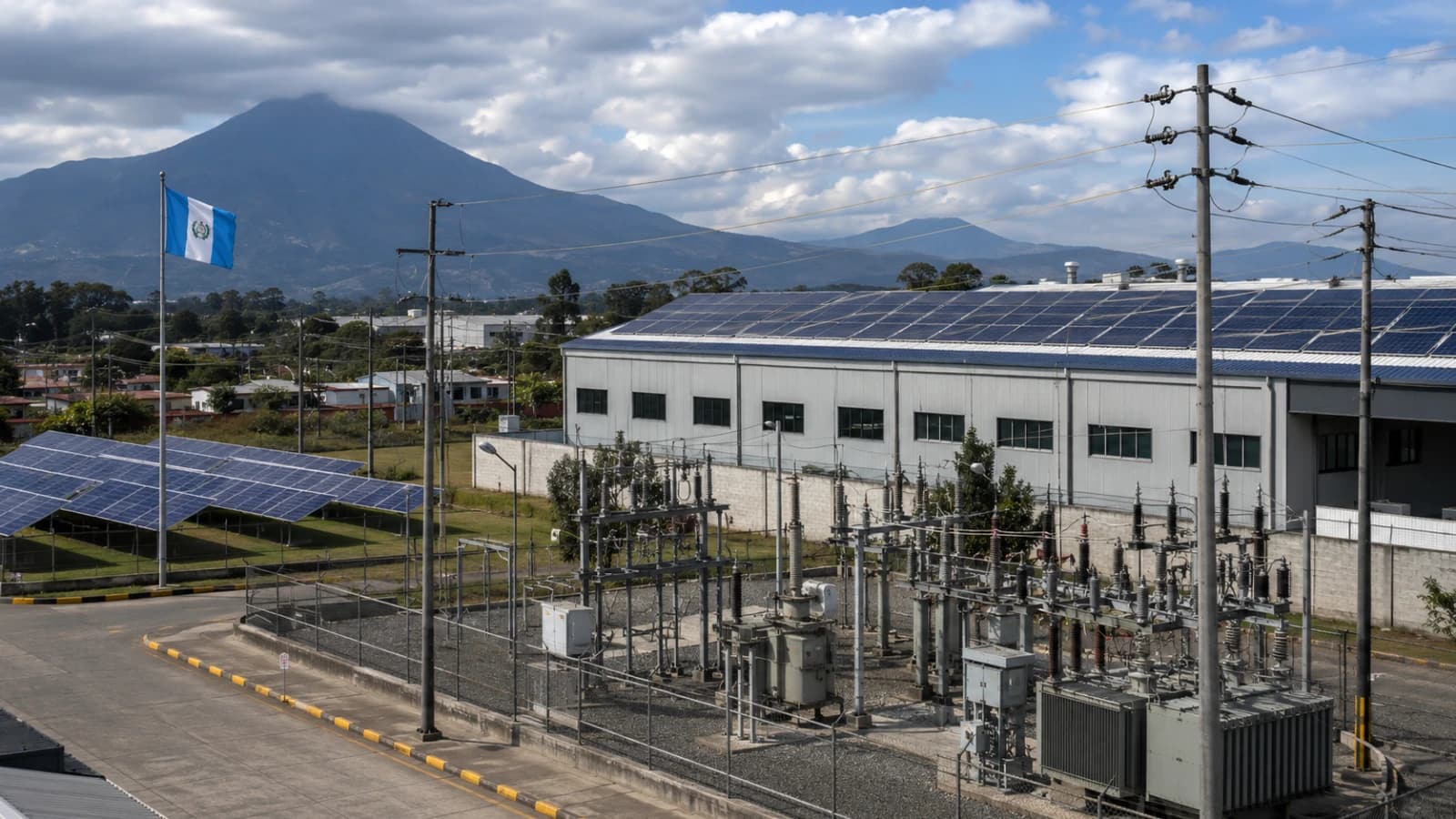
The new regulation of Renewable Distributed Generation (RDG) in Guatemala poses an immediate decision for developers who are already processing projects with distributors: maintain the conditions applicable at the beginning of the file or expressly request their incorporation into the scheme approved by Resolution CNEE-230-2026 .
The choice will affect the economic and contractual structure of each project. The new framework modifies the interconnection procedure, reorganizes the relationship with distribution companies, and requires a guarantee of 5% of the estimated investment amount , which must be considered in financial planning.
Published on July 27, 2026 , in the Diario de Centro América, the provision will take effect 15 days later, on August 11. Its scope includes renewable energy plants that inject up to 5 MW of net power into the Distribution System.
The regulation replaces a substantial part of the scheme approved by Resolution CNEE-227-2014. Among the repealed provisions are several articles that until now governed the connection process for distributed generation.
Ongoing projects will have two regulatory alternatives , without automatic migration. Article 27 establishes that applications initiated before the entry into force will continue under the previous procedure, unless the interested party expressly states their intention to adopt the new regulation.
The right to choose belongs to the developer , not to the distributor or the National Electric Energy Commission (CNEE). This point will be crucial for those who have already allocated resources to studies, engineering, permits, and administrative procedures.
Although the resolution does not set a single stage for exercising that option, it will be advisable to define it before the distribution company issues substantial decisions on available capacity, electrical studies or access conditions.
A subsequent migration could open up controversies about the rules applicable to actions already carried out, the documentation that must be updated, and the obligations that arise under the new procedure .
The main financial impact arises from the signing of the Interconnection Agreement. The interested party must provide a guarantee equivalent to 5% of the estimated investment in the power plant , intended to support the execution of the project and its connection within the authorized timeframe.
The regulation empowers the distributor to implement this backup plan when the developer fails to complete the interconnection within the allotted timeframe. This obligation introduces an additional variable during the structuring and financial closing stages.
For a power plant with an estimated investment of $10 million , the backing would amount to $500,000 . Although this amount does not necessarily represent a final outlay, it can generate bank fees, jeopardize lines of credit, or reduce the capital available for construction and equipment.
For this reason, the migration must be evaluated in conjunction with its operational benefits and financial cost . The analysis will have to consider the progress of the project, the approved studies, the resources already committed, and the expected date for becoming operational.
It will also be necessary to assess the execution risk. The developer must know precisely the connection timeframe, the conditions that trigger the guarantee payment, and the actions required to demonstrate compliance with the schedule.
The comparison between the two procedures should not focus solely on processing speed. The legal certainty of the actions taken, available capacity, position within the application queue, and the required network infrastructure work can have a greater impact.
Article 27 preserves the effects of actions validly taken when the interested party opts for the new framework. Outstanding requirements, however, must be adapted to Resolution CNEE-230-2026, which may require additional documentation or a review of the technical conditions.
This transitional regime prevents the case from returning completely to its initial state, although it leaves open possible interpretative differences regarding the scope of previous studies, recognized investments, or decisions issued before the change.
Resolution CNEE-230-2026 structures the procedure around the Capacity and Connection Assessment (DCC) . The document must contain the interconnection proposal, the technical evaluations, the required works, and the terms that will later be included in the Interconnection Agreement.
Continue reading
The framework also incorporates a Management Order , determined by the date and time each request is declared complete and valid. This order will define the sequence of service and help distribute the financial responsibilities for the updates needed to enable each connection.
This consideration is particularly relevant in networks with limited capacity. The administrative location of the file may affect the availability of the interconnection point and the costs of the reinforcements or expansions required for the simultaneous integration of different projects.
Distributors will also be required to provide digital channels for submitting applications, tracking their progress, and allowing for regulatory oversight. Platforms will need to provide traceability of all actions taken and facilitate the monitoring of each step.
In turn, companies will be required to designate a contact unit and publish indicative information about their network capacity. Every six months, they must publish maps identifying congested, saturated, or technically restricted areas.
These instruments will also identify areas where the GDR can reduce losses, alleviate burdens, or generate operational benefits , although their nature will be referential and will not automatically guarantee access.
From the date of entry into force, distributors will have 60 days to submit their network codes, digitization mechanisms, and cost proposals to the CNEE. If the count begins on August 11, the deadline will be October 10, 2026 .
During this period, a significant portion of the practical application of the scheme will be defined. Charges for processing, studies, operation, and dispatch will be key variables in calculating the total connection cost.
For this reason, the formal implementation of the resolution will not immediately clarify all the economic conditions . Developers must await approval of each distributor's codes and methodologies before finalizing their budgets.
The regulations also require compliance with the international standard IEEE 1547 for interconnection. Investors will need to demonstrate compliance with UL 1741 or its equivalent from the International Electrotechnical Commission, which will raise the requirements for safety and technical response.
In operational terms, the distributor will manage and dispatch the generation connected to its network. It may also require corrective measures when a power plant causes adverse impacts on the quality, stability, or reliability of the supply.
Storage systems can be integrated into power plants, but they can only be charged with the project's own production . This restriction will prevent drawing electricity from the grid, storing it, and then selling it as generated by the facility.
The regulatory change coincides with a review of other components of Guatemala's electricity expansion. The CNEE authorized a new tender to cover the remaining 300 MW of the PEG-5 project , linked to the additional needs arising from increased demand.
The contracting timeline also forced generators to recalculate bids, guarantees, and contractual terms. The start of supply was set for November 1, 2026 , while companies of varying sizes evaluated the updated schedule.
In parallel, the PEG-5 awarded 1258 MW distributed across 57 projects , with a renewable share of 73% . This volume will increase the demands on transmission, firm power, and the services required to incorporate new capacity without creating operational constraints.
This context expands the scope of Resolution CNEE-230-2026. Guatemala is moving forward with the contracting of new generation while reorganizing the conditions of access, operation and use of networks subject to greater technical requirements .
For ongoing GDR applications, the priority will be to avoid automatic selection. Each applicant must review their position, quantify the cost of the guarantee, identify their outstanding obligations, and document the arrangement under which the process will continue.
The regulation aims to modernize access and improve the traceability of the procedure. However, its first effect on existing projects will be to require a decision with a concrete financial, regulatory, and contractual impact .