



The International Renewable Energy Agency (IRENA) warns that the record growth of renewable energy is still not enough to meet the global goal of tripling installed capacity by 2030.
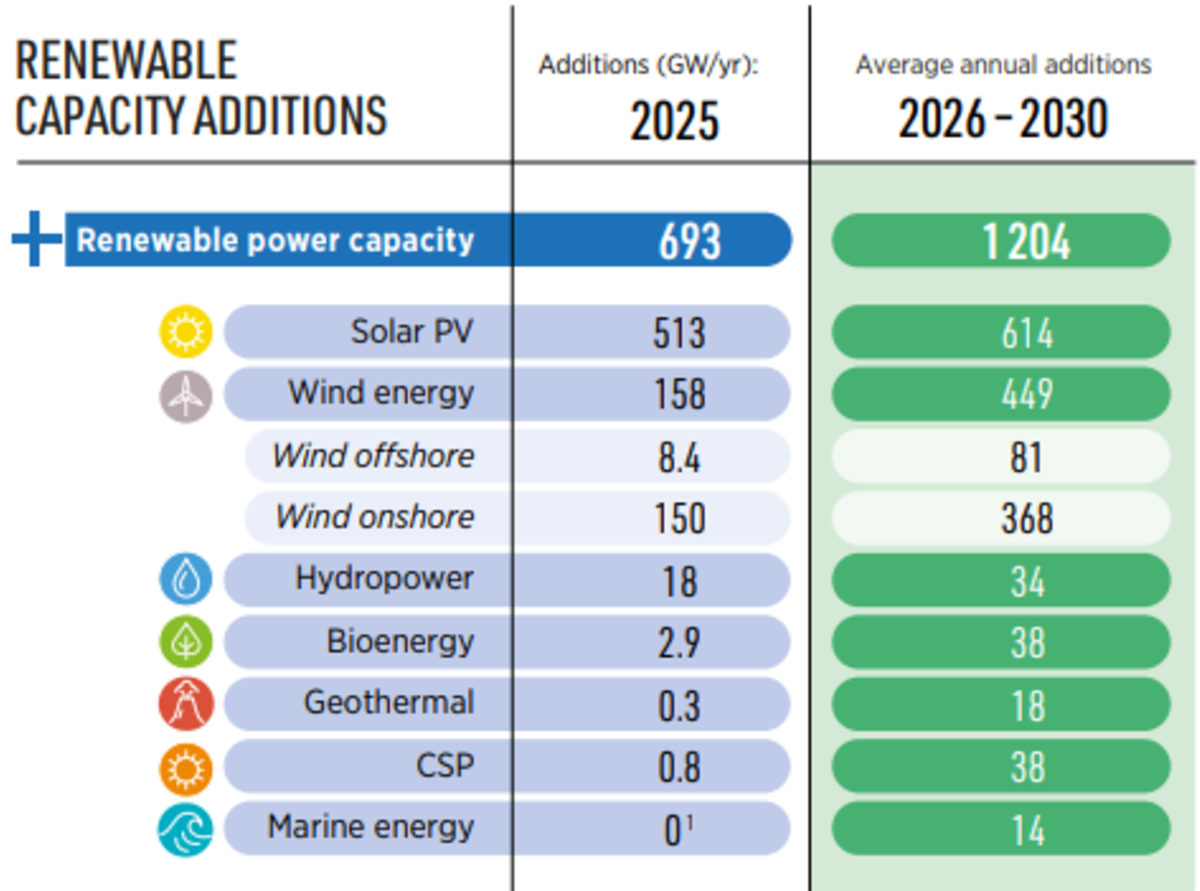
Why? While IRENA estimates that global renewable capacity reached 5.15 TW by the end of 2025 , after adding a record 693 GW in a single year , it also points out that, to close the gap, the world will need to accelerate deployment to an average of 1200 GW per year between 2026 and 2030.
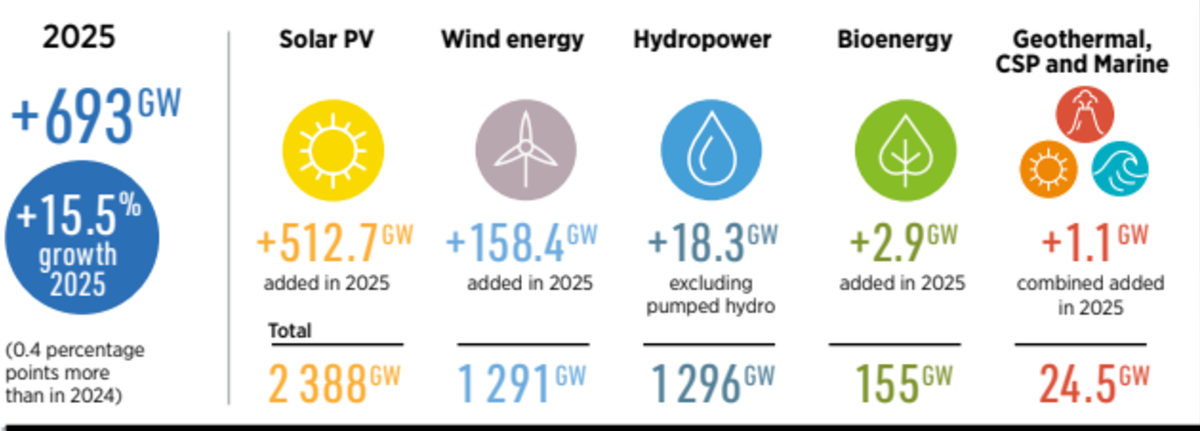
However, to reach 11.2 TW by 2030 , the system will need to more than double current levels in just five years.
This means installing more renewable capacity between 2026 and 2030 than in all previous years combined , according to the report prepared by IRENA, the COP31 Presidency and the Global Renewables Alliance.
The document also shows that the challenge is not solely about adding generational capacity.
Energy intensity improved by around 2% in 2025 , well below the 4% per year needed to meet the target of doubling the global rate of improvement in energy efficiency.
“Renewable energy can still close the gap by 2030, but energy efficiency is lagging, electricity demand is increasing faster than expected, and grid infrastructure has not been able to keep up,” said Francesco La Camera, Director-General of IRENA.
The organization suggests that the next stage should combine more generation with a parallel acceleration in networks, storage, flexibility, and electrification .
One of the main fronts will be the electrical infrastructure.
The report estimates that nearly USD 1 trillion per year will need to be invested in networks between 2026 and 2030 , more than double the levels recorded in 2025.
The goal is to support the growth of renewables, reduce connection bottlenecks, and allow a greater proportion of solar and wind power to be safely integrated into the system.
Storage appears as another of the pillars.
Battery costs fell approximately 30% between 2024 and 2025 and nearly 95% since 2010 , which is beginning to change the economics of projects and the way new renewable capacity is designed.
The combination of solar power and storage is already starting to gain scale.
According to the report, around a quarter of the utility-scale solar capacity put into operation during 2025 incorporated integration schemes with storage.
Solar, wind and storage will need to cover an increasingly larger portion of the system.
IRENA projects that by 2030 variable renewables, mainly solar and wind, will exceed the total installed capacity of fossil fuels .
Together they would represent approximately 62% of all installed global power , compared to around 35% in 2025.
Solar power will continue to be one of the main drivers of growth.
The report predicts that average annual net additions of photovoltaics could double by 2030 compared to 2025 levels , solidifying this technology as one of the main pillars of global electricity expansion.
But that growth will require more flexibility.
IRENA proposes accelerating the development of systems that combine solar, wind, and storage to deliver firm energy 24 hours a day , as well as expanding the use of digitalization and artificial intelligence to coordinate demand, generation, and grid operation.
António Guterres, the United Nations Secretary-General, warned that renewable energy records must now translate into greater acceleration.
“ Renewable energy records are being broken year after year, but we must go further and faster to remove the obstacles that are delaying the transition ,” he said.
The agenda also extends beyond 2030.
COP31 will seek to promote a new target for 35% of final energy consumption to be electrified by 2035 , which would accelerate the replacement of fossil fuels in transport, buildings and industry.
IRENA's new assessment thus reveals a clear paradox: the world has never installed as much renewable energy as in 2025, but the record pace would still need to almost double to meet the 2030 target .
With 5.15 TW already operational and a target of 11.2 TW, the next five years will be crucial. The bottleneck will no longer be solely in building more solar and wind power, but in having grids, batteries, flexibility, and electrified demand capable of absorbing that growth .