


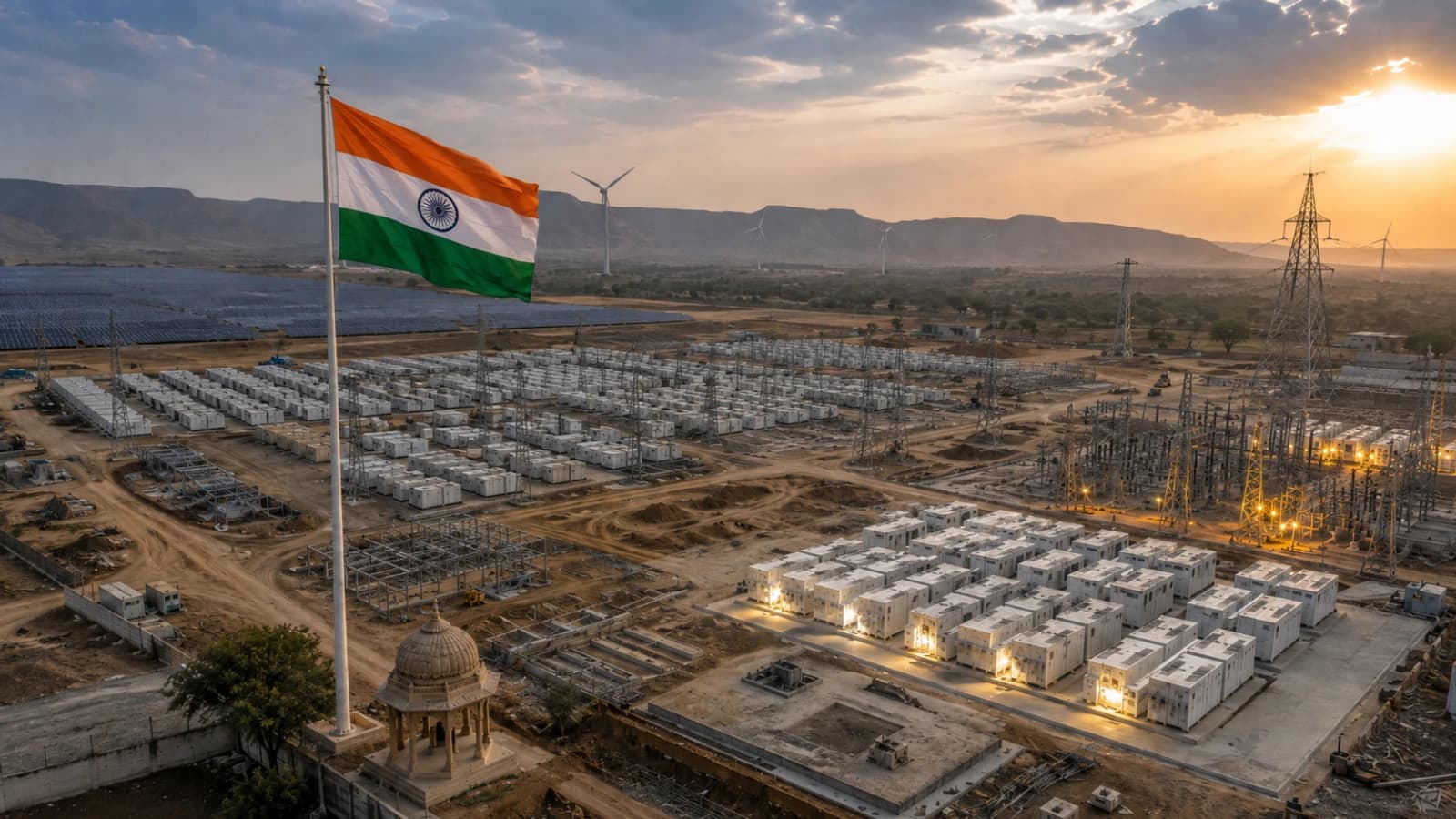
India has surpassed 100 GW of energy storage capacity tendered, although transforming that pipeline into operational assets now appears to be the market's main challenge. As of June 2026, the country had 103.4 GW tendered, around 50 GW awarded, and only 10.3 GW actually commissioned.
This means that less than 10% of all the power put into service is already operational , according to the latest edition of EnergyWatts , prepared by the Institute for Energy Economics and Financial Analysis (IEEFA) and JMK Research & Analytics.
The Central Electricity Authority (CEA) projects 60.63 GW of storage capacity by fiscal year 2030. Compared to current levels, India will need to increase its operational capacity almost sixfold over the next four years, while simultaneously accelerating the integration of variable renewables into its electricity system.
The gap is even wider within the battery segment. India has 2.9 GW of BESS (Battery Energy Storage System) compared to a target of 41.65 GW by 2030 , while pumped hydro storage totals 7.4 GW and aims for 18.98 GW.
The current composition also reflects the technological shift taking place in the market. Of the 10.3 GW commissioned, 7.4 GW correspond to pumped hydro storage and 2.9 GW to battery storage systems , the latter equivalent to 8.3 GWh.
Nearly 5 GW of pumped storage capacity was installed before 2021 , while more recent additions are being led by battery storage systems. Around 82% of all currently operational BESS capacity was added during the last three months surveyed by IEEFA and JMK Research.
The report defined this process as a “rapid shift” toward battery-led deployment. The speed of commissioning thus began to change, although a considerable gap still exists between projects launched on the market and those that have actually achieved commercial operation.

India tendered 7232 MW of storage during the first three months of fiscal year 2027. Of that total, stand-alone BESSs accounted for 3182.5 MW, about 44%, and consolidated themselves as the dominant modality of the new tenders.
In June alone, authorities launched 4.2 GW of grid-scale storage, an 85% increase over the previous month . Standalone BESS systems accounted for 2.9 GW, while firm and dispatchable renewable projects added 1.2 GW, and clean generation combined with storage initiatives contributed another 100 MW.
The two-hour configuration still accounts for the majority of the volume, with around 3 GW of the quarter's tenders . However, four-hour solutions began to gain traction after a clarification from the Ministry of Energy that enabled minimum daily downloads of four hours.
Vasu Mor, Research Associate at JMK Research & Analytics, linked the growth in calls for proposals to “declining battery prices” and to the public support measures implemented for stand-alone BESS devices.
Among these tools is Viability Gap Funding (VGF) . Tenders launched in June by MSEDCL, GUVNL, and KREDL provided support of up to 1.8 million rupees per MWh—around $18,955/MWh—for a combined volume of 2,900 MW of stand-alone batteries.
In parallel, the market began demanding systems capable of delivering energy over longer periods. NTPC Renewable Energy Limited launched 1140 MW of four-hour stand-alone BESS in June , linked to solar plants located in Gujarat, Rajasthan, and Uttar Pradesh.
These assets represent more than 90% of the 1260 MW of EPC storage tenders published during the month and were intended to shift a greater proportion of daytime solar generation towards evening demand periods.
The expansion, however, still shows significant differences between the processes launched and the contracts actually awarded. During the first quarter of fiscal year 2027, approximately 920 MW were awarded, a 78% year-on-year decrease , despite the growth in the volume tendered.
Continue reading
Rama Reflection India, KCC Buildcon and Stockwell Solar concentrated approximately 64% of the awarded capacity during that period within the independent BESS segment.
Prabhakar Sharma, Senior Consultant at JMK Research & Analytics, warned that participants will need to “recalibrate to execution realities” after the aggressiveness observed in certain offers in the Indian market.
This warning is particularly relevant because not all contracted capacity starts from the same economic conditions to become operational . A previous analysis by IEEFA and JMK Research determined that, among the two-hour stand-alone BESS units awarded during 2025, approximately 75% of the evaluated capacity fell into a risk category compared to the tariff benchmark used by the authors.
The first GWs are starting to come out of the pipeline
Despite implementation challenges, the commissioning pace accelerated significantly at the start of fiscal year 2027. By June, India had added approximately 2440 MW / 7526 MWh of BESS, in addition to 250 MW of pumped hydro storage.
Approximately 215 MW / 545 MWh of new capacity came online in June, all of which was battery storage . These additions accounted for about 8% of the total capacity commissioned during the fiscal year up to that point.
ACME Solar Holdings commissioned projects in Phalodi and Jodhpur totaling 33 MW/120 MWh and in Jaisalmer totaling approximately 120 MW/240 MWh , while Adani Green Energy added around 62 MW/185 MWh in Khavda. All three projects operate on a merchant model.
IEEFA and JMK Research noted that independent BESS projects tendered over the past two to three years “are now beginning to move into operation.” The authors therefore predicted an acceleration as construction progresses on the already awarded assets.
The contracted volume provides room to sustain this trend. Of the 103.4 GW tendered, some 50 GW have already passed the award stage , so much of the challenge has shifted towards financing, equipment supply, construction, connection, and commissioning.
One of the biggest distortions within the pipeline is related to pumped hydropower. This segment accounts for 34% of the tendered capacity , largely due to the 16.4 GW project by Rewa Ultra Mega Solar Limited in Madhya Pradesh, launched in 2023 and delayed by restrictions related to identifying suitable land and sites.
In contrast, firm and dispatchable renewable projects and those that combine clean generation with ESS show a relatively faster conversion from bidding to award , according to the report.
India is part of a global race for storage
India's acceleration is part of a broader international trend. New auctions are increasingly combining renewables, storage, and firm capacity , while Europe, Australia, South Africa, Saudi Arabia, and India are simultaneously increasing the volume of opportunities.
Saudi Arabia offers a benchmark for the speed at which this deployment can be achieved. The Saudi market reached 12.5 GWh of connected BESS and accounted for 37% of global connected utility-scale storage in June , compared to 30% for China and 7% for Europe, according to a survey by Energía Estratégica.
Europe presents another snapshot of the gap that can exist between awarding and building projects. During 2025, more than 80 GWh were allocated through public mechanisms in at least ten European countries, while only about 25 GWh were actually built that year.
Within this scenario, India already has sufficient contractual scale to become one of the core markets of the next global wave of storage , although the capacity currently commissioned confirms that the volume of competitive processes still needs to be moved to physical assets.
The next determining indicator will be the speed at which the 50 GW awarded begin to become connected projects , especially within BESS, where the country starts from 2.9 GW and should reach 41.65 GW by 2030.
With 103.4 GW put into the pipeline and only 10.3 GW operational, India's challenge is no longer solely about generating new competitive processes. The market's capacity to finance, build, and connect the contracted volume over the next four years will determine how much of that enormous pipeline is actually integrated into the electrical grid.