


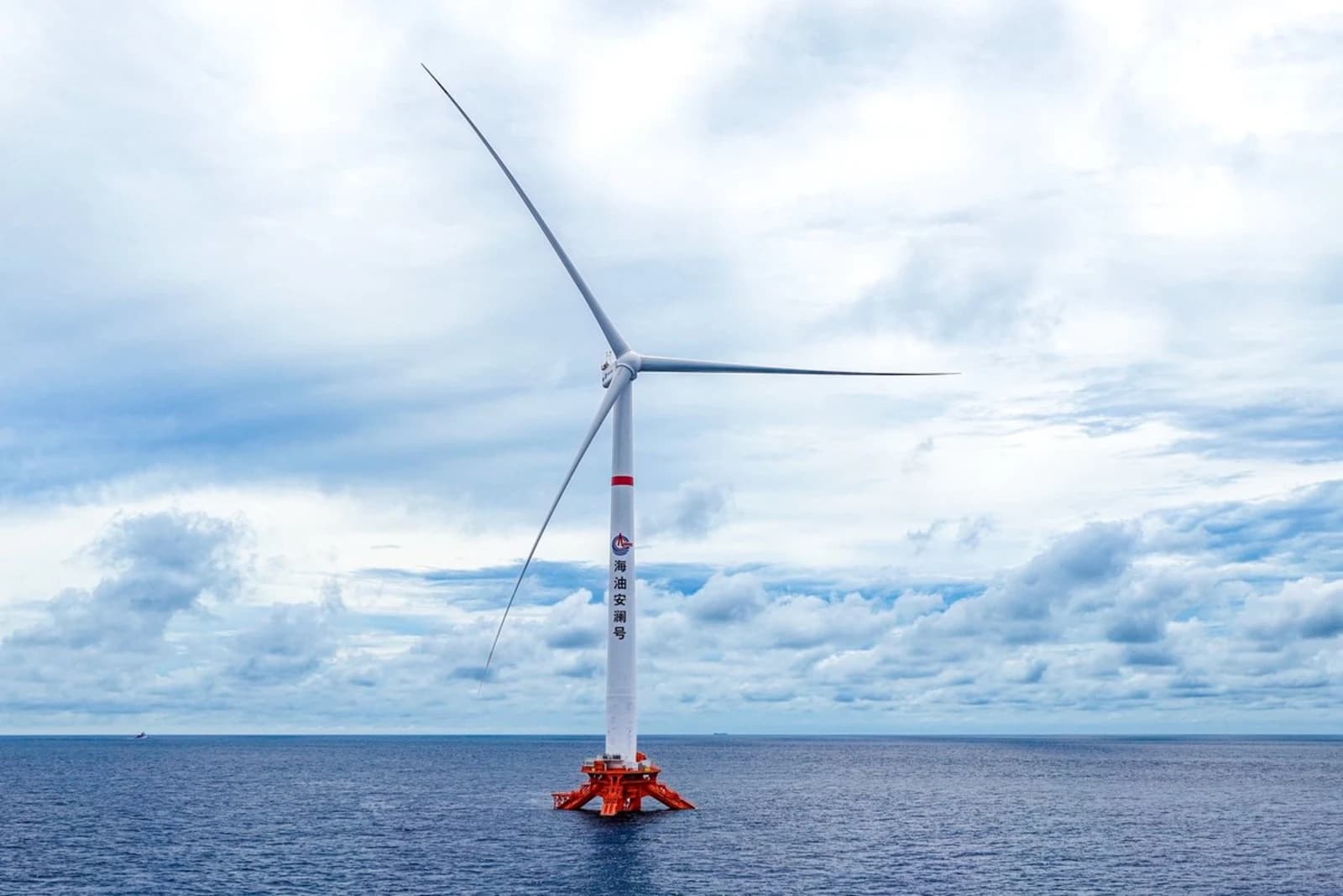
China National Offshore Oil Corporation (CNOOC), the state-owned oil company, has put into operation the world's first 16 MW floating offshore wind platform (TLP) , designed to supply electricity directly to its offshore oil and gas operations.
The facility was connected to the electrical grid of the Lufeng oil field in the South China Sea on August 6th via underwater infrastructure. The project is located 136 kilometers off the coast in waters 136 meters deep .
The platform is equipped with a 16 MW wind turbine and was designed to operate for 25 years in extreme marine conditions. According to CNOOC, the structure can withstand Category 17 typhoons.
Its scale also reflects the complexity of the development: it reaches a height comparable to a building of approximately 110 floors and weighs close to 7,800 tons.
Once fully operational, it is expected to generate around 54 million kWh annually , equivalent to 54 GWh, which will be used directly by CNOOC's offshore facilities.
The supply will allow for the replacement of some of the liquid fuel-based power generation currently used by oil operations. The company estimates savings of approximately 15,000 cubic meters of fuel oil per year and a reduction of about 35,000 tons of CO₂ annually .
Unlike a wind farm connected directly to the conventional electrical system, the project will be part of its own energy network linked to the deposit.
CNOOC will combine wind power generation with energy storage and conventional generation , with the aim of compensating for resource variations and maintaining a stable supply for oil and gas facilities.
The configuration allows wind power to cover a greater proportion of offshore demand without compromising the continuity of operations that require electricity on a permanent basis.
The company aims to use renewable generation to reduce fuel consumption on platforms located far from the coast, where electrification from land can be technically complex or too expensive.
Floating wind turbines for deepwater oil operations
The technology used is a tensioned leg platform, known as a Tension Leg Platform (TLP) . This type of floating structure remains anchored to the seabed by tensioning systems that limit its movement in response to wind and waves.
The solution allows large wind turbines to be installed in areas where the depth makes the use of conventional fixed foundations unfeasible or considerably more expensive.
The CNOOC project also represents a different application for floating wind power: instead of allocating all production to an onshore electricity grid, the electricity is consumed directly within an offshore oil and gas infrastructure.
For the Chinese oil company, this approach allows it to leverage its expertise in marine engineering, floating structures, and deep-water operations to incorporate renewable generation into its own assets.
The deployment also serves to test the integration of high-power turbines with isolated or partially autonomous electrical systems, storage, and conventional generation.
With the commissioning of the 16 MW, CNOOC incorporates wind generation directly into the energy consumption of the Lufeng field and reduces the use of fuels intended to produce electricity offshore.