

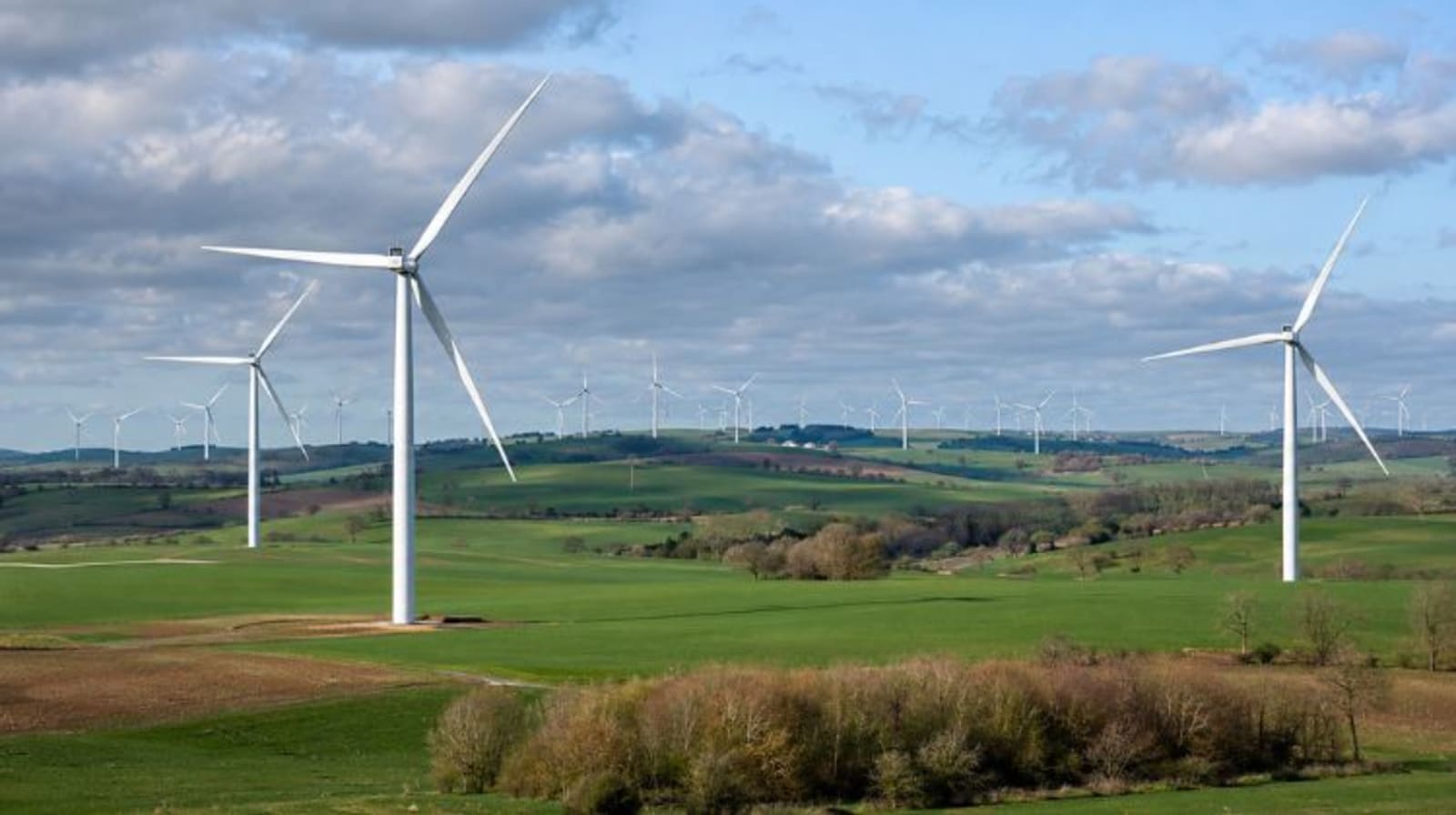
France's onshore wind energy tender received 171 bids for a cumulative capacity of 2,724 MW , compared to a contracting target of 1,000 MW, under the twelfth period of the PPE2 program. The tender thus recorded an oversubscription rate of 272%, with bids equivalent to 2.72 times the required capacity.
After completing the technical and economic evaluation of the applications, the Energy Regulatory Commission (CRE) proposed selecting 63 projects with a combined capacity of 1006.21 MW and a weighted average price of 78.57 euros per MWh .
It should be noted that the selection proposed by the CRE does not, in itself, constitute a final award , since it is up to the Minister in charge of Energy to formalize the results and publish the list of awarded projects.
The capacity offered reached exactly 2723.67 MW , exceeding the approximately 2378 MW registered during the eleventh call for bids. However, the oversubscription rate was lower than the 297% of the previous period, due to the increase in the volume tendered, which rose from 800 to 1000 MW.
Regarding the evaluation procedure, the CRE initially rejected 13 applications, equivalent to 148.60 MW , because their reference prices exceeded the confidential maximum limit established in the terms and conditions.
Of the remaining 158 applications, representing 2575.07 MW, the agency examined 91 proposals with a chance of being selected and eliminated three others for non-compliance with the established requirements.
Finally, the proposed capacity for selection reached 1006.21 MW , equivalent to 100.6% of the target power, in a scenario marked by high competition among developers.
Prices increased by 1.9%, but remain below previous rounds.
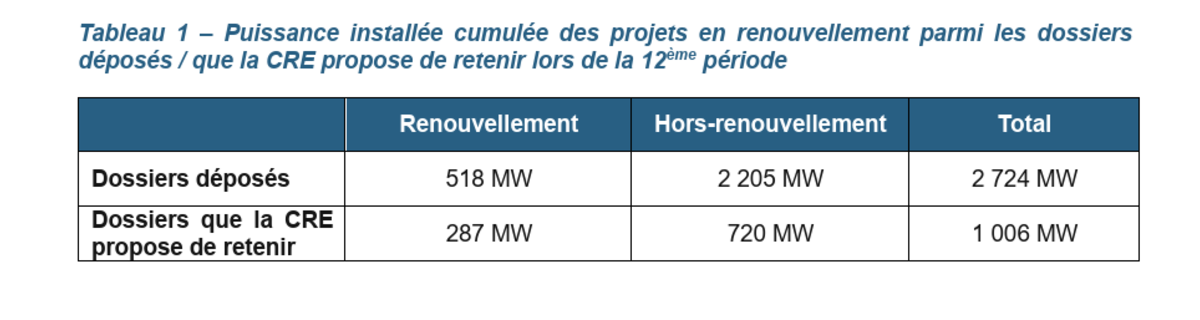
One of the main indicators of the call is the behavior of prices, given that the weighted average value of the offers selected by the CRE stood at 78.57 euros per MWh , compared to 77.08 euros per MWh corresponding to the eleventh round.
The difference represents an increase of 1.9% , equivalent to approximately €1.49 per MWh. However, the regulator notes that the values remain considerably below those observed in previous periods.
The CRE attributes this behavior mainly to the continued competition between developers and, to a lesser extent, to the high participation of projects to renovate existing wind farms .
These latter initiatives have particular economic characteristics, because they involve the replacement of existing facilities and can take advantage of previously developed infrastructure and sites.
Meanwhile, the weighted average price of all the proposals submitted reached 81.28 euros per MWh , representing a decrease of 2.1% compared to the previous procedure, held in May 2026.
This evolution allows us to distinguish between the behavior of the economic offers of all participants and the prices corresponding to the projects recommended for their selection.
Another element identified by the CRE is the lower dispersion between the prices of the selected candidacies .
In this twelfth call, the values of the first and third quartiles were respectively 0.70 euros per MWh below and 1.30 euros per MWh above the weighted average.
In comparison, during the previous period these differences had reached -2.60 and +4.90 euros per MWh, respectively, which shows a greater concentration of economic proposals.
The agency is also analyzing the effects of the modifications introduced in the eleventh round on the treatment of income linked to the electricity capacity mechanism.
According to the CRE, these revenues represent an estimated value of between two and three euros per MWh for onshore wind energy projects , a component that affects the economic structure of the bids.
Furthermore, the evaluation considers the potential impact of the projects on public finances during the 20-year term of the supplementary remuneration contracts .
The projections depend on the evolution of wholesale electricity prices, since the mechanism considers the differences between the contractual reference values and the income obtained in the market.
Continue reading
Under an intermediate wholesale price scenario, regulatory estimates anticipate an accumulated balance of -39 million euros in 2026 for public service charges.
In a low-price scenario, that cost would amount to 906 million euros , while under a high-price scenario, the estimated balance would reach -1219 million euros.
These projections assume that all facilities will be operational by June 1, 2029 , in accordance with the average forecasts reported by the participants.
 Park renewal and regulatory constraints: the challenges of PPE3
In addition to the economic results, the CRE dedicates a relevant part of its evaluation to the projects for the renewal of existing wind power installations , whose participation directly influences the accounting of new power.
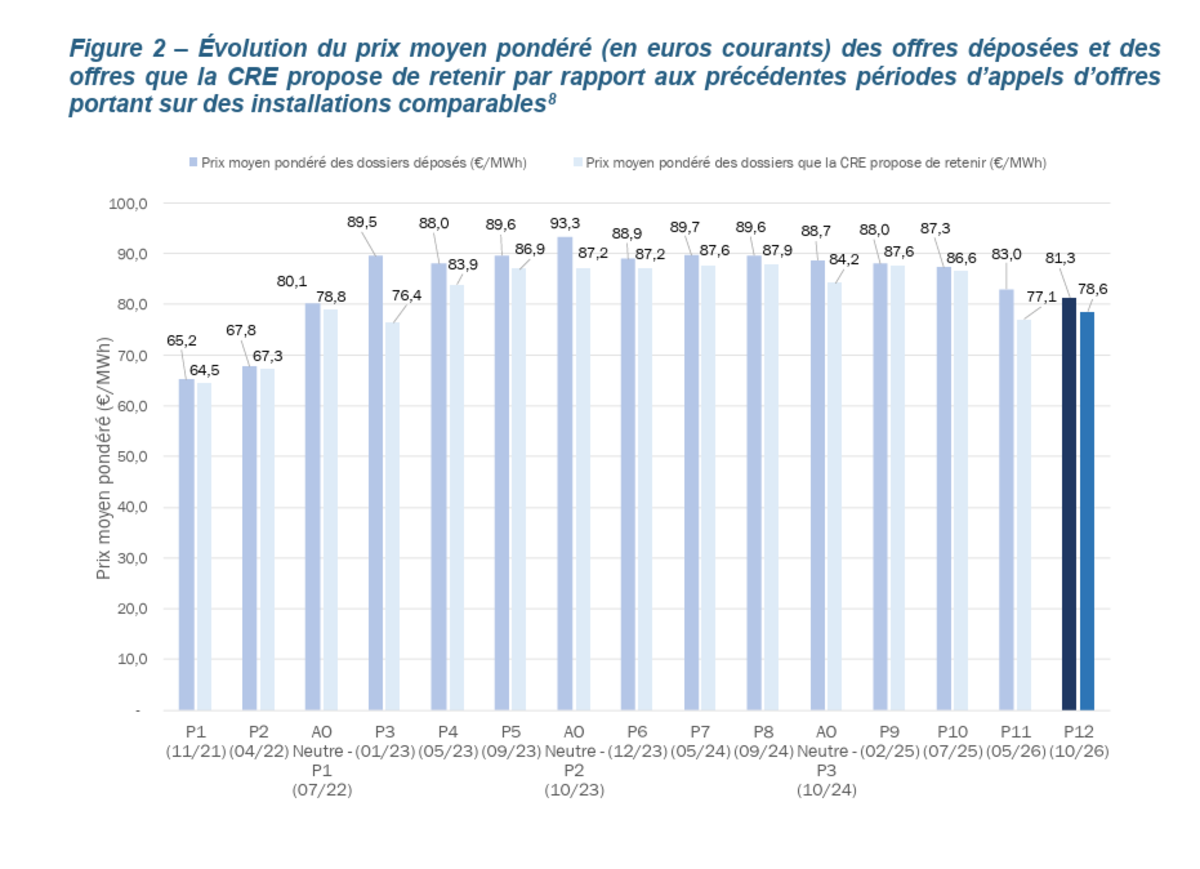
In this call for proposals, renewal initiatives for 518 MW were presented, compared to 642 MW in the eleventh round and 314 MW in the tenth.
Of that total, the regulator proposed selecting 287 MW , equivalent to approximately 28% of the total recommended capacity. This proportion represents a significant decrease compared to the 66% recorded in the previous period.
Projects that do not correspond to renewals, for their part, concentrated around 720 MW proposed for selection , out of a total volume of 2205 MW.
From an economic point of view, the renewal initiatives registered weighted average prices approximately 1.50 euros per MWh lower than those corresponding to completely new installations.
However, this advantage was less than the difference of nearly eight euros per MWh observed during the eleventh round.
One of the main points highlighted by the regulator is that the power selected in a tender does not necessarily equate to the effective increase in installed capacity , especially when some of the projects replace existing wind turbines.
According to information declared by the developers, the 287 MW of renovation projects would replace approximately 190 MW of current facilities , so their net contribution would be close to 96 MW.
The documentation examined identifies projects with less than 15 years of operation , even though the usual lifespan of onshore wind turbines is estimated to be between 20 and 25 years.
There are also initiatives that contemplate renovations without increases in power and even with reductions in capacity, while others present increases close to 50% after operating periods of between 15 and 20 years.
In light of these differences, the CRE announces that it will deepen its analysis of the economic and technical reasons driving early renewals , particularly in facilities whose support mechanisms have ended or are about to expire. The agency seeks to understand why certain developers choose to replace their equipment before the end of its useful life and to evaluate the conditions that justify their participation in new tenders.
France is preparing another 1000 MW wind power tender for December
In parallel with the results of the twelfth round, France has already scheduled the thirteenth period of the PPE2 tender for onshore wind energy, with a contracting target of another 1000 MW .
According to the updated terms and conditions in October 2026, the submission of bids will begin on December 7 and end on December 17, 2026, at 23:59 hours .
The call for tenders will maintain the supplementary remuneration contracts for 20 years and will require financial guarantees equivalent to 30,000 euros per MW of power presented.
Furthermore, it incorporates a specific condition on the supply of permanent magnets used in wind turbine generators, which limits to 85% the proportion of supply from a dominant third country outside the European Union .
The new period also includes evaluation criteria that award 95 points to the offered price , while shared governance commitments can contribute up to five additional points and crowdfunding mechanisms up to two points, without the possibility of accumulating both incentives.
In this way, the next round will offer another 1000 MW for new onshore wind developments , after a call in which the capacity presented far exceeded the required volume.
The continuation of the program will allow us to observe whether competitive pressure on prices is maintained and how the participation of renewal projects evolves, in a context in which the CRE insists on differentiating the power replaced from the new capacity incorporated into the French electricity system.

 By Florencia Guglielmetti

 By Emilia Lardizabal

 By Ailén Pedrotti