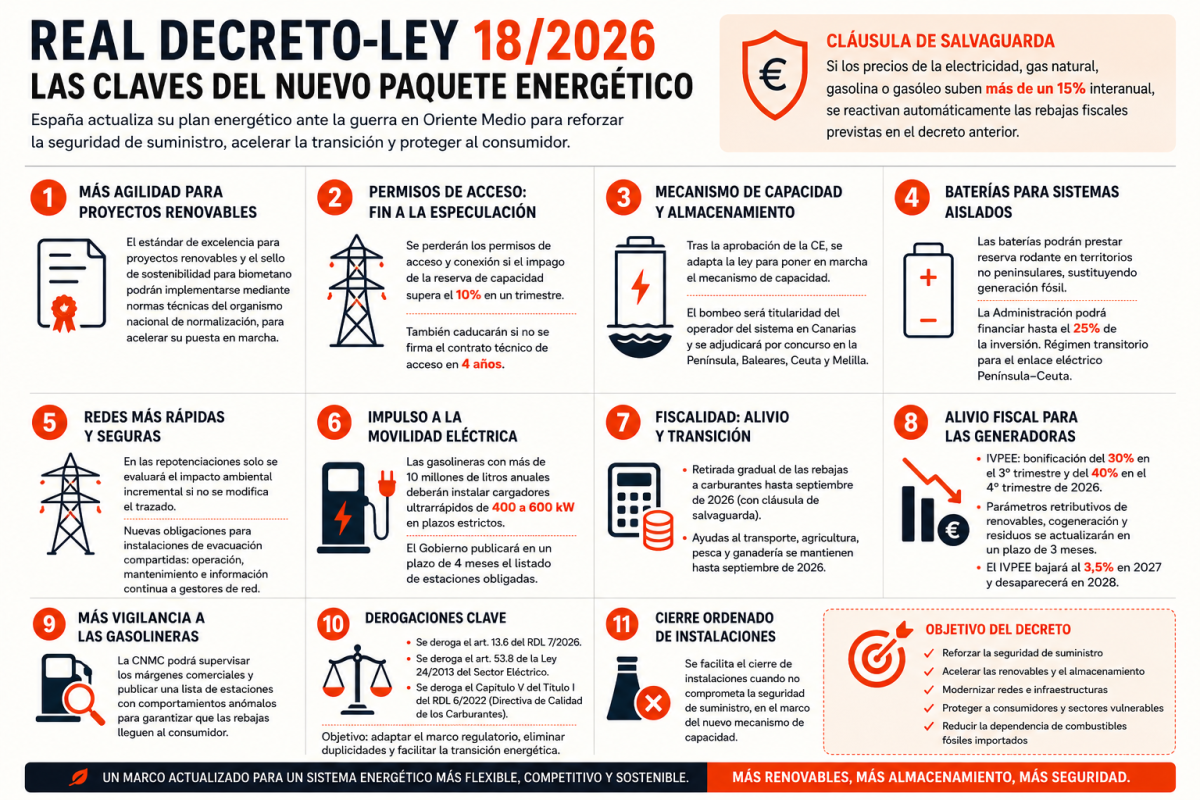
The Spanish Government approved Royal Decree-Law 18/2026 , a regulation that updates the energy package launched in March through Royal Decree-Law 7/2026 to strengthen security of supply and accelerate the energy transition in a context marked by geopolitical uncertainty stemming from the conflict in the Middle East.
Although it maintains the roadmap designed just a few months ago, the new decree incorporates regulatory changes that directly impact the development of renewable energies, energy storage, electricity grids, electric mobility, and the sector's tax framework. Furthermore, it introduces automatic mechanisms to respond to potential energy price spikes and adapts Spanish regulations to the future capacity mechanism recently authorized by the European Commission.
In the explanatory memorandum, the government argues that Spain is facing the current crisis from a more favorable position than in previous episodes thanks to the growth of renewable energy. According to the decree itself, the increased share of wind and solar power generation considerably reduced the hours during which gas-fired power plants set the electricity market price, allowing the wholesale market to register average prices of between €41 and €54 per MWh between March and May , below the European average.
However, the Government acknowledges that external energy dependence continues to stand at around 67% of total energy consumption , especially outside the electricity sector, and therefore considers it necessary to continue promoting the electrification of the economy and reducing the consumption of imported fossil fuels.
In this context, the decree maintains a large part of the extraordinary measures approved in March, but establishes a schedule for progressive withdrawal — the so-called phase out — that will extend until the end of September 2026.
The key points of the new energy package
This decree includes a safeguard clause that will allow for the automatic reactivation of tax incentives if energy inflation surges again. Specifically, if electricity, natural gas, gasoline, or diesel prices increase by more than 15% year-on-year , the tax reductions established in the previous decree will be automatically reinstated, without the need for new measures.
One of the chapters with the greatest impact on the energy sector is the one dedicated to the deployment of renewable energies. Royal Decree-Law 18/2026 develops the instruments created in March to recognize projects with the greatest social and territorial acceptance, allowing the standard of excellence for renewable projects and the sustainability label for biomethane to be implemented through technical standards developed by the national standards body. The objective is to accelerate their implementation and facilitate a more streamlined process for new installations.
The regulation also tightens the conditions for maintaining access and connection permits to the grid. From now on, developers will automatically lose these permits if non-payment of the capacity reservation fee exceeds 10% during a calendar quarter . Furthermore, the decree introduces a new ground for expiration for projects that have not signed the technical access contract within a maximum period of four years , a measure with which the government seeks to prevent speculation with grid capacity and promote the development of more mature projects.
Continue reading
The decree also adapts Spanish legislation to the future implementation of the capacity mechanism , recently authorized by the European Commission, with the aim of ensuring that the system has sufficient generation capacity, storage and flexibility to respond to demand at all times.
It's worth remembering that the sector is awaiting regulations for the capacity market and anticipates the auctions . According to Roger Pasola Dolader, Head of Public Affairs and Regulation at SSE for Spain, the most likely scenario places the first call for bids at the beginning of 2027, although there are still regulatory definitions that could affect the timelines and, above all, the opportunities for new investments in storage.
“ The first capacity market auction will be in 2027, it could be in January or it could be delayed until the end of March ,” Pasola stated in an interview with Energía Estratégica, depending on the time still required for the approval of the pending regulations.
To this end, it amends the Electricity Sector Law, allowing, under certain conditions that do not compromise security of supply, the closure of facilities without requiring an express decision from the competent authority, and regulates the ownership of pumped storage facilities. While in the Canary Islands these infrastructures will remain in the hands of the system operator, in the Peninsula, the Balearic Islands, Ceuta, and Melilla they will be awarded through competitive bidding processes.
In parallel, the legislation promotes battery storage in non-peninsular electrical systems by enabling its use for providing rolling reserve services, progressively reducing dependence on fossil fuel-fired power plants. As an incentive, the government may recognize up to 25% of the investment in these systems, while the remainder must be financed with internal resources or European funds. The legislation also incorporates a transitional regime for the operation of the future submarine power link between the Iberian Peninsula and Ceuta, an infrastructure project designed to decrease the use of fossil fuel generation in the autonomous city.
Another new measure aims to accelerate the development of electricity grids. In transmission and distribution line upgrade projects, only the incremental environmental impact compared to the existing infrastructure will be assessed, provided the route remains unchanged. Furthermore, the decree introduces new obligations for shared evacuation facilities, whose owners must guarantee their proper operation and maintenance, as well as provide technical information to grid operators to strengthen coordination and the security of the electricity system.
In the area of mobility, the Government is tightening the requirements for certain service stations, which will be required to install ultra-fast charging points of between 400 and 600 kW to accelerate the rollout of electric vehicles . It is also strengthening the powers of the National Commission on Markets and Competition (CNMC), which will be able to monitor the profit margins of gas stations and publish a list of those exhibiting anomalous behavior if they fail to pass on tax reductions to the final price of fuel.
In terms of taxation, the Royal Decree-Law extends the relief on the Tax on the Value of Electricity Production (IVPEE) for the remainder of 2026, excluding 30% of the revenue obtained in the third quarter and 40% of that obtained in the fourth quarter from the tax calculation. The regulation also grants a three-month period to update the remuneration parameters for renewable energy, cogeneration, and waste-to-energy facilities, adapting them to the anticipated tax changes.
Finally, the decree expressly repeals Article 13.6 of Royal Decree-Law 7/2026, Article 53.8 of Law 24/2013 on the Electricity Sector and Chapter V of Title I of Royal Decree-Law 6/2022, with the aim of adapting the regulatory framework to the new capacity mechanism, eliminating regulatory duplication and preparing for the future regulation of the decarbonization of transport.