



The heat waves of June and July 2026 altered the operation of several major European electrical systems. According to the latest report from Ember , while demand increased due to air conditioning use and various conventional technologies faced restrictions, solar power generation reached up to 17% higher output during the days of extreme temperatures .
The largest increase was recorded in France and Hungary, at 17% , while Spain showed a 5% improvement. Italy remained at levels similar to those of the rest of June and July.
The improvement coincided with a sharp increase in consumption. During the heat wave at the end of June, daily electricity demand grew by 26% in Hungary, 22% in Italy, 11% in France, and 8% in Spain compared to the previous week.
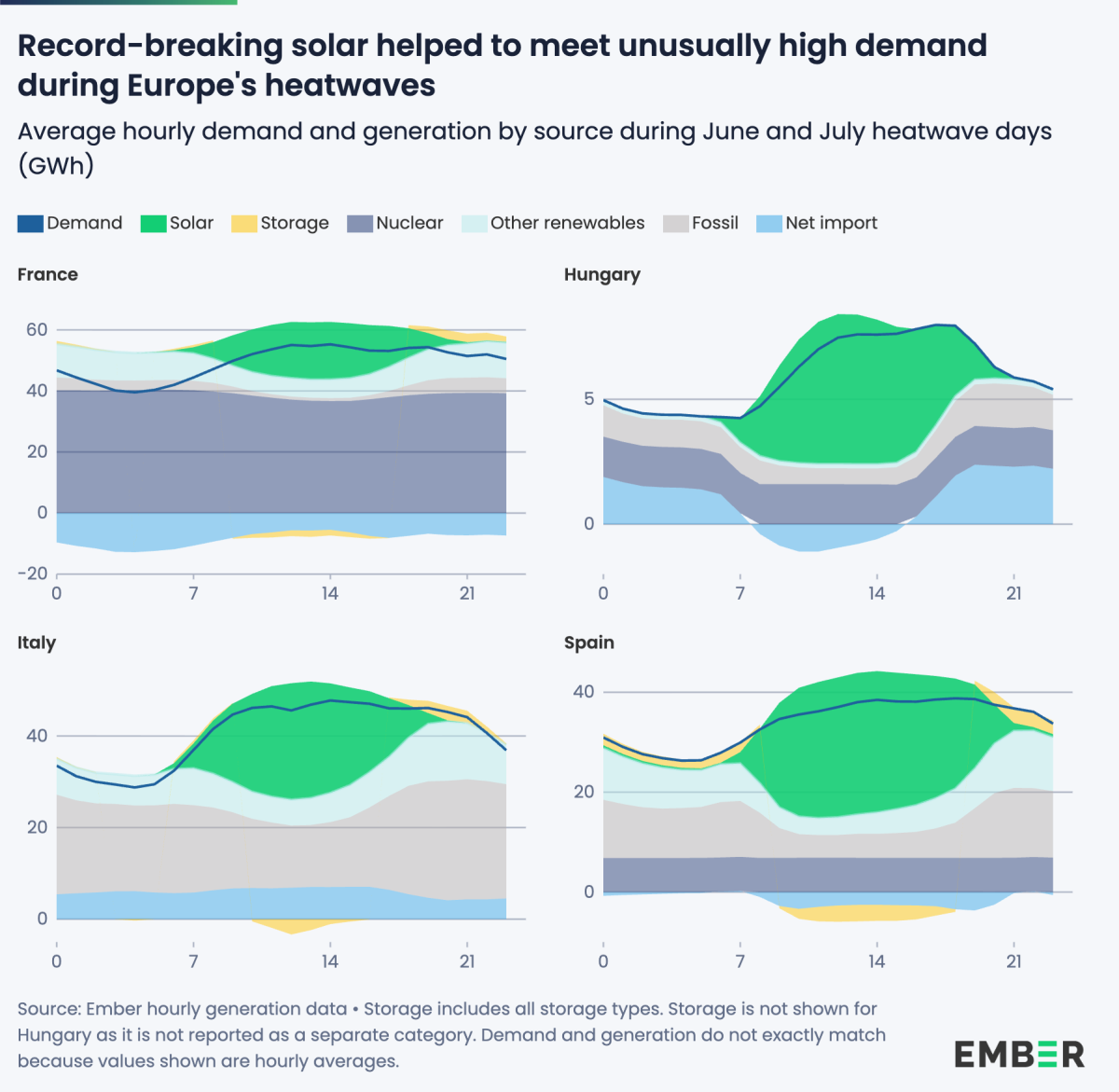

Ember's analysis shows that photovoltaics was the only major generation source that outperformed its usual counterparts during these periods. Furthermore, in June and July, it covered 25% of the European Union's electricity , a record high for both months.
This behavior is partly due to the weather conditions themselves. The air masses that cause heat waves in Europe are usually accompanied by clear skies and high solar radiation, which favors photovoltaic production.
The timing of generation also proved relevant. The solar curve coincides for much of the day with the increase in consumption associated with cooling. The graph included in the report for France, Hungary, Italy, and Spain shows how photovoltaic production covers a significant portion of the daytime increase in demand.
“The surge in solar production helped stabilize the grid at a time when other sources were struggling to respond,” said Chris Rosslowe, senior energy analyst at Ember.
The contrast with other technologies was significant. The heat and drought reduced the availability of nuclear, gas, and coal-fired power plants, many of which depend on water for their cooling systems.
In France, up to 29 GW of nuclear capacity was unavailable on July 12 , although not all of that reduction can be directly attributed to weather conditions. Ember estimates that up to 11 GW out of service that day were linked to forced shutdowns or environmental issues.
Gas-fired power generation also faced restrictions. Five British plants reduced their output by a combined 2.5 GW during June, while low levels of the Po River threatened some of Italy's thermal capacity. Poland and Serbia, in turn, recorded cuts in coal-fired power plants due to insufficient water for cooling.
Continue reading
The drought also hit hydroelectric power. In July, seven of the eight largest producers in the European Union recorded levels below their five-year averages. European hydroelectric generation fell to its lowest level in at least a decade in May, June, and July.
The combination of higher consumption and lower availability of conventional generation ended up being passed on to prices.
During the heat waves of late June and early July, average daily values increased by 119% in Hungary, 44% in France, 13% in Italy and 7% in Spain compared to comparable days of the previous week.
The biggest peaks appeared at the end of the day, when solar generation decreased but cooling demand remained high.
France reached €313/MWh on June 24th and Italy reached €285/MWh. Hungary exceeded €900/MWh on June 30th and Spain surpassed €250/MWh on July 23rd, something that had not happened since 2022.
The tension shifts to the hours without sunlight.
According to Ember, market behavior shows that the main problem is no longer solely about having sufficient generation capacity, but about having the flexibility to shift energy from one time to another.
During the day, photovoltaics helped cover increased consumption and moderate prices. However, when its production fell, systems had to rely more heavily on thermal generation, primarily gas-fired.
“Solar is already doing much of the work during heat waves, but the real challenge begins after sunset,” Rosslowe explained.
The report identifies battery storage as one of the most direct solutions to reduce this gap. BESS systems can charge during peak photovoltaic production hours and discharge in the afternoon and evening, when consumption remains high and reliance on more expensive thermal power plants increases.
Ember also points to demand response and strengthening interconnections between countries as necessary tools to increase system resilience.
The heat wave thus revealed an increasingly clear pattern for the European electricity market: solar power can keep pace with increased consumption during the hottest hours, but the stability and cost of the system will increasingly depend on the ability to shift that energy to later hours.